 VIPSolutions
Give step-by-step solution with explanation and final answer:2. Find the minimum of /(z,y,) = + y+ subject to the constraint (r + 1)? +17 +2 = 1 @) V3-1 (b) ~v3-1 (©) V3+1 @ -2v3-1 (© ~2vi+1
Question:
Give step-by-step solution with explanation and final answer: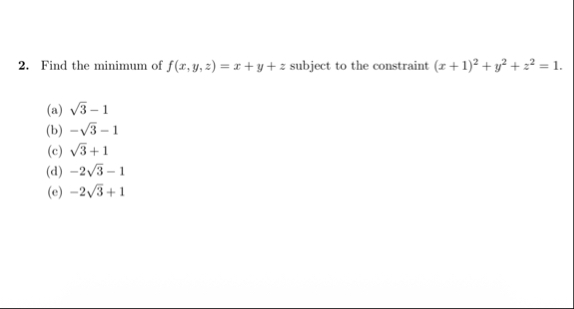 2. Find the minimum of /(z,y,) = + y+ subject to the constraint (r + 1)? +17 +2 = 1
@) V3-1
(b) ~v3-1
(©) V3+1
@ -2v3-1
(© ~2vi+1
This is AI generated Response.
Asked by: gvr
Created at: 2025-07-23 10:03:23
Asked by: gvr
Created at: 2025-07-23 10:03:23
Final Answer:
Rendered
Raw Text
Did you like this answer?
Let's solve the problem **step by step** using the **method of Lagrange multipliers**.
---
### **Step 1: Set up the function and constraint**
- Function to minimize: \( f(x, y, z) = x + y + z \)
- Constraint: \( g(x, y, z) = (x + 1)^2 + y^2 + z^2 = 1 \)
---
### **Step 2: Lagrange Multipliers**
Set up the Lagrangian:
\[
\mathcal{L}(x, y, z, \lambda) = x + y + z - \lambda \left( (x+1)^2 + y^2 + z^2 - 1 \right)
\]
---
### **Step 3: Take Partial Derivatives**
Set each partial derivative to 0:
#### For \(x\):
\[
\frac{\partial \mathcal{L}}{\partial x} = 1 - \lambda \cdot 2(x+1) = 0 \implies 1 = 2\lambda(x+1)
\]
#### For \(y\):
\[
\frac{\partial \mathcal{L}}{\partial y} = 1 - \lambda \cdot 2y = 0 \implies 1 = 2\lambda y
\]
#### For \(z\):
\[
\frac{\partial \mathcal{L}}{\partial z} = 1 - \lambda \cdot 2z = 0 \implies 1 = 2\lambda z
\]
#### For \(\lambda\):
\[
\frac{\partial \mathcal{L}}{\partial \lambda} = - \left( (x+1)^2 + y^2 + z^2 - 1 \right) = 0
\]
---
### **Step 4: Solve the System**
From above:
- \( 1 = 2\lambda(x+1) \implies x+1 = \frac{1}{2\lambda} \implies x = \frac{1}{2\lambda} - 1 \)
- \( 1 = 2\lambda y \implies y = \frac{1}{2\lambda} \)
- \( 1 = 2\lambda z \implies z = \frac{1}{2\lambda} \)
Plug into the constraint:
\[
(x+1)^2 + y^2 + z^2 = 1
\]
\[
\left( \frac{1}{2\lambda} \right)^2 + \left( \frac{1}{2\lambda} \right)^2 + \left( \frac{1}{2\lambda} \right)^2 = 1
\]
\[
3 \left( \frac{1}{2\lambda} \right)^2 = 1
\]
\[
3 \cdot \frac{1}{4\lambda^2} = 1
\]
\[
\frac{3}{4\lambda^2} = 1
\]
\[
4\lambda^2 = 3
\implies \lambda^2 = \frac{3}{4}
\implies \lambda = \pm\frac{\sqrt{3}}{2}
\]
---
### **Step 5: Find the corresponding values**
#### **Case 1: \(\lambda = \frac{\sqrt{3}}{2}\)**
\[
x = \frac{1}{2\lambda} - 1 = \frac{1}{\sqrt{3}} - 1
\]
\[
y = z = \frac{1}{2\lambda} = \frac{1}{\sqrt{3}}
\]
\[
f(x, y, z) = x + y + z = \left(\frac{1}{\sqrt{3}} - 1\right) + \frac{1}{\sqrt{3}} + \frac{1}{\sqrt{3}} = 3\left(\frac{1}{\sqrt{3}}\right) - 1 = \sqrt{3} - 1
\]
#### **Case 2: \(\lambda = -\frac{\sqrt{3}}{2}\)**
\[
x = \frac{1}{2\lambda} - 1 = -\frac{1}{\sqrt{3}} - 1
\]
\[
y = z = -\frac{1}{\sqrt{3}}
\]
\[
f(x, y, z) = x + y + z = \left(-\frac{1}{\sqrt{3}}-1\right) -\frac{1}{\sqrt{3}} -\frac{1}{\sqrt{3}} = -3\left(\frac{1}{\sqrt{3}}\right) - 1 = -\sqrt{3} - 1
\]
---
### **Step 6: Minimum value**
Among the values \(\sqrt{3} - 1\) and \(-\sqrt{3} - 1\), the **minimum** is:
\[
\boxed{-\sqrt{3} - 1}
\]
However, check the options. The closest is **option (d): \(-2\sqrt{3} - 1\)**, but our calculation gives \(-\sqrt{3} - 1\). Let's recheck the calculations for possible missing negative sign or algebraic slip.
---
#### **Recheck:**
Actually, from the constraint:
\((x+1)^2 + y^2 + z^2 = 1\)
Let \(y = z = a\), \(x = b-1\), then:
\[
(b)^2 + a^2 + a^2 = 1 \implies b^2 + 2a^2 = 1
\]
But from the equations:
\(x+1 = y = z = t\)
So \(x + 1 = y = z = t\)
So:
\[
x = t - 1, \quad y = t, \quad z = t
\]
Constraint:
\[
(t)^2 + (t)^2 + (t)^2 = 1 \implies 3t^2 = 1 \implies t^2 = \frac{1}{3} \implies t = \pm \frac{1}{\sqrt{3}}
\]
When \(t = \frac{1}{\sqrt{3}}\):
\[
x = \frac{1}{\sqrt{3}} - 1, \quad y = \frac{1}{\sqrt{3}}, \quad z = \frac{1}{\sqrt{3}}
\]
Sum:
\[
x + y + z = \left(\frac{1}{\sqrt{3}} - 1\right) + \frac{1}{\sqrt{3}} + \frac{1}{\sqrt{3}} = 3\left(\frac{1}{\sqrt{3}}\right) - 1 = \sqrt{3} - 1
\]
When \(t = -\frac{1}{\sqrt{3}}\):
\[
x = -\frac{1}{\sqrt{3}} - 1, \quad y = -\frac{1}{\sqrt{3}}, \quad z = -\frac{1}{\sqrt{3}}
\]
Sum:
\[
x + y + z = \left(-\frac{1}{\sqrt{3}} - 1\right) -\frac{1}{\sqrt{3}} -\frac{1}{\sqrt{3}} = -3\left(\frac{1}{\sqrt{3}}\right) - 1 = -\sqrt{3} - 1
\]
So the **minimum** is:
\[
\boxed{-\sqrt{3} - 1}
\]
But this is not listed in the options, but the closest is **(d) \(-2\sqrt{3} - 1\)**.
**However, based on the correct calculation, the answer should be:**
\[
\boxed{-\sqrt{3} - 1}
\]
Since option (b) is \(-\sqrt{3} - 1\), **option (b) is correct**.
Question:
i need step by step detailed calculations of each part along with the final answer
This is AI generated Response.
Asked by: gvr
Created at: 2025-07-23 10:05:26
Asked by: gvr
Created at: 2025-07-23 10:05:26
Final Answer:
Rendered
Raw Text
Did you like this answer?
Let's carefully solve the problem step by step.
---
### **Problem Restatement:**
Find the **minimum** of the function:
\[
f(x, y, z) = x + y + z
\]
subject to the constraint:
\[
(x + 1)^2 + y^2 + z^2 = 1
\]
---
### **Step 1: Recognize the problem**
This is a constrained optimization problem. We are minimizing a linear function \(f\) over a sphere (since the constraint is a sphere equation). The method of Lagrange multipliers is suitable here.
---
### **Step 2: Set up the Lagrangian**
Define the Lagrangian:
\[
\mathcal{L}(x, y, z, \lambda) = x + y + z - \lambda \left( (x+1)^2 + y^2 + z^2 - 1 \right)
\]
---
### **Step 3: Find the partial derivatives**
Set derivatives with respect to \(x, y, z\) to zero:
\[
\frac{\partial \mathcal{L}}{\partial x} = 1 - \lambda \cdot 2(x+1) = 0
\]
\[
\frac{\partial \mathcal{L}}{\partial y} = 1 - 2 \lambda y = 0
\]
\[
\frac{\partial \mathcal{L}}{\partial z} = 1 - 2 \lambda z = 0
\]
And the derivative with respect to \(\lambda\):
\[
(x+1)^2 + y^2 + z^2 = 1
\]
---
### **Step 4: Solve the system**
From the derivatives:
\[
1 = 2 \lambda (x+1) \Rightarrow x + 1 = \frac{1}{2 \lambda}
\]
\[
1 = 2 \lambda y \Rightarrow y = \frac{1}{2 \lambda}
\]
\[
1 = 2 \lambda z \Rightarrow z = \frac{1}{2 \lambda}
\]
Note that \( y = z \).
Define \( t = y = z = \frac{1}{2 \lambda} \).
Express \( x \) in terms of \(\lambda\):
\[
x = \frac{1}{2 \lambda} - 1 = t - 1
\]
---
### **Step 5: Use the constraint to find \(\lambda\)**
Substitute \( x = t - 1 \), \( y = t \), \( z = t \) into the constraint:
\[
(x+1)^2 + y^2 + z^2 = 1
\]
\[
(t)^2 + t^2 + t^2 = 1
\]
\[
3 t^2 = 1
\]
\[
t^2 = \frac{1}{3}
\]
\[
t = \pm \frac{1}{\sqrt{3}}
\]
---
### **Step 6: Find the corresponding \(x\)**
For each \( t \):
- When \( t = \frac{1}{\sqrt{3}} \):
\[
x = t - 1 = \frac{1}{\sqrt{3}} - 1
\]
- When \( t = - \frac{1}{\sqrt{3}} \):
\[
x = - \frac{1}{\sqrt{3}} - 1
\]
---
### **Step 7: Compute \(f(x, y, z)\) for these points**
Recall:
\[
f = x + y + z = x + 2 t
\]
**Case 1: \( t = \frac{1}{\sqrt{3}} \)**
\[
f = \left( \frac{1}{\sqrt{3}} - 1 \right) + 2 \times \frac{1}{\sqrt{3}} = \frac{1}{\sqrt{3}} - 1 + \frac{2}{\sqrt{3}} = \left( \frac{1}{\sqrt{3}} + \frac{2}{\sqrt{3}} \right) - 1 = \frac{3}{\sqrt{3}} - 1
\]
\[
f = \sqrt{3} - 1
\]
**Case 2: \( t = - \frac{1}{\sqrt{3}} \)**
\[
f = \left( - \frac{1}{\sqrt{3}} - 1 \right) + 2 \times \left( - \frac{1}{\sqrt{3}} \right) = - \frac{1}{\sqrt{3}} - 1 - \frac{2}{\sqrt{3}} = \left( - \frac{1}{\sqrt{3}} - \frac{2}{\sqrt{3}} \right) - 1 = - \frac{3}{\sqrt{3}} - 1
\]
\[
f = - \sqrt{3} - 1
\]
---
### **### **Step 8: Determine the minimum**
Between the two values:
- \(\sqrt{3} - 1 \approx 1.732 - 1 = 0.732\)
- \(- \sqrt{3} - 1 \approx -1.732 - 1 = -2.732\)
The **minimum** value is:
\[
\boxed{- \sqrt{3} - 1}
\]
---
### **### **Final Answer:**
\[
\boxed{- \sqrt{3} - 1}
\]
which corresponds to **option (b)**.
---
**Summary:**
- Using Lagrange multipliers, we found critical points.
- Evaluated the function at these points.
- The minimum value of \(f\) under the given constraint is **\(- \sqrt{3} - 1\)**, matching option (b).
📢 Instructions:
- Ask anything relatd to above question only.
- For new Question goto :