 VIPSolutions
Give step-by-step solution with explanation and final answer:Section 6.2 — Volume Preliminary Example. Colonel Armstrong is a 1300 year old Redwood tree whose trunk is 300 feet tall. Every 60 feet, a diameter measurement of S| I Colonel Armstrong has been taken (see diagram to right). Use this informa- I tion to estimate the volume of wood in Colonel Armstrong's trunk. S= = oe ——\ | = Example 1. Find the volume of the solid region generated by rotating the curve y = sin about the z-axis on the interval [0, 7).
Question:
Give step-by-step solution with explanation and final answer: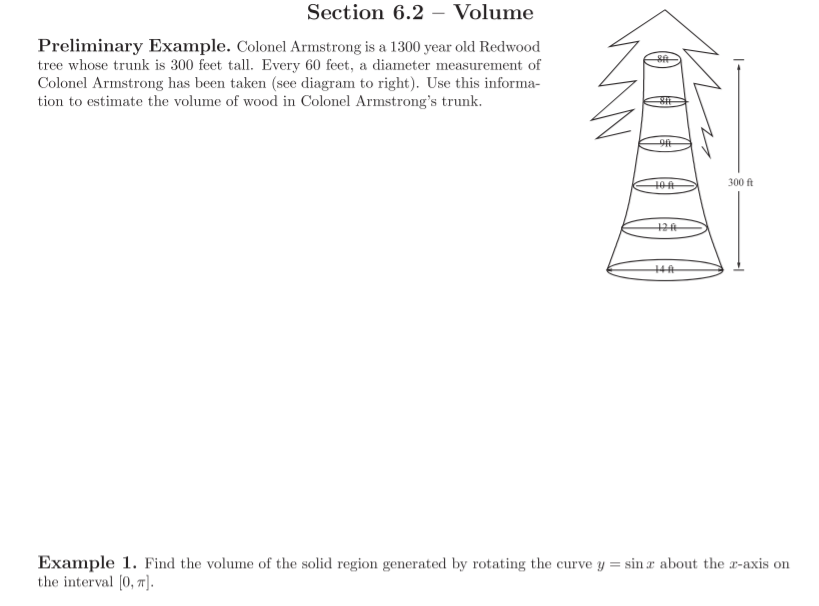 Section 6.2 — Volume
Preliminary Example. Colonel Armstrong is a 1300 year old Redwood
tree whose trunk is 300 feet tall. Every 60 feet, a diameter measurement of S| I
Colonel Armstrong has been taken (see diagram to right). Use this informa- I
tion to estimate the volume of wood in Colonel Armstrong's trunk. S=
= oe
——\ |
=
Example 1. Find the volume of the solid region generated by rotating the curve y = sin about the z-axis on
the interval [0, 7).
This is AI generated Response.
Asked by: gvr
Created at: 2025-07-23 05:36:31
Asked by: gvr
Created at: 2025-07-23 05:36:31
Final Answer:
Rendered
Raw Text
Did you like this answer?
Let's solve both **the preliminary example** and **Example 1** step by step:
---
## **Preliminary Example Solution**:
We are given:
- The trunk is **300 ft** tall.
- Every **60 ft**, a diameter was measured: **8 ft, 8 ft, 9 ft, 10 ft, 12 ft, 14 ft** (from top to bottom).
We can model the trunk as 5 frustums (truncated cones), each 60 ft tall.
### **Step 1: List the Radii**
Convert diameters to **radii**:
| Section | Diameter (ft) | Radius (ft) |
|---------|---------------|-------------|
| Top | 8 | 4 |
| | 8 | 4 |
| | 9 | 4.5 |
| | 10 | 5 |
| | 12 | 6 |
| Bottom | 14 | 7 |
### **Step 2: Volume of a Frustum**
The volume of a frustum of a cone is:
\[
V = \frac{1}{3}\pi h (R_1^2 + R_1 R_2 + R_2^2)
\]
where \( h \) is the height, \( R_1 \) and \( R_2 \) are the radii of the ends.
### **Step 3: Calculate Each Frustum's Volume**
Each frustum is **60 ft** tall.
#### **a) Between 4 ft and 4 ft:**
\[
V_1 = \frac{1}{3}\pi (60) (4^2 + 4 \times 4 + 4^2)
= \frac{1}{3}\pi (60) (16 + 16 + 16)
= \frac{1}{3}\pi (60) (48)
= 20\pi (48)
= 960\pi \text{ ft}^3
\]
#### **b) Between 4 ft and 4.5 ft:**
\[
V_2 = \frac{1}{3}\pi (60) (4^2 + 4 \times 4.5 + 4.5^2)
= \frac{1}{3}\pi (60) (16 + 18 + 20.25)
= \frac{1}{3}\pi (60) (54.25)
= 20\pi (54.25)
= 1085\pi \text{ ft}^3
\]
#### **c) Between 4.5 ft and 5 ft:**
\[
V_3 = \frac{1}{3}\pi (60) (4.5^2 + 4.5 \times 5 + 5^2)
= \frac{1}{3}\pi (60) (20.25 + 22.5 + 25)
= \frac{1}{3}\pi (60) (67.75)
= 20\pi (67.75)
= 1355\pi \text{ ft}^3
\]
#### **d) Between 5 ft and 6 ft:**
\[
V_4 = \frac{1}{3}\pi (60) (5^2 + 5 \times 6 + 6^2)
= \frac{1}{3}\pi (60) (25 + 30 + 36)
= \frac{1}{3}\pi (60) (91)
= 20\pi (91)
= 1820\pi \text{ ft}^3
\]
#### **e) Between 6 ft and 7 ft:**
\[
V_5 = \frac{1}{3}\pi (60) (6^2 + 6 \times 7 + 7^2)
= \frac{1}{3}\pi (60) (36 + 42 + 49)
= \frac{1}{3}\pi (60) (127)
= 20\pi (127)
= 2540\pi \text{ ft}^3
\]
### **Step 4: Add Up All Volumes**
\[
V_\text{total} = (960 + 1085 + 1355 + 1820 + 2540)\pi
= 7760\pi \text{ ft}^3
\]
### **Step 5: Plug in \(\pi \approx 3.1416\)**
\[
V_\text{total} \approx 7760 \times 3.1416 = 24,372 \text{ ft}^3
\]
---
## **Final Answer (Preliminary Example):**
\[
\boxed{24,372\ \text{ft}^3}
\]
(Rounded to the nearest ft³.)
---
## **Example 1 Solution**
**Find the volume of the solid generated by rotating \(y = \sin x\) about the x-axis, \(x \in [0, \pi]\).**
### **Step 1: Formula for Volume of Revolution**
\[
V = \pi \int_{a}^{b} [f(x)]^2 dx
\]
Here, \(f(x) = \sin x\), \(a = 0\), \(b = \pi\):
\[
V = \pi \int_{0}^{\pi} [\sin x]^2 dx
\]
### **Step 2: Simplify the Integral**
Recall:
\[
\sin^2 x = \frac{1 - \cos(2x)}{2}
\]
So:
\[
V = \pi \int_{0}^{\pi} \frac{1 - \cos(2x)}{2} dx
= \frac{\pi}{2} \int_{0}^{\pi} (1 - \cos(2x)) dx
\]
### **Step 3: Integrate**
\[
\int (1 - \cos(2x)) dx = x - \frac{1}{2}\sin(2x)
\]
So:
\[
V = \frac{\pi}{2} \left[ x - \frac{1}{2}\sin(2x) \right]_{0}^{\pi}
\]
### **Step 4: Evaluate the Limits**
- At \(x = \pi\): \(x = \pi\), \(\sin(2\pi) = 0\)
- At \(x = 0\): \(x = 0\), \(\sin(0) = 0\)
\[
V = \frac{\pi}{2} \left[ (\pi - 0) - \frac{1}{2}(0 - 0) \right]
= \frac{\pi}{2} (\pi)
= \frac{\pi^2}{2}
\]
---
## **Final Answer (Example 1):**
\[
\boxed{\frac{\pi^2}{2}}
\]
Or, as a decimal (using \(\pi \approx 3.1416\)):
\[
\frac{(3.1416)^2}{2} \approx \frac{9.8696}{2} \approx 4.9348
\]
---
### **Summary of Final Answers:**
- **Tree Trunk Volume Estimate:** \(\boxed{24,372\ \text{ft}^3}\)
- **Solid of Revolution Volume:** \(\boxed{\frac{\pi^2}{2}}\) (or \(\approx 4.9348\))
📢 Instructions:
- Ask anything relatd to above question only.
- For new Question goto :