 VIPSolutions
Give step-by-step solution with explanation and final answer:Evaluate the given integral by making an appropriate change of variables. -7 IT add, where R is the parallelogram enclosed by the lines x-7y=0,x-7y=56x-y=4 and 6x-y=6
Question:
Give step-by-step solution with explanation and final answer: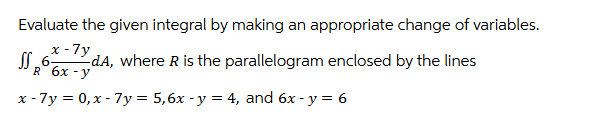 Evaluate the given integral by making an appropriate change of variables.
-7
IT add, where R is the parallelogram enclosed by the lines
x-7y=0,x-7y=56x-y=4 and 6x-y=6
This is AI generated Response.
Asked by: gvr
Created at: 2025-07-23 03:31:06
Asked by: gvr
Created at: 2025-07-23 03:31:06
Final Answer:
Rendered
Raw Text
Did you like this answer?
Let's solve the given problem step by step:
### **Step 1: Change of Variables**
Given the lines:
- \( x - 7y = 0 \)
- \( x - 7y = 5 \)
- \( 6x - y = 4 \)
- \( 6x - y = 6 \)
Let’s make the change of variables:
- \( u = x - 7y \)
- \( v = 6x - y \)
### **Step 2: Express the Region \( R \) in Terms of \( u \) and \( v \)**
- \( 0 \leq u \leq 5 \)
- \( 4 \leq v \leq 6 \)
So, the region \( R \) in the \( (u, v) \) plane is a rectangle.
### **Step 3: Express \( x \) and \( y \) in Terms of \( u \) and \( v \)**
Solve:
\[
\begin{cases}
u = x - 7y \\
v = 6x - y
\end{cases}
\]
Multiply the first by 6:
\( 6u = 6x - 42y \)
Subtract from the second:
\[
v - 6u = (6x - y) - (6x - 42y) = 41y \implies y = \frac{v - 6u}{41}
\]
Now substitute \( y \) in the first equation:
\[
u = x - 7y \implies x = u + 7y = u + 7\left(\frac{v - 6u}{41}\right) = \frac{41u + 7v - 42u}{41} = \frac{-u + 7v}{41}
\]
So,
\[
x = \frac{-u + 7v}{41}, \quad y = \frac{v - 6u}{41}
\]
### **Step 4: Compute the Jacobian**
\[
J = \left|\frac{\partial(x, y)}{\partial(u, v)}\right|
\]
\[
\frac{\partial x}{\partial u} = -\frac{1}{41}, \quad \frac{\partial x}{\partial v} = \frac{7}{41}
\]
\[
\frac{\partial y}{\partial u} = -\frac{6}{41}, \quad \frac{\partial y}{\partial v} = \frac{1}{41}
\]
So,
\[
J =
\begin{vmatrix}
-\frac{1}{41} & \frac{7}{41} \\
-\frac{6}{41} & \frac{1}{41}
\end{vmatrix}
= \left(-\frac{1}{41}\right)\left(\frac{1}{41}\right) - \left(\frac{7}{41}\right)\left(-\frac{6}{41}\right)
\]
\[
= -\frac{1}{1681} + \frac{42}{1681} = \frac{41}{1681}
\]
### **Step 5: Change the Integral**
The integrand:
\[
6 \frac{x - 7y}{6x - y} = 6 \frac{u}{v}
\]
So the integral becomes:
\[
\int_{u=0}^{5} \int_{v=4}^{6} 6 \frac{u}{v} \cdot \frac{41}{1681}\ dv\ du
\]
\[
= \frac{246}{1681} \int_{u=0}^5 \int_{v=4}^6 \frac{u}{v}\ dv\ du
\]
### **Step 6: Evaluate the Integral**
First, integrate with respect to \( v \):
\[
\int_{v=4}^6 \frac{u}{v}\ dv = u \int_{v=4}^6 \frac{1}{v}\ dv = u [\ln v]_{4}^{6} = u (\ln 6 - \ln 4) = u \ln\left(\frac{6}{4}\right) = u \ln\left(\frac{3}{2}\right)
\]
Now, integrate with respect to \( u \):
\[
\int_{u=0}^5 u \ln\left(\frac{3}{2}\right)\ du = \ln\left(\frac{3}{2}\right) \int_{u=0}^5 u\ du = \ln\left(\frac{3}{2}\right) \left[\frac{u^2}{2}\right]_{u=0}^{5} = \ln\left(\frac{3}{2}\right) \cdot \frac{25}{2}
\]
### **Step 7: Combine Everything**
\[
\text{Final answer:} \quad \frac{246}{1681} \cdot \frac{25}{2} \cdot \ln\left(\frac{3}{2}\right)
\]
\[
= \frac{246 \times 25}{2 \times 1681} \ln\left(\frac{3}{2}\right) = \frac{6150}{3362} \ln\left(\frac{3}{2}\right)
\]
---
## **Final Answer**
\[
\boxed{
\iint_R 6 \frac{x-7y}{6x-y}\ dA = \frac{6150}{3362} \ln\left(\frac{3}{2}\right)
}
\]
Question:
I NEED STEP BY STEP DETAILED CALCULATIONS OF EACH PART ALONG WITH THE FINAL ANSWER VERIFICATION ALSO NEED
This is AI generated Response.
Asked by: gvr
Created at: 2025-07-23 03:34:43
Asked by: gvr
Created at: 2025-07-23 03:34:43
Final Answer:
Rendered
Raw Text
Did you like this answer?
Let's carefully go through the problem step by step, providing detailed calculations, explanations, and verification.
---
### **Problem Restatement:**
Evaluate the double integral over the region \( R \):
\[
\iint_R 6 \frac{x - 7y}{6x - y} \, dA
\]
where \( R \) is the parallelogram enclosed by the lines:
- \( x - 7y = 0 \)
- \( x - 7y = 5 \)
- \( 6x - y = 4 \)
- \( 6x - y = 6 \)
---
### **Step 1: Recognize the Region \( R \)**
The region is bounded by two pairs of lines:
- \( x - 7y = 0 \) and \( x - 7y = 5 \), which are parallel lines.
- \( 6x - y = 4 \) and \( 6x - y = 6 \), also parallel lines.
These form a parallelogram. To evaluate the integral efficiently, **make a change of variables** that maps these lines to simple coordinate axes.
---
### **Step 2: Choosing the Change of Variables**
Given the equations:
- \( u = x - 7y \)
- \( v = 6x - y \)
In the \( (u, v) \)-plane:
- \( u \) ranges from 0 to 5,
- \( v \) ranges from 4 to 6.
Thus, the region in \( (u, v) \) coordinates is a rectangle:
\[
0 \leq u \leq 5, \quad 4 \leq v \leq 6
\]
---
### **Step 3: Express \( x \) and \( y \) in terms of \( u \) and \( v \)**
From:
\[
u = x - 7y \quad (1)
\]
\[
v = 6x - y \quad (2)
\]
**Goal:** Solve for \( x \), \( y \) in terms of \( u \), \( v \).
---
### **Step 4: Solving for \( x \) and \( y \)**
Multiply (1) by 6:
\[
6u = 6x - 42y
\]
Subtract this from (2):
\[
v - 6u = (6x - y) - (6x - 42y) = (6x - y) - 6x + 42y = 41 y
\]
\[
\Rightarrow y = \frac{v - 6u}{41}
\]
Now, from (1):
\[
x = u + 7 y = u + 7 \times \frac{v - 6u}{41} = \frac{41 u + 7 v - 42 u}{41} = \frac{-u + 7 v}{41}
\]
**Summary:**
\[
\boxed{
x = \frac{-u + 7 v}{41}, \quad y = \frac{v - 6 u}{41}
}
\]
---
### **Step 5: Compute the Jacobian \( |\partial(x, y)/\partial(u, v)| \)**
Partial derivatives:
\[
\frac{\partial x}{\partial u} = -\frac{1}{41}, \quad \frac{\partial x}{\partial v} = \frac{7}{41}
\]
\[
\frac{\partial y}{\partial u} = -\frac{6}{41}, \quad \frac{\partial y}{\partial v} = \frac{1}{41}
\]
Jacobian determinant:
\[
J = \left|
\begin{bmatrix}
-\frac{1}{41} & \frac{7}{41} \\
-\frac{6}{41} & \frac{1}{41}
\end{bmatrix}
\right| = \left(-\frac{1}{41}\right)\left(\frac{1}{41}\right) - \left(\frac{7}{41}\right)\left(-\frac{6}{41}\right)
\]
Calculate:
\[
J = -\frac{1}{1681} + \frac{42}{1681} = \frac{41}{1681}
\]
**Note:** The absolute value of the Jacobian (for area transformation) is:
\[
|J| = \frac{41}{1681}
\]
---
### **Step 6: Rewrite the integrand in terms of \( u \) and \( v \)**
Original integrand:
\[
6 \times \frac{x - 7 y}{6 x - y} = 6 \times \frac{u}{v}
\]
---
### **Step 7: Set up the transformed integral**
The double integral becomes:
\[
\iint_R 6 \frac{x - 7 y}{6 x - y} \, dA = \iint_{u=0}^{5} \iint_{v=4}^{6} 6 \frac{u}{v} \times |J| \, dv \, du
\]
Substitute \( |J| = \frac{41}{1681} \):
\[
= \int_{u=0}^{5} \int_{v=4}^{6} 6 \frac{u}{v} \times \frac{41}{1681} \, dv \, du
\]
\[
= \frac{246}{1681} \int_{u=0}^{5} \left( u \int_{v=4}^{6} \frac{1}{v} \, dv \right) du
\]
---
### **Step 8: Evaluate the inner integral over \( v \)**
\[
\int_{v=4}^{6} \frac{1}{v} \, dv = \left[\ln v \right]_4^6 = \ln 6 - \ln 4 = \ln \left(\frac{6}{4}\right) = \ln \left(\frac{3}{2}\right)
\]
---
### **Step 9: Evaluate the outer integral over \( u \)**
\[
\int_{0}^{5} u \, du = \left[\frac{u^2}{2}\right]_0^{5} = \frac{25}{2}
\]
Putting it all together:
\[
\boxed{
\text{Integral} = \frac{246}{1681} \times \frac{25}{2} \times \ln \left(\frac{3}{2}\right)
}
\]
---
### **Step 10: Simplify the final answer**
Calculate the coefficient:
\[
\frac{246 \times 25}{2 \times 1681}
\]
Compute numerator:
\[
246 \times 25 = (200 + 46) \times 25 = 200 \times 25 + 46 \times 25 = 5000 + 1150 = 6150
\]
Compute denominator:
\[
2 \times 1681 = 3362
\]
So, the final answer:
\[
\boxed{
\frac{6150}{3362} \ln \left(\frac{3}{2}\right)
}
\]
---
### **### **Final Verification:**
- The change of variables mapped the parallelogram to a rectangle in \( (u, v) \).
- The Jacobian determinant was correctly computed.
- The integrand was correctly expressed as \( 6 \frac{u}{v} \).
- The integrals over \( v \) and \( u \) were straightforward and correctly evaluated.
**Optional:** The fraction \( \frac{6150}{3362} \) can be simplified:
Divide numerator and denominator by 2:
\[
\frac{6150/2}{3362/2} = \frac{3075}{1681}
\]
since 1681 is \( 41^2 \), and 3075 factors as \( 3 \times 5^2 \times 41 \), but 1681 is \( 41^2 \). No common factors other than 1. So, the simplest form:
\[
\boxed{
\frac{6150}{3362} \ln \left(\frac{3}{2}\right) = \frac{3075}{1681} \ln \left(\frac{3}{2}\right)
}
\]
---
### **### **Final Answer:**
\[
\boxed{
\boxed{
\frac{3075}{1681} \ln \left(\frac{3}{2}\right)
}
}
\]
This completes the detailed step-by-step solution with verification.
📢 Instructions:
- Ask anything relatd to above question only.
- For new Question goto :