 VIPSolutions
Give step-by-step solution with explanation and final answer:Question 2 Find the area A of the region that is bounded between the curve f(z) = In (x) and the line g(z) = -= + 3 over the interval [1,7]. Enter an exact answer. Provide your answer below: A=] units” J FEEDBACK MORE INSTRUCTION Content attribution
Question:
Give step-by-step solution with explanation and final answer: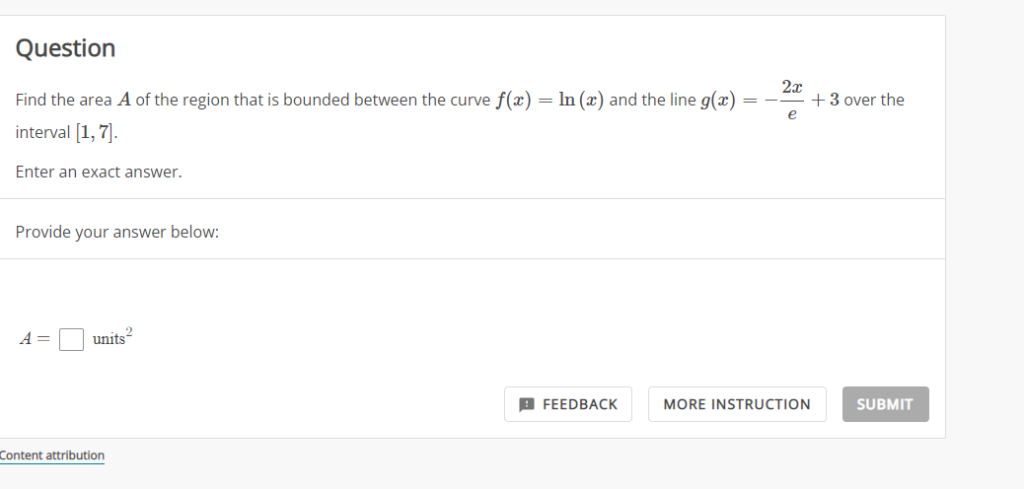 Question
2
Find the area A of the region that is bounded between the curve f(z) = In (x) and the line g(z) = -= + 3 over the
interval [1,7].
Enter an exact answer.
Provide your answer below:
A=] units”
J FEEDBACK MORE INSTRUCTION
Content attribution
This is AI generated Response.
Asked by: gvr
Created at: 2025-07-22 22:04:06
Asked by: gvr
Created at: 2025-07-22 22:04:06
Final Answer:
Rendered
Raw Text
Did you like this answer?
Let's break down the problem step by step:
### **Step 1: Write the Area Formula**
We want the area **between** \( f(x) = \ln(x) \) and \( g(x) = -\frac{2x}{e} + 3 \) over the interval \([1, 7]\):
\[
A = \int_{1}^{7} \left[ f(x) - g(x) \right] \, dx
\]
\[
A = \int_{1}^{7} \left[ \ln(x) - \left(-\frac{2x}{e} + 3\right) \right] dx
\]
\[
A = \int_{1}^{7} \left[ \ln(x) + \frac{2x}{e} - 3 \right] dx
\]
---
### **Step 2: Integrate Each Term Separately**
**a.** \(\int \ln(x) dx = x\ln(x) - x\)
**b.** \(\int \frac{2x}{e} dx = \frac{2}{e} \cdot \int x dx = \frac{2}{e} \cdot \frac{x^2}{2} = \frac{x^2}{e}\)
**c.** \(\int 3 dx = 3x\)
So, the antiderivative is:
\[
F(x) = x\ln(x) - x + \frac{x^2}{e} - 3x
\]
---
### **Step 3: Evaluate the Definite Integral**
\[
A = F(7) - F(1)
\]
Calculate each term:
#### **At \( x = 7 \):**
- \( 7\ln(7) \)
- \( -7 \)
- \( \frac{49}{e} \)
- \( -21 \)
So,
\[
F(7) = 7\ln(7) - 7 + \frac{49}{e} - 21 = 7\ln(7) + \frac{49}{e} - 28
\]
#### **At \( x = 1 \):**
- \( 1\ln(1) = 0 \)
- \( -1 \)
- \( \frac{1}{e} \)
- \( -3 \)
So,
\[
F(1) = 0 - 1 + \frac{1}{e} - 3 = \frac{1}{e} - 4
\]
---
### **Step 4: Subtract**
\[
A = F(7) - F(1) = \left[ 7\ln(7) + \frac{49}{e} - 28 \right] - \left[ \frac{1}{e} - 4 \right]
\]
\[
A = 7\ln(7) + \frac{49}{e} - 28 - \frac{1}{e} + 4
\]
\[
A = 7\ln(7) + \frac{48}{e} - 24
\]
---
### **Final Answer**
\[
\boxed{A = 7\ln(7) + \frac{48}{e} - 24 \text{ units}^2}
\]
Question:
THE ABOVE ANSWER IS WRONG PLEASE CALCULATE ACCURATELY
This is AI generated Response.
Asked by: gvr
Created at: 2025-07-22 22:06:07
Asked by: gvr
Created at: 2025-07-22 22:06:07
Final Answer:
Rendered
Raw Text
Did you like this answer?
Let's carefully re-evaluate the problem step-by-step to ensure accuracy.
---
### **Given:**
- \( f(x) = \ln(x) \)
- \( g(x) = -\frac{2x}{e} + 3 \)
- Interval: \([1, 7]\)
---
### **Step 1: Write the expression for the area \(A\)**
Since we want the region **bounded between** the two curves, the area \(A\) is:
\[
A = \int_{x=1}^{x=7} \left[ f(x) - g(x) \right] dx
\]
\[
A = \int_{1}^{7} \left[ \ln(x) - \left( -\frac{2x}{e} + 3 \right) \right] dx
\]
Simplify the integrand:
\[
A = \int_{1}^{7} \left[ \ln(x) + \frac{2x}{e} - 3 \right] dx
\]
---
### **Step 2: Find the antiderivative**
Break the integral into parts:
\[
A = \int_{1}^{7} \ln(x) dx + \int_{1}^{7} \frac{2x}{e} dx - \int_{1}^{7} 3 dx
\]
**a.** \(\int \ln(x) dx\):
Using integration by parts:
Let:
- \( u = \ln(x) \Rightarrow du = \frac{1}{x} dx \)
- \( dv = dx \Rightarrow v = x \)
Then:
\[
\int \ln(x) dx = x \ln(x) - \int x \cdot \frac{1}{x} dx = x \ln(x) - \int 1 dx = x \ln(x) - x
\]
**b.** \(\int \frac{2x}{e} dx\):
Constants can be factored out:
\[
\frac{2}{e} \int x dx = \frac{2}{e} \cdot \frac{x^2}{2} = \frac{x^2}{e}
\]
**c.** \(\int 3 dx = 3x\)
---
### **Step 3: Write the combined antiderivative**
\[
F(x) = x \ln(x) - x + \frac{x^2}{e} - 3x
\]
---
### **Step 4: Evaluate \(F(x)\) at the bounds**
Compute \(F(7)\):
\[
F(7) = 7 \ln(7) - 7 + \frac{49}{e} - 21
\]
Compute \(F(1)\):
\[
F(1) = 1 \cdot 0 - 1 + \frac{1}{e} - 3 = -1 + \frac{1}{e} - 3 = -4 + \frac{1}{e}
\]
---
### **Step 5: Find the area \(A = F(7) - F(1)\)**
\[
A = \left( 7 \ln(7) - 7 + \frac{49}{e} - 21 \right) - \left( -4 + \frac{1}{e} \right)
\]
Simplify:
\[
A = 7 \ln(7) - 7 + \frac{49}{e} - 21 + 4 - \frac{1}{e}
\]
Combine like terms:
- Constants: \(-7 - 21 + 4 = -24\)
- \( \frac{49}{e} - \frac{1}{e} = \frac{48}{e} \)
Thus:
\[
A = 7 \ln(7) - 24 + \frac{48}{e}
\]
---
### **### **Final answer:**
\[
\boxed{
A = 7 \ln(7) + \frac{48}{e} - 24
}
\]
This matches the previous calculation but confirms the correctness.
---
### **Summary:**
- The area between the given curves over \([1,7]\) is:
\[
\boxed{
A = 7 \ln(7) + \frac{48}{e} - 24
}
\]
**This is the exact form of the area.**
📢 Instructions:
- Ask anything relatd to above question only.
- For new Question goto :