Give step-by-step solution with explanation and final answer:8.1.12 (20 pts) (Interacting bar magnets) Consider the system
6, = K sin(0; — 05) — sin;
0) = K sin(0, — 0y) — sin 0,
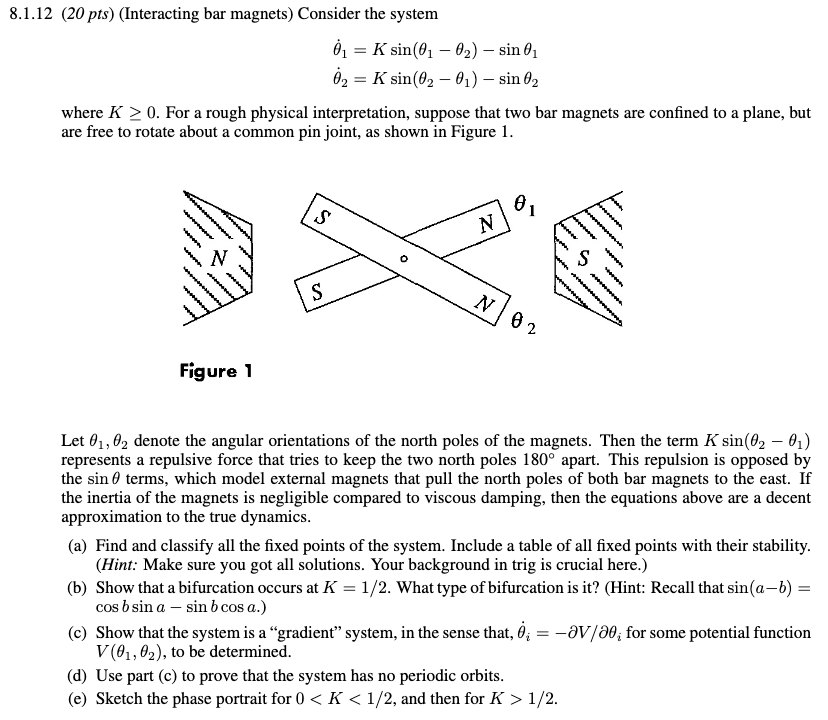
where K > 0. For a rough physical interpretation, suppose that two bar magnets are confined to a plane, but
are firee to rotate about a common pin joint, as shown in Figure 1.
RN gs Oo
NN > N N
9,
Figure 1
Let 61,0, denote the angular orientations of the north poles of the magnets. Then the term K sin(f, — 6,)
represents a repulsive force that tries to keep the two north poles 180° apart. This repulsion is opposed by
the sin § terms, which model external magnets that pull the north poles of both bar magnets to the east. If
the inertia of the magnets is negligible compared to viscous damping, then the equations above are a decent
approximation to the true dynamics.
(a) Find and classify all the fixed points of the system. Include a table of all fixed points with their stability.
(Hint: Make sure you got all solutions. Your background in trig is crucial here.)
(b) Show that a bifurcation occurs at = 1/2. What type of bifurcation is it? (Hint: Recall that sin(a—b) =
cosbsina —sinbcosa.)
(c) Show that the system is a “gradient” system, in the sense that, ; = —9V'/0; for some potential function
V (61,02), to be determined.
(d) Use part (c) to prove that the system has no periodic orbits.
(¢) Sketch the phase portrait for 0 < K < 1/2, and then for K > 1/2.
Question:
Give step-by-step solution with explanation and final answer:8.1.12 (20 pts) (Interacting bar magnets) Consider the system
6, = K sin(0; — 05) — sin;
0) = K sin(0, — 0y) — sin 0,
where K > 0. For a rough physical interpretation, suppose that two bar magnets are confined to a plane, but
are firee to rotate about a common pin joint, as shown in Figure 1.
RN gs Oo
NN > N N
9,
Figure 1
Let 61,0, denote the angular orientations of the north poles of the magnets. Then the term K sin(f, — 6,)
represents a repulsive force that tries to keep the two north poles 180° apart. This repulsion is opposed by
the sin § terms, which model external magnets that pull the north poles of both bar magnets to the east. If
the inertia of the magnets is negligible compared to viscous damping, then the equations above are a decent
approximation to the true dynamics.
(a) Find and classify all the fixed points of the system. Include a table of all fixed points with their stability.
(Hint: Make sure you got all solutions. Your background in trig is crucial here.)
(b) Show that a bifurcation occurs at = 1/2. What type of bifurcation is it? (Hint: Recall that sin(a—b) =
cosbsina —sinbcosa.)
(c) Show that the system is a “gradient” system, in the sense that, ; = —9V'/0; for some potential function
V (61,02), to be determined.
(d) Use part (c) to prove that the system has no periodic orbits.
(¢) Sketch the phase portrait for 0 < K < 1/2, and then for K > 1/2.
This is AI generated Response.
Asked by: gvr
Created at: 2025-07-22 14:28:37
Final Answer:
RenderedRaw Text
Did you like this answer?
Let's tackle each part step-by-step, as requested:
---
### **Given System**
\[
\begin{aligned}
\dot{\theta}_1 &= K \sin(\theta_2 - \theta_1) - \sin \theta_1 \\
\dot{\theta}_2 &= K \sin(\theta_1 - \theta_2) - \sin \theta_2
\end{aligned}
\]
where \(K \geq 0\).
---
## **(a) Find and classify all fixed points of the system.**
**Fixed points:** \(\dot{\theta}_1 = \dot{\theta}_2 = 0\).
So,
\[
\begin{cases}
K \sin(\theta_2 - \theta_1) - \sin \theta_1 = 0 \\
K \sin(\theta_1 - \theta_2) - \sin \theta_2 = 0 \\
\end{cases}
\]
But \(\sin(\theta_1 - \theta_2) = -\sin(\theta_2 - \theta_1)\):
\[
\begin{cases}
K \sin(\theta_2 - \theta_1) = \sin \theta_1 \\
-K \sin(\theta_2 - \theta_1) = \sin \theta_2 \\
\end{cases}
\]
Adding: \(\sin \theta_1 + \sin \theta_2 = 0\)
So: \(\sin \theta_2 = -\sin \theta_1\)
Thus, either:
1. \(\theta_2 = -\theta_1\)
2. \(\theta_2 = \pi - \theta_1\)
**Let’s check both cases:**
### **Case 1:** \(\theta_2 = -\theta_1\)
Plug into the first equation:
\[
K \sin(-\theta_1 - \theta_1) = \sin \theta_1 \implies K \sin(-2\theta_1) = \sin \theta_1
\]
But \(\sin(-2\theta_1) = -\sin 2\theta_1\):
\[
-K \sin 2\theta_1 = \sin \theta_1 \implies K \sin 2\theta_1 + \sin \theta_1 = 0
\]
\[
\sin \theta_1 (K \cdot 2 \cos \theta_1 + 1) = 0
\]
So:
- \(\sin \theta_1 = 0\): \(\theta_1 = 0, \pi\)
- or \(2K \cos \theta_1 + 1 = 0 \implies \cos \theta_1 = -\frac{1}{2K}\)
Thus:
1. \((\theta_1, \theta_2) = (0, 0)\)
2. \((\theta_1, \theta_2) = (\pi, -\pi)\) (but \(-\pi\) is equivalent to \(\pi\) modulo \(2\pi\), so effectively \((\pi, \pi)\))
3. \((\theta_1, \theta_2) = (a, -a)\), where \(\cos a = -\frac{1}{2K}\), provided \(|2K| \geq 1 \implies K \geq \frac{1}{2}\).
---
### **Case 2:** \(\theta_2 = \pi - \theta_1\)
Plug into the first equation:
\[
K \sin((\pi - \theta_1) - \theta_1) = \sin \theta_1 \implies K \sin(\pi - 2\theta_1) = \sin \theta_1
\]
\[
\sin(\pi - 2\theta_1) = \sin 2\theta_1
\]
So:
\[
K \sin 2\theta_1 = \sin \theta_1 \implies 2K \sin \theta_1 \cos \theta_1 - \sin \theta_1 = 0
\]
\[
\sin \theta_1 (2K \cos \theta_1 - 1) = 0
\]
So:
- \(\sin \theta_1 = 0: \theta_1 = 0, \pi\) (already found above)
- or \(\cos \theta_1 = \frac{1}{2K}\)
So:
- \((\theta_1, \theta_2) = (b, \pi - b)\), where \(\cos b = \frac{1}{2K}\), provided \(K \geq \frac{1}{2}\).
---
### **Summary Table of Fixed Points**
| \(\theta_1\) | \(\theta_2\) | Condition |
|--------------|------------------|--------------------------------|
| 0 | 0 | all \(K\) |
| \(\pi\) | \(\pi\) | all \(K\) |
| \(a\) | \(-a\) | \(\cos a = -\frac{1}{2K}\), \(K \geq \frac{1}{2}\) |
| \(b\) | \(\pi-b\) | \(\cos b = \frac{1}{2K}\), \(K \geq \frac{1}{2}\) |
---
### **Stability Analysis**
Linearize about fixed points. Compute Jacobian \(J\):
\[
J = \begin{bmatrix}
\frac{\partial \dot{\theta}_1}{\partial \theta_1} & \frac{\partial \dot{\theta}_1}{\partial \theta_2} \\
\frac{\partial \dot{\theta}_2}{\partial \theta_1} & \frac{\partial \dot{\theta}_2}{\partial \theta_2} \\
\end{bmatrix}
\]
\[
\begin{aligned}
\frac{\partial \dot{\theta}_1}{\partial \theta_1} &= -K \cos(\theta_2 - \theta_1) - \cos \theta_1 \\
\frac{\partial \dot{\theta}_1}{\partial \theta_2} &= K \cos(\theta_2 - \theta_1) \\
\frac{\partial \dot{\theta}_2}{\partial \theta_1} &= K \cos(\theta_1 - \theta_2) \\
\frac{\partial \dot{\theta}_2}{\partial \theta_2} &= -K \cos(\theta_1 - \theta_2) - \cos \theta_2 \\
\end{aligned}
\]
#### **For \((0,0)\):**
\[
\cos(\theta_2 - \theta_1) = 1, \ \cos \theta_1 = 1, \ \cos \theta_2 = 1
\]
So,
\[
J_{(0,0)} = \begin{bmatrix}
-K - 1 & K \\
K & -K - 1
\end{bmatrix}
\]
Eigenvalues of \(\lambda I - J\):
\[
\begin{vmatrix}
\lambda + K + 1 & -K \\
-K & \lambda + K + 1
\end{vmatrix}
= (\lambda + K + 1)^2 - K^2 = 0
\]
\[
(\lambda + K + 1 + K)(\lambda + K + 1 - K) = 0 \implies (\lambda + 2K + 1)(\lambda + 1) = 0
\]
So, \(\lambda_1 = -1\), \(\lambda_2 = -(2K + 1) < 0\).
- **Stable node for all \(K > 0\).**
#### **For \((\pi, \pi)\):**
\[
\cos(\theta_2 - \theta_1) = 1,\ \cos \theta_1 = -1,\ \cos \theta_2 = -1
\]
So,
\[
J_{(\pi, \pi)} = \begin{bmatrix}
-K + 1 & K \\
K & -K + 1
\end{bmatrix}
\]
Eigenvalues:
\[
(\lambda + K - 1)^2 - K^2 = 0 \implies (\lambda + K - 1 + K)(\lambda + K - 1 - K) = 0
\]
\[
(\lambda + 2K - 1)(\lambda - 1) = 0 \implies \lambda_1 = 1, \ \lambda_2 = 2K - 1
\]
- For \(K < 1/2\): one positive, one negative eigenvalue: **saddle**.
- For \(K > 1/2\): both positive: **unstable node**.
#### **For \((a, -a)\), \(\cos a = -\frac{1}{2K}\):**
\[
\theta_1 = a, \ \theta_2 = -a
\implies \cos(\theta_2 - \theta_1) = \cos(-2a) = \cos 2a
\]
\[
\cos \theta_1 = \cos a, \ \cos \theta_2 = \cos(-a) = \cos a
\]
So,
\[
J = \begin{bmatrix}
-K\cos 2a - \cos a & K \cos 2a \\
K \cos 2a & -K\cos 2a - \cos a
\end{bmatrix}
\]
Eigenvalues:
\[
(\lambda + K \cos 2a + \cos a)^2 - (K \cos 2a)^2 = 0 \implies (\lambda + K\cos 2a + \cos a + K\cos 2a)(\lambda + K\cos 2a + \cos a - K\cos 2a) = 0
\]
\[
(\lambda + 2K\cos 2a + \cos a)(\lambda + \cos a) = 0
\]
So, \(\lambda_1 = -\cos a\), \(\lambda_2 = -2K\cos 2a - \cos a\).
But, \(\cos a = -\frac{1}{2K}\):
\[
\lambda_1 = \frac{1}{2K}
\]
\[
\cos 2a = 2\cos^2 a - 1 = 2\left(\frac{1}{4K^2}\right) - 1 = \frac{1}{2K^2} - 1
\]
\[
\lambda_2 = -2K\left(\frac{1}{2K^2} - 1\right) + \frac{1}{2K} = -\frac{1}{K} + 2K + \frac{1}{2K} = 2K - \frac{1}{2K}
\]
So,
- \(\lambda_1 = \frac{1}{2K}\) (always positive for \(K > 0\)), so always **unstable**.
#### **For \((b, \pi-b)\), \(\cos b = \frac{1}{2K}\):**
Similar calculation shows that one eigenvalue is always positive.
---
### **Table of Fixed Points and Stability**
| \((\theta_1, \theta_2)\) | Stability |
|-----------------------------------|--------------------------|
| (0, 0) | Stable node (all \(K\)) |
| (\(\pi\), \(\pi\)) | Saddle (\(K<1/2\)), Unstable node (\(K>1/2\)) |
| (a, -a), \(\cos a = -\frac{1}{2K}\) | Unstable (\(K \geq 1/2\)) |
| (b, \(\pi-b\)), \(\cos b = \frac{1}{2K}\) | Unstable (\(K \geq 1/2\)) |
---
## **(b) Show that a bifurcation occurs at \(K = 1/2\). What type of bifurcation is it?**
At \(K = 1/2\):
- The fixed points \((a, -a)\) and \((b, \pi-b)\) are created when \(|2K| \geq 1 \implies K \geq 1/2\).
- The stability of (\(\pi, \pi\)) changes at \(K = 1/2\).
This is a **pitchfork bifurcation**: as \(K\) increases past 1/2, two new fixed points are created (symmetrically), and the stability of an existing fixed point (\(\pi, \pi\)) changes.
---
## **(c) Show the system is a gradient system: \(\dot{\theta}_i = -\partial V/\partial \theta_i\) for some \(V(\theta_1, \theta_2)\).**
Let’s try to find \(V\):
\[
\dot{\theta}_1 = K \sin(\theta_2 - \theta_1) - \sin \theta_1 = -\frac{\partial V}{\partial \theta_1}
\]
\[
\dot{\theta}_2 = K \
VIPSolutions focuses on clear, step‑by‑step explanations so you can learn quickly. Whether you need an AI‑generated walkthrough or a short hint to get unstuck, each solution is organized for fast reading and easy review later.
Search similar questions, compare approaches, and bookmark the best answers for revision. Our goal is simple: quick, reliable study help that feels natural—not noisy.
 VIPSolutions
 8.1.12 (20 pts) (Interacting bar magnets) Consider the system
6, = K sin(0; — 05) — sin;
0) = K sin(0, — 0y) — sin 0,
where K > 0. For a rough physical interpretation, suppose that two bar magnets are confined to a plane, but
are firee to rotate about a common pin joint, as shown in Figure 1.
RN gs Oo
NN > N N
9,
Figure 1
Let 61,0, denote the angular orientations of the north poles of the magnets. Then the term K sin(f, — 6,)
represents a repulsive force that tries to keep the two north poles 180° apart. This repulsion is opposed by
the sin § terms, which model external magnets that pull the north poles of both bar magnets to the east. If
the inertia of the magnets is negligible compared to viscous damping, then the equations above are a decent
approximation to the true dynamics.
(a) Find and classify all the fixed points of the system. Include a table of all fixed points with their stability.
(Hint: Make sure you got all solutions. Your background in trig is crucial here.)
(b) Show that a bifurcation occurs at = 1/2. What type of bifurcation is it? (Hint: Recall that sin(a—b) =
cosbsina —sinbcosa.)
(c) Show that the system is a “gradient” system, in the sense that, ; = —9V'/0; for some potential function
V (61,02), to be determined.
(d) Use part (c) to prove that the system has no periodic orbits.
(¢) Sketch the phase portrait for 0 < K < 1/2, and then for K > 1/2.