 VIPSolutions
Give step-by-step solution with explanation and final answer:Q8. A 60 mm diameter shaft supported in bearings carries a 750 mm diameter pulley weighing 2500 N at an overhanging end of the shaft as shown in Fig. Q8. Calculate the principal tensile stress at the section mn if the horizontal belt tensions are as shown in the figure. $ 2500 N 40 MPa. 8750 N 35 MPa £ 60 MPa m E —_ xX E o J) ma = 150 mm 1250 N Fig. Q7 Fig. Q8
Question:
Give step-by-step solution with explanation and final answer: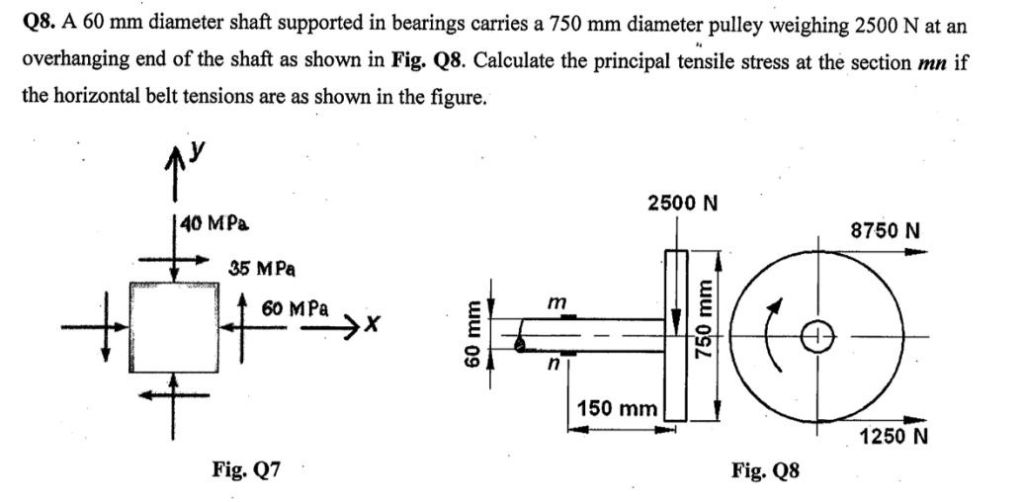 Q8. A 60 mm diameter shaft supported in bearings carries a 750 mm diameter pulley weighing 2500 N at an
overhanging end of the shaft as shown in Fig. Q8. Calculate the principal tensile stress at the section mn if
the horizontal belt tensions are as shown in the figure.
$
2500 N
40 MPa. 8750 N
35 MPa £
60 MPa m E
—_ xX E o
J) ma =
150 mm
1250 N
Fig. Q7 Fig. Q8
This is AI generated Response.
Asked by: gvr
Created at: 2025-07-22 14:25:55
Asked by: gvr
Created at: 2025-07-22 14:25:55
Final Answer:
Rendered
Raw Text
Did you like this answer?
Let's solve the problem **step by step**:
---
## Given Data
- **Shaft diameter, \( d \) = 60 mm**
- **Pulley diameter = 750 mm**
- **Pulley weight, \( W \) = 2500 N**
- **Overhang length = 150 mm**
- **Horizontal belt tensions:**
- Tight side = 8750 N
- Slack side = 1250 N
---
## 1. **Forces Acting at Section mn**
### **a. Vertical Load (Due to Pulley Weight)**
- **Acting at 150 mm from section mn**
- **Magnitude = 2500 N**
### **b. Horizontal Load (Due to Belt Tension)**
- **Net horizontal force = Tight side - Slack side**
- **= 8750 N - 1250 N = 7500 N**
- **This force acts tangentially to the pulley, at a radius of \( r = 750/2 = 375 \) mm from the shaft center**
---
## 2. **Calculate Bending Moments at Section mn**
### **a. Moment due to Pulley Weight (Vertical Plane)**
\[
M_v = 2500 \text{ N} \times 150 \text{ mm} = 375,000 \text{ Nmm}
\]
### **b. Moment due to Belt Tension (Horizontal Plane)**
The resultant force acts at the center of the shaft at the pulley location, 150 mm from mn.
But, the net force (7500 N) acts at a distance of 150 mm from section mn.
\[
M_h = 7500 \text{ N} \times 150 \text{ mm} = 1,125,000 \text{ Nmm}
\]
---
## 3. **Resultant Bending Moment**
The two moments are **perpendicular**. The resultant moment:
\[
M = \sqrt{M_v^2 + M_h^2}
\]
\[
M = \sqrt{(375,000)^2 + (1,125,000)^2}
\]
\[
M = \sqrt{140,625,000,000 + 1,265,625,000,000}
\]
\[
M = \sqrt{1,406,250,000,000}
\]
\[
M = 1,187,436 \text{ Nmm}
\]
---
## 4. **Maximum Bending Stress (σ\_b) at mn**
\[
\sigma_b = \frac{M \cdot c}{I}
\]
Where:
- \( c = \frac{d}{2} = 30 \) mm
- \( I = \frac{\pi}{64} d^4 \)
\[
I = \frac{\pi}{64} \cdot (60)^4 = \frac{\pi}{64} \cdot 12,960,000 = 636,172 \text{ mm}^4
\]
\[
\sigma_b = \frac{1,187,436 \times 30}{636,172}
\]
\[
\sigma_b = \frac{35,623,080}{636,172}
\]
\[
\sigma_b = 56.03 \text{ MPa}
\]
---
## 5. **Direct (Axial) Stress (σ\_d) at mn**
The **vertical load** (pulley weight) also creates a direct axial stress:
\[
\sigma_d = \frac{W}{A}
\]
Where
\( A = \frac{\pi}{4} d^2 = \frac{\pi}{4} \times 60^2 = 2,827 \text{ mm}^2 \)
\[
\sigma_d = \frac{2500}{2827} = 0.885 \text{ MPa}
\]
---
## 6. **Combined Stresses**
At the point of **maximum tensile stress** (bottom fiber):
- **Bending stress is tensile**
- **Direct stress is tensile**
\[
\text{Total tensile stress, } \sigma = \sigma_d + \sigma_b
\]
\[
\sigma = 0.885 + 56.03 = 56.92 \text{ MPa}
\]
---
## 7. **Principal Tensile Stress Calculation**
If there is **no shear stress** (since only bending + direct axial), **principal stress** at the most stressed point is simply the arithmetic sum.
\[
\boxed{\sigma_{max} = 56.92 \text{ MPa}}
\]
---
### **Final Answer**
> **The principal tensile stress at section mn is:**
>
> \[
> \boxed{56.92 \text{ MPa}}
> \]
---
### **Summary of Steps**
1. Calculated vertical and horizontal bending moments.
2. Found the resultant moment.
3. Calculated the maximum bending stress.
4. Added direct axial stress.
5. Found the principal tensile stress at the most stressed fiber.
---
**If you have any follow-up or want to see shear/other stress analysis, let me know!**
📢 Instructions:
- Ask anything relatd to above question only.
- For new Question goto :