 VIPSolutions
Give step-by-step solution with explanation and final answer:5152 0 0t= EB al @ ‘= Chegg 8 v Hide student question (© Time Left: 01:59:54 Student question a. Fill in the following table from Appendix B. Note: Round your answers to 3 decimal places. b. Does the choice between a low or a high [e)] discount rate have a greater impact on = © short - term or long - term cash flows? [& Long - term Short - term Exit 4 » Submit
Question:
Give step-by-step solution with explanation and final answer: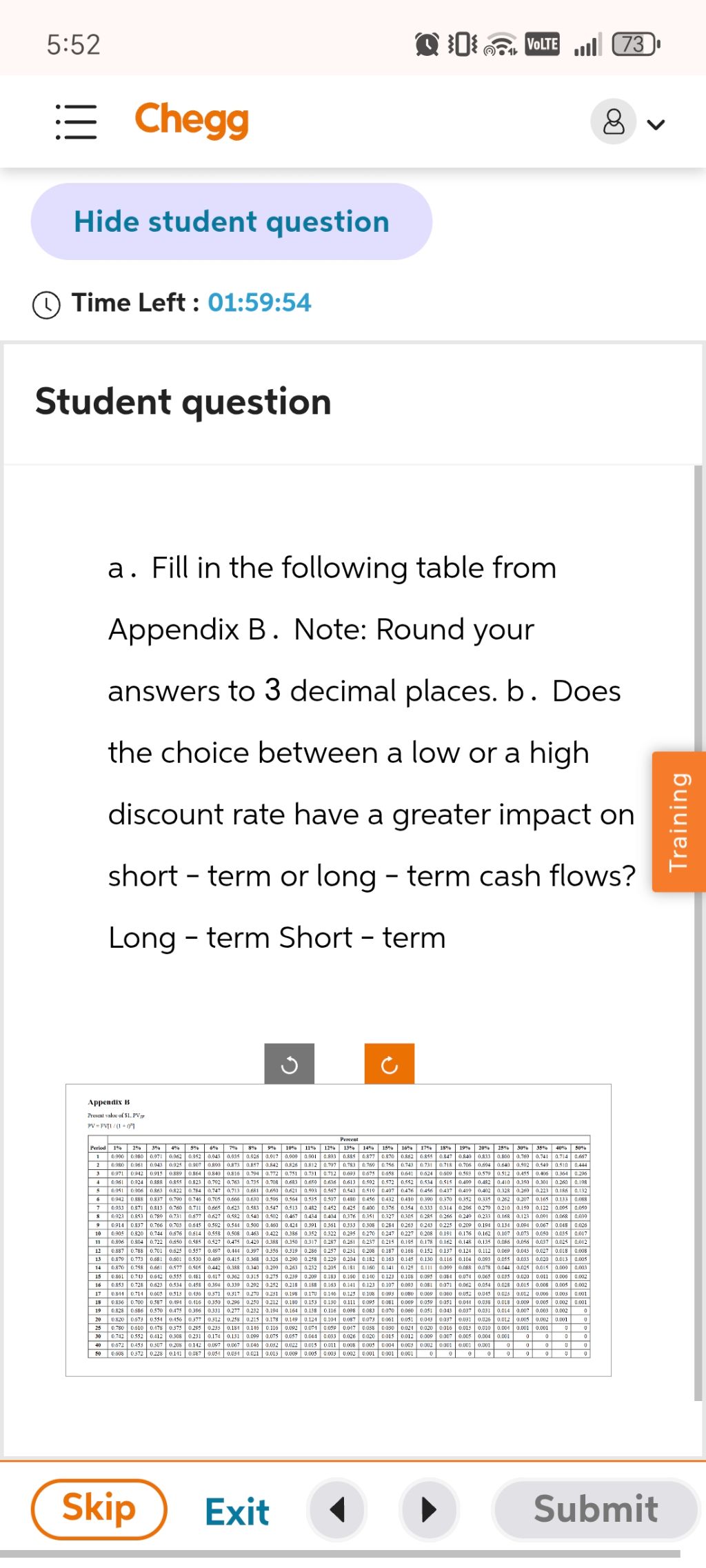 5152 0 0t= EB al @
‘= Chegg 8 v
Hide student question
(© Time Left: 01:59:54
Student question
a. Fill in the following table from
Appendix B. Note: Round your
answers to 3 decimal places. b. Does
the choice between a low or a high
[e)]
discount rate have a greater impact on =
©
short - term or long - term cash flows? [&
Long - term Short - term
Exit 4 » Submit
This is AI generated Response.
Asked by: Kota Swarupa Rani
Created at: 2025-07-21 05:53:28
Asked by: Kota Swarupa Rani
Created at: 2025-07-21 05:53:28
Final Answer:
Rendered
Raw Text
Did you like this answer?
Let's break down your question step-by-step.
---
### a. Fill in the following table from Appendix B.
Since the actual table that needs to be filled is not provided in your screenshot, but Appendix B (Present Value Table) is visible, I'll explain **how to use the table** and give an example:
#### **How to Use the Present Value Table (Appendix B):**
- **Rows:** Represent the number of periods (years, months, etc.).
- **Columns:** Represent the discount rate (interest rate).
- **Value:** The factor you multiply by a future cash flow to get its present value.
#### **Example:**
Suppose you want the present value factor for 5 years at a 10% discount rate:
- Find row for **5** periods.
- Move to the column for **10%**.
- The intersection gives the present value factor. (From the image, this is **0.621**.)
**If your table requires you to fill in different periods and rates, use this method for each cell.**
---
### b. Does the choice between a low or a high discount rate have a greater impact on short-term or long-term cash flows?
**Explanation:**
- **Short-term cash flows:** Present value is less sensitive to changes in the discount rate because there are fewer periods for interest to compound.
- **Long-term cash flows:** Present value is **more sensitive** to changes in the discount rate because the effect of discounting compounds over more periods.
**Example from the table:**
- For 1 period at 5%: PV factor ≈ 0.952
- For 1 period at 20%: PV factor ≈ 0.833
- Difference = 0.119
- For 10 periods at 5%: PV factor ≈ 0.614
- For 10 periods at 20%: PV factor ≈ 0.162
- Difference = 0.452
**The difference is much larger for long-term cash flows.**
---
### **Final Answer:**
**The choice between a low or a high discount rate has a greater impact on long-term cash flows.**
---
#### **Summary Table Example**
| Period | 5% | 10% | 20% |
|--------|------|------|------|
| 1 | 0.952| 0.909| 0.833|
| 5 | 0.784| 0.621| 0.402|
| 10 | 0.614| 0.386| 0.162|
- As you can see, the difference between discount rates **increases** as the period increases.
---
**If you have a specific table to fill, let me know the periods and rates, and I can fill it for you!**
📢 Instructions:
- Ask anything relatd to above question only.
- For new Question goto :