 VIPSolutions
Give step-by-step solution with explanation and final answer:1) Consider the function C (x) = [; cos(§mt?)dt a) Find the derivative of C(x). b) On what intervals is the function C increasing? c) On what intervals is the function C deceasing?
Question:
Give step-by-step solution with explanation and final answer: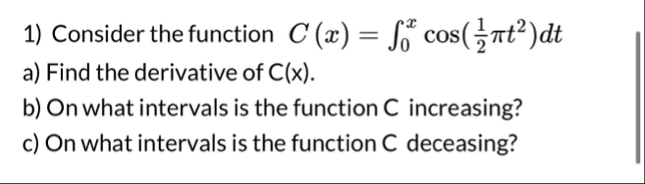 1) Consider the function C (x) = [; cos(§mt?)dt
a) Find the derivative of C(x).
b) On what intervals is the function C increasing?
c) On what intervals is the function C deceasing?
This is AI generated Response.
Asked by: gvr
Created at: 2025-07-14 14:39:57
Asked by: gvr
Created at: 2025-07-14 14:39:57
Final Answer:
Rendered
Raw Text
Did you like this answer?
Let's tackle the problem step by step:
### 1. The function:
\[
C(x) = \int_0^x \cos\left(\frac{1}{2}\pi t^2\right) dt
\]
---
#### **a) Find the derivative of \( C(x) \)**
By the **Fundamental Theorem of Calculus**:
\[
C'(x) = \frac{d}{dx} \left( \int_0^x \cos\left(\frac{1}{2}\pi t^2\right) dt \right) = \cos\left(\frac{1}{2}\pi x^2\right)
\]
---
#### **b) On what intervals is the function \( C \) increasing?**
A function increases when its derivative is positive.
\[
C'(x) = \cos\left(\frac{1}{2}\pi x^2\right) > 0
\]
So, \( C(x) \) is **increasing** where:
\[
\frac{1}{2}\pi x^2 \in (2\pi n - \frac{\pi}{2}, 2\pi n + \frac{\pi}{2}) \quad \text{for integers } n
\]
This simplifies to:
\[
2\pi n - \frac{\pi}{2} < \frac{1}{2}\pi x^2 < 2\pi n + \frac{\pi}{2}
\]
Divide both sides by \( \frac{1}{2}\pi \):
\[
4n - 1 < x^2 < 4n + 1
\]
So,
\[
x \in (-\sqrt{4n + 1}, -\sqrt{4n - 1}) \cup (\sqrt{4n - 1}, \sqrt{4n + 1})
\]
for all \( n \geq 1 \) (since \( x^2 > 0 \)), and for \( n = 0 \), \( x \in (-1,1) \).
---
#### **c) On what intervals is the function \( C \) decreasing?**
A function decreases when its derivative is negative:
\[
C'(x) = \cos\left(\frac{1}{2}\pi x^2\right) < 0
\]
So, \( C(x) \) is **decreasing** where:
\[
\frac{1}{2}\pi x^2 \in (2\pi n + \frac{\pi}{2}, 2\pi n + \frac{3\pi}{2})
\]
This simplifies to:
\[
4n + 1 < x^2 < 4n + 3
\]
So,
\[
x \in (-\sqrt{4n + 3}, -\sqrt{4n + 1}) \cup (\sqrt{4n + 1}, \sqrt{4n + 3})
\]
for all \( n \geq 0 \).
---
### **Summary Table**
| Part | Answer |
|------|--------|
| (a) | \( C'(x) = \cos\left(\frac{1}{2}\pi x^2\right) \) |
| (b) | \( C(x) \) is **increasing** on \( (-\sqrt{4n + 1}, -\sqrt{4n - 1}) \cup (\sqrt{4n - 1}, \sqrt{4n + 1}) \), \( n = 1,2,3,... \) and \( (-1,1) \) for \( n = 0 \) |
| (c) | \( C(x) \) is **decreasing** on \( (-\sqrt{4n + 3}, -\sqrt{4n + 1}) \cup (\sqrt{4n + 1}, \sqrt{4n + 3}) \), \( n = 0,1,2,... \) |
Let me know if you'd like to see this with an explicit computation for the first few intervals!
Question:
i need step by step detailed calculations of each part along with the final Answer
This is AI generated Response.
Asked by: gvr
Created at: 2025-07-14 14:43:24
Asked by: gvr
Created at: 2025-07-14 14:43:24
Final Answer:
Rendered
Raw Text
Did you like this answer?
Let's carefully work through each part of the problem with detailed explanations and calculations.
---
### Given Function:
\[
C(x) = \int_0^x \cos\left(\frac{1}{2}\pi t^2\right) dt
\]
---
## Part (a): Find the derivative \( C'(x) \)
### Step 1: Recall the Fundamental Theorem of Calculus
- If \( C(x) = \int_a^x f(t) dt \), then \( C'(x) = f(x) \).
### Step 2: Identify \( f(t) \)
- Here, \( f(t) = \cos\left(\frac{1}{2}\pi t^2\right) \).
### Step 3: Write the derivative
\[
C'(x) = \cos\left(\frac{1}{2}\pi x^2\right)
\]
**Final answer for part (a):**
\[
\boxed{
\boxed{
C'(x) = \cos\left(\frac{1}{2}\pi x^2\right)
}
}
\]
---
## Part (b): Find intervals where \( C \) is increasing
### Step 1: Recall that \( C \) is increasing where \( C'(x) > 0 \).
\[
\Rightarrow \cos\left(\frac{1}{2}\pi x^2\right) > 0
\]
### Step 2: Find where cosine is positive
- \( \cos \theta > 0 \) in intervals:
\[
\theta \in (2\pi n - \frac{\pi}{2}, 2\pi n + \frac{\pi}{2}) \quad \text{for all integers } n
\]
but more precisely, cosine is positive in the intervals:
\[
\theta \in (-\frac{\pi}{2} + 2\pi n, \frac{\pi}{2} + 2\pi n)
\]
### Step 3: Set \( \theta = \frac{1}{2}\pi x^2 \)
\[
\frac{1}{2}\pi x^2 \in \left( 2\pi n - \frac{\pi}{2}, 2\pi n + \frac{\pi}{2} \right)
\]
### Step 4: Solve for \( x^2 \)
Multiply all parts by 2:
\[
\pi x^2 \in \left( 4\pi n - \pi, 4\pi n + \pi \right)
\]
Divide by \( \pi \):
\[
x^2 \in \left( 4 n - 1, 4 n + 1 \right)
\]
### Step 5: Find \( x \)
\[
x \in \left( -\sqrt{4 n + 1}, -\sqrt{4 n - 1} \right) \cup \left( \sqrt{4 n - 1}, \sqrt{4 n + 1} \right)
\]
- For \( n=0 \):
\[
x^2 \in (-1, 1) \Rightarrow x \in (-1, 1)
\]
- For \( n \geq 1 \):
\[
x \in \left( -\sqrt{4 n + 1}, -\sqrt{4 n - 1} \right) \cup \left( \sqrt{4 n - 1}, \sqrt{4 n + 1} \right)
\]
---
### **Answer for part (b):**
\[
\boxed{
\text{C is increasing on} \quad (-1, 1) \quad \text{and} \quad \bigcup_{n=1}^\infty \left[ \left( -\sqrt{4n+1}, -\sqrt{4n-1} \right) \cup \left( \sqrt{4n-1}, \sqrt{4n+1} \right) \right]
}
\]
---
## Part (c): Find intervals where \( C \) is decreasing
### Step 1: \( C \) is decreasing where \( C'(x) < 0 \).
\[
\Rightarrow \cos\left(\frac{1}{2}\pi x^2\right) < 0
\]
### Step 2: Determine where cosine is negative
- Cosine is negative in intervals:
\[
\theta \in \left( \pi/2 + 2\pi n, 3\pi/2 + 2\pi n \right), \quad n \in \mathbb{Z}
\]
### Step 3: Set \( \theta = \frac{1}{2}\pi x^2 \)
\[
\frac{1}{2}\pi x^2 \in \left( \frac{\pi}{2} + 2\pi n, \frac{3\pi}{2} + 2\pi n \right)
\]
### Step 4: Solve for \( x^2 \)
Multiply all parts by 2:
\[
\pi x^2 \in \left( \pi + 4\pi n, 3\pi + 4\pi n \right)
\]
Divide by \( \pi \):
\[
x^2 \in \left( 1 + 4 n, 3 + 4 n \right)
\]
### Step 5: Find \( x \)
\[
x \in \left( -\sqrt{3 + 4 n}, -\sqrt{1 + 4 n} \right) \cup \left( \sqrt{1 + 4 n}, \sqrt{3 + 4 n} \right)
\]
- For \( n=0 \):
\[
x^2 \in (1, 3) \Rightarrow x \in (-\sqrt{3}, -1) \cup (1, \sqrt{3})
\]
- For \( n \geq 1 \):
\[
x \in \left( -\sqrt{4 n + 3}, -\sqrt{4 n + 1} \right) \cup \left( \sqrt{4 n + 1}, \sqrt{4 n + 3} \right)
\]
---
### **Answer for part (c):**
\[
\boxed{
\text{C is decreasing on} \quad \bigcup_{n=0}^\infty \left[ \left( -\sqrt{4 n + 3}, -\sqrt{4 n + 1} \right) \cup \left( \sqrt{4 n + 1}, \sqrt{4 n + 3} \right) \right]
}
\]
---
# **Summary:**
| Part | Derivative \( C'(x) \) | Intervals of Increase | Intervals of Decrease |
|--------|------------------------------|--------------------------------|---------------------------------|
| (a) | \( \cos\left(\frac{1}{2} \pi x^2 \right) \) | \( (-1, 1) \), and for \( n \geq 1 \), \( (\pm \sqrt{4n-1}, \pm \sqrt{4n+1}) \) | For \( n \geq 0 \), \( (\pm \sqrt{4n+1}, \pm \sqrt{4n+3}) \) |
Let me know if you'd like a specific numerical example or further clarification!
📢 Instructions:
- Ask anything relatd to above question only.
- For new Question goto :