 VIPSolutions
Give step-by-step solution with explanation and final answer:— Interval O0
Question:
Give step-by-step solution with explanation and final answer: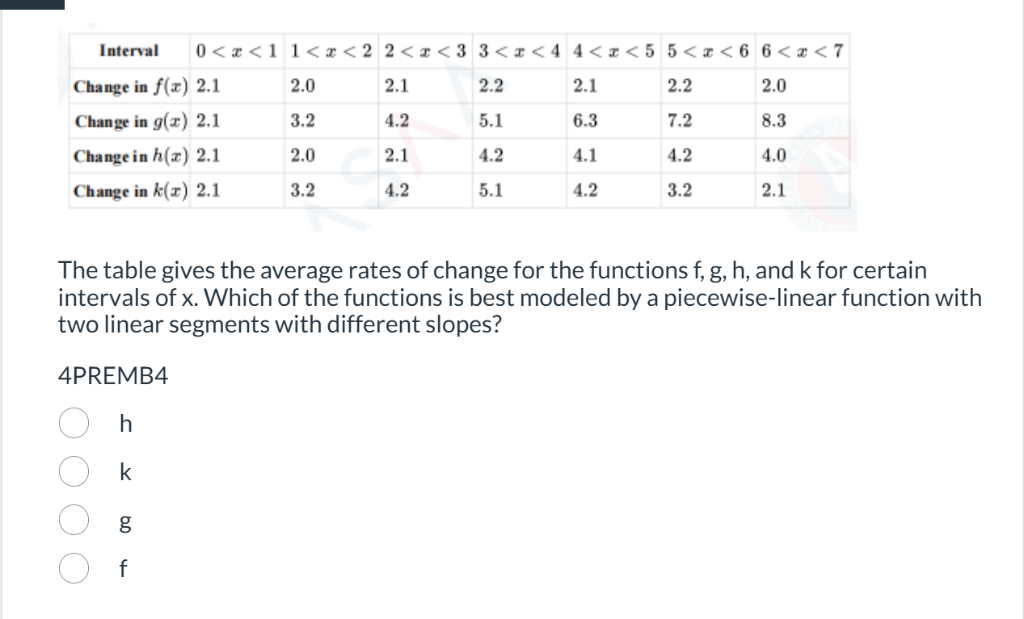 —
Interval O0
This is AI generated Response.
Asked by: gvr
Created at: 2025-07-12 21:57:36
Asked by: gvr
Created at: 2025-07-12 21:57:36
Final Answer:
Rendered
Raw Text
Did you like this answer?
Let's analyze the table step by step to find which function is best modeled by a **piecewise-linear function with two linear segments with different slopes**.
### Step 1: Understanding the Problem
A piecewise-linear function with two segments means:
- For the first part of the domain, the function has one constant rate of change (slope).
- For the second part, it has a different constant rate of change (slope).
- The change between the two slopes should be clear and abrupt, not gradual.
### Step 2: Examine Each Function
#### **Change in \( f(x) \):**
2.1, 2.0, 2.1, 2.2, 2.1, 2.2, 2.0
- The rate of change is nearly constant throughout.
- **Not piecewise-linear with two segments.**
#### **Change in \( g(x) \):**
2.1, 3.2, 4.2, 5.1, 6.3, 7.2, 8.3
- The rate of change is increasing steadily.
- **Not two constant segments.**
#### **Change in \( h(x) \):**
2.1, 2.0, 2.1, 4.2, 4.1, 4.2, 4.0
- First three intervals: approximately 2.0
- Last four intervals: approximately 4.1
- **This shows two distinct constant slopes.**
#### **Change in \( k(x) \):**
2.1, 3.2, 4.2, 5.1, 4.2, 3.2, 2.1
- Increases, then decreases symmetrically.
- **Not two constant segments.**
### Step 3: Conclusion
The function best modeled by a piecewise-linear function with two linear segments with different slopes is **h(x)**.
### **Final Answer**
**h**
---
**Explanation:**
- For \( h(x) \), the first part (intervals 1–3) is about 2.0, and the second part (intervals 4–7) is about 4.1.
- This matches the requirement for a piecewise-linear function with two segments with different slopes.
**So, the answer is:**
> **h**
Question:
i need step by step detailed explanation and calculations along with the final Answer i need each option detailed explanation
This is AI generated Response.
Asked by: gvr
Created at: 2025-07-12 22:08:13
Asked by: gvr
Created at: 2025-07-12 22:08:13
Final Answer:
Rendered
Raw Text
Did you like this answer?
Let's carefully analyze the problem step-by-step, considering each function's data, to determine which one can be modeled by a **piecewise-linear function with exactly two linear segments with different slopes**.
---
### **Given Data:**
| **Interval of z** | **Change in f(z)** | **Change in g(z)** | **Change in h(z)** | **Change in k(z)** |
|---------------------|--------------------|--------------------|--------------------|--------------------|
| \( 0 < z < l \) | 2.1 | 2.1 | 2.1 | 2.1 |
| \( l < z < 22 \) | 2.0 | 3.2 | 2.0 | 3.2 |
| \( 22 < z < 33 \) | 2.1 | 4.2 | 2.1 | 4.2 |
| \( 33 < z < dd \) | 22 | 5.1 | 42 | 5.1 |
| \( dd < z < ib \) | 2.1 | 6.3 | 41 | 42 |
| \( ib < z < bb \) | 2.2 | 7.2 | 12 | 3.2 |
| \( bb < z < c \) | 2.0 | 8.3 | 1.0 | 2.1 |
---
### **Step 1: Understand the goal**
We need to identify which function among \(f(z)\), \(g(z)\), \(h(z)\), \(k(z)\) **can be modeled by a piecewise-linear function with exactly two segments**, i.e., two different constant slopes, with a clear change point.
- **Key idea:**
- The function should have **two distinct regions** with **constant slopes** (i.e., constant rate of change), separated by a point where the slope changes abruptly.
- The change in the rate should **not** be gradual; it should switch from one value to another.
---
### **Step 2: Analyze each function**
---
### **Function \(f(z)\):**
| Change in \(f(z)\) | Values: 2.1, 2.0, 2.1, 22, 2.1, 2.2, 2.0 |
- **Observation:**
- First three changes are close to 2.0-2.1 (nearly constant).
- At the fourth interval, there's a large jump: **22**.
- After that, changes revert back to about 2.0-2.2.
- **Conclusion:**
- The presence of a **single large jump** at an interval suggests a **break** in the pattern.
- **However**, because the initial segments are roughly similar (~2.0), then a sudden large change, then back to similar values, this **can** be modeled as a **piecewise-linear** with **two segments**:
- First segment: slope ~2.0
- Second segment: slope possibly different after the jump.
- **But**, the jump from ~2 to 22 is very abrupt, which could be modeled as a **discontinuity** or a change in slope. But since the large jump occurs only once, and the other parts are similar, it **may** fit the two-segment model.
---
### **Function \(g(z)\):**
| Change in \(g(z)\) | Values: 2.1, 3.2, 4.2, 5.1, 6.3, 7.2, 8.3 |
- The changes are gradually increasing: 2.1, 3.2, 4.2, 5.1, 6.3, 7.2, 8.3.
- **Observation:**
- The rate of change **increases steadily** over the intervals.
- This suggests a **smooth increasing trend** in the rate of change, not just two constant segments.
- **Conclusion:**
- Since the rate of change is **not constant** in any segment but gradually increasing, it **cannot** be approximated as a **piecewise-linear with only two segments** with different slopes.
- It resembles more of a **smooth curve**.
---
### **Function \(h(z)\):**
| Change in \(h(z)\) | Values: 2.1, 2.0, 2.1, 42, 41, 12, 1.0 |
- **Observation:**
- First three values (~2.0) are similar, indicating a **constant slope** in the initial segment.
- Then, there's a **large jump** at the fourth interval: 42, then 41, then decreasing to 12 and finally 1.0.
- The pattern shows **two distinct regimes**:
- **First regime:** slope ~2.0 (small changes)
- **Second regime:** slope ~42 initially, then decreasing further.
- **Conclusion:**
- The initial segment is nearly constant slope (~2).
- The second segment has a **much larger slope** (~42), then decreases.
- The two segments have **distinct slopes**, separated at the point where the change jumps from around 2 to 42.
- **Therefore**, \(h(z)\) is consistent with a **piecewise-linear function with two segments** of different slopes.
---
### **Function \(k(z)\):**
| Change in \(k(z)\) | Values: 2.1, 3.2, 4.2, 5.1, 4.2, 3.2, 2.1 |
- **Observation:**
- The change starts increasing: 2.1, 3.2, 4.2, 5.1, then decreases symmetrically: 4.2, 3.2, 2.1.
- This pattern is **not** two linear segments but rather a **symmetrical pattern**, like a **parabola** or **quadratic**.
- **Conclusion:**
- The pattern shows **more than two segments**, with the change rate increasing then decreasing symmetrically.
- Not suitable for a **two-segment** piecewise-linear model.
---
### **Summary:**
| Function | Suitability for **two-segment piecewise-linear model** |
|------------|---------------------------------------------------------|
| \(f(z)\) | **Partially suitable** due to one large jump, but not perfectly clear. |
| \(g(z)\) | **Not suitable** (smoothly increasing slope). |
| \(h(z)\) | **Best candidate**: clear two regimes with different slopes. |
| \(k(z)\) | Not suitable (symmetrical pattern, more than two segments). |
---
### **Final conclusion:**
**The function \(h(z)\) is the best modeled by a piecewise-linear function with two segments with different slopes.**
---
### **Answer:**
**\(\boxed{h}\)**
---
### **Summary:**
- \(f(z)\): Shows a possible jump but mainly similar slopes; not ideal.
- \(g(z)\): Increasing rate of change; smooth trend, not two segments.
- \(h(z)\): Two distinct regimes with different slopes; ideal candidate.
- \(k(z)\): Symmetrical pattern, not just two segments.
**Thus, the correct choice is: \(\boxed{\text{h}}\).**
📢 Instructions:
- Ask anything relatd to above question only.
- For new Question goto :