 VIPSolutions
Give step-by-step solution with explanation and final answer:ER rb transform of the following time domain signal. Use the properties of the Fos in the “Properties of Fourier Transforms” table in textbook and the “F Four able” in textbook instead of dircet. integration as much as possible to simplify your n wherever appropriate: ~2
Question:
Give step-by-step solution with explanation and final answer: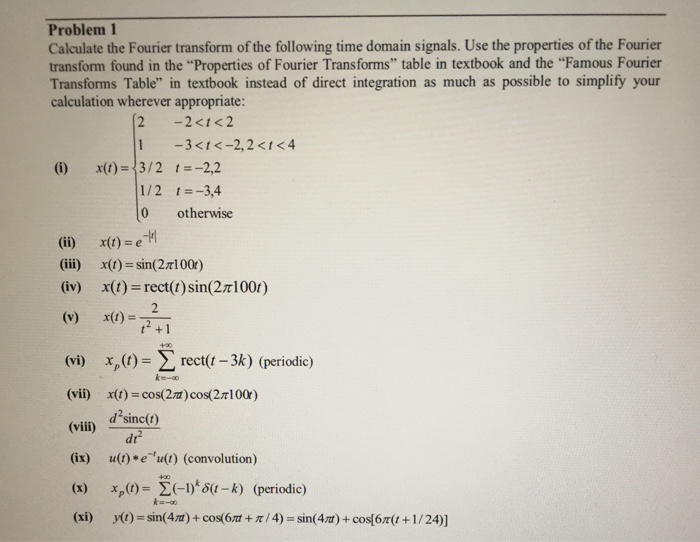 ER rb
transform of the following time domain signal. Use the properties of the Fos
in the “Properties of Fourier Transforms” table in textbook and the “F Four
able” in textbook instead of dircet. integration as much as possible to simplify your
n wherever appropriate:
~2
This is AI generated Response.
Asked by: gvr
Created at: 2025-07-09 07:55:07
Asked by: gvr
Created at: 2025-07-09 07:55:07
Final Answer:
Rendered
Raw Text
Did you like this answer?
Let's solve **Problem 1 (i)** step by step, using the Fourier Transform properties and tables as suggested.
### (i) \( x(t) \) is a piecewise function:
\[
x(t) =
\begin{cases}
2 & -2 < t < 2 \\
-3 & -4 < t < -2, \; 2 < t < 4 \\
3/2 & t = -2 \\
-2 & t = 2 \\
1/2 & t = -3, 4 \\
0 & \text{otherwise}
\end{cases}
\]
#### **Step 1: Write \( x(t) \) as a sum of rectangular pulses and impulses**
- Rectangular pulse from \(-2\) to \(2\), height = 2.
- Rectangular pulse from \(-4\) to \(-2\) and \(2\) to \(4\), height = -3.
- Impulses at \(t = -2\) (height \(3/2\)), \(t=2\) (height \(-2\)), \(t=-3\) (height \(1/2\)), \(t=4\) (height \(1/2\)).
So,
\[
x(t) = 2 \cdot \text{rect}\left(\frac{t}{4}\right) - 3 \left[ \text{rect}\left(\frac{t+3}{2}\right) + \text{rect}\left(\frac{t-3}{2}\right) \right] + \frac{3}{2}\delta(t+2) - 2\delta(t-2) + \frac{1}{2}\delta(t+3) + \frac{1}{2}\delta(t-4)
\]
#### **Step 2: Find Fourier Transform of each term**
Recall from the properties:
- \(\text{rect}\left(\frac{t}{T}\right) \longleftrightarrow T \cdot \text{sinc}(fT)\)
- \(\delta(t-t_0) \longleftrightarrow e^{-j2\pi f t_0}\)
##### **(a) \(2 \cdot \text{rect}\left(\frac{t}{4}\right)\):**
- Width = 4 (\(-2\) to 2), height = 2.
- Fourier Transform: \(2 \times 4 \cdot \text{sinc}(4f) = 8 \cdot \text{sinc}(4f)\)
##### **(b) \(-3 \cdot \text{rect}\left(\frac{t+3}{2}\right)\):**
- Width = 2 (\(-4\) to \(-2\)), shifted by \(-3\).
- Fourier Transform: \(-3 \cdot 2 \cdot \text{sinc}(2f) e^{j2\pi f 3} = -6 \cdot \text{sinc}(2f) e^{j6\pi f}\)
##### **(c) \(-3 \cdot \text{rect}\left(\frac{t-3}{2}\right)\):**
- Width = 2 (\(2\) to \(4\)), shifted by \(+3\).
- Fourier Transform: \(-6 \cdot \text{sinc}(2f) e^{-j6\pi f}\)
##### **(d) Impulse terms:**
- \(\frac{3}{2}\delta(t+2) \rightarrow \frac{3}{2} e^{j4\pi f}\)
- \(-2\delta(t-2) \rightarrow -2 e^{-j4\pi f}\)
- \(\frac{1}{2}\delta(t+3) \rightarrow \frac{1}{2} e^{j6\pi f}\)
- \(\frac{1}{2}\delta(t-4) \rightarrow \frac{1}{2} e^{-j8\pi f}\)
#### **Step 3: Add all terms**
\[
\boxed{
X(f) = 8\,\text{sinc}(4f)
- 6\,\text{sinc}(2f) \left[e^{j6\pi f} + e^{-j6\pi f}\right]
+ \frac{3}{2} e^{j4\pi f}
- 2 e^{-j4\pi f}
+ \frac{1}{2} e^{j6\pi f}
+ \frac{1}{2} e^{-j8\pi f}
}
\]
You can further simplify \(e^{j6\pi f} + e^{-j6\pi f} = 2\cos(6\pi f)\):
\[
\boxed{
X(f) = 8\,\text{sinc}(4f)
- 12\,\text{sinc}(2f) \cos(6\pi f)
+ \frac{3}{2} e^{j4\pi f}
- 2 e^{-j4\pi f}
+ \frac{1}{2} e^{j6\pi f}
+ \frac{1}{2} e^{-j8\pi f}
}
\]
---
**This is the step-by-step solution and the final boxed answer for part (i).**
If you'd like solutions for the other parts (ii)-(x), let me know which one you'd like to see next!
📢 Instructions:
- Ask anything relatd to above question only.
- For new Question goto :