 VIPSolutions
Give step-by-step solution with explanation and final answer:Question 5 10 Points If @ =x?yz3 and A=xz i —y2j + 2x? k Find the magnitude of the gradient at (1,1,2). Use 2 decimal places. Add your answer Integer, decimal, or E notation allowed Question 6 10 Points Find k so that the vectors [2,-3,5] and [3,k,-2] are orthogonal. Use 2 decimal places. Add your answer Integer, decimal, or E notation allowed
Question:
Give step-by-step solution with explanation and final answer: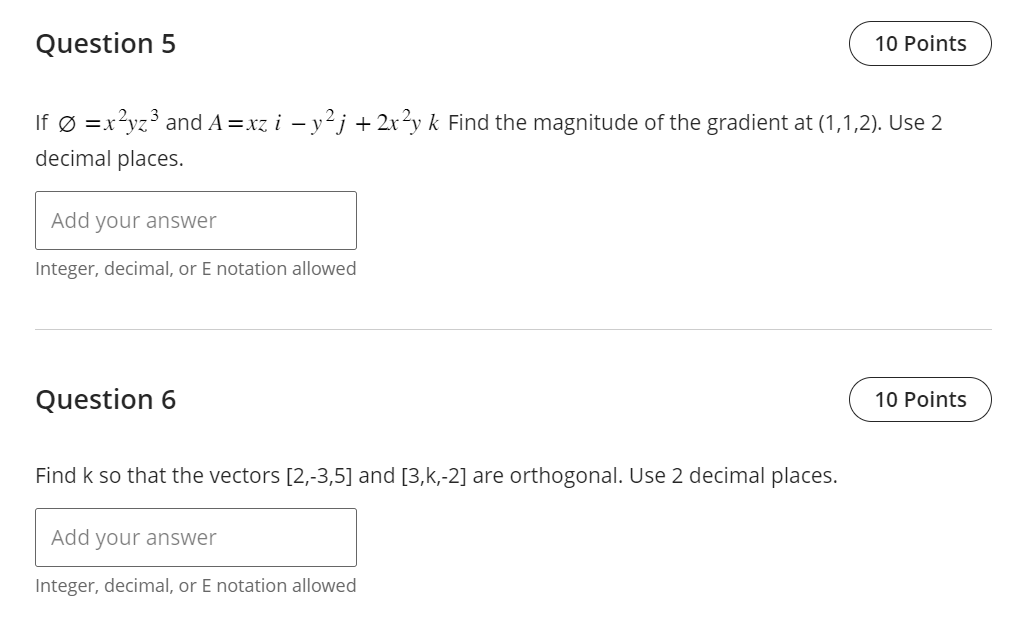 Question 5 10 Points
If @ =x?yz3 and A=xz i —y2j + 2x? k Find the magnitude of the gradient at (1,1,2). Use 2
decimal places.
Add your answer
Integer, decimal, or E notation allowed
Question 6 10 Points
Find k so that the vectors [2,-3,5] and [3,k,-2] are orthogonal. Use 2 decimal places.
Add your answer
Integer, decimal, or E notation allowed
This is AI generated Response.
Asked by: gvr
Created at: 2025-07-09 07:30:11
Asked by: gvr
Created at: 2025-07-09 07:30:11
Final Answer:
Rendered
Raw Text
Did you like this answer?
Let's solve each question step by step.
---
## **Question 5**
Given:
\(\varnothing = x^2 y z^3\)
Find the **magnitude of the gradient** at \((1,1,2)\).
### **Step 1: Find the Gradient**
The gradient of \(\varnothing(x, y, z)\) is
\[
\nabla \varnothing = \left( \frac{\partial \varnothing}{\partial x}, \frac{\partial \varnothing}{\partial y}, \frac{\partial \varnothing}{\partial z} \right)
\]
Calculate each partial derivative:
1. \(\frac{\partial \varnothing}{\partial x} = 2x y z^3\)
2. \(\frac{\partial \varnothing}{\partial y} = x^2 z^3\)
3. \(\frac{\partial \varnothing}{\partial z} = 3x^2 y z^2\)
### **Step 2: Evaluate at (1, 1, 2)**
Plug \(x = 1, y = 1, z = 2\):
1. \(\frac{\partial \varnothing}{\partial x} = 2(1)(1)(2^3) = 2 \times 1 \times 8 = 16\)
2. \(\frac{\partial \varnothing}{\partial y} = (1^2)(2^3) = 1 \times 8 = 8\)
3. \(\frac{\partial \varnothing}{\partial z} = 3(1^2)(1)(2^2) = 3 \times 1 \times 1 \times 4 = 12\)
So, the gradient vector at (1,1,2) is \(\langle 16,\, 8,\, 12 \rangle\)
### **Step 3: Magnitude of the Gradient**
\[
|\nabla \varnothing| = \sqrt{16^2 + 8^2 + 12^2} = \sqrt{256 + 64 + 144} = \sqrt{464}
\]
\[
\sqrt{464} \approx 21.54
\]
**Final Answer for Question 5:**
\[
\boxed{21.54}
\]
---
## **Question 6**
Given vectors: \(\mathbf{a} = [2, -3, 5]\), \(\mathbf{b} = [3, k, -2]\)
Vectors are **orthogonal** if their dot product is 0.
### **Step 1: Write Dot Product**
\[
\mathbf{a} \cdot \mathbf{b} = 2 \cdot 3 + (-3) \cdot k + 5 \cdot (-2) = 0
\]
\[
6 - 3k - 10 = 0
\]
\[
-3k - 4 = 0
\]
\[
-3k = 4
\]
\[
k = -\frac{4}{3} \approx -1.33
\]
**Final Answer for Question 6:**
\[
\boxed{-1.33}
\]
---
### **Summary**
- **Q5:** \(21.54\)
- **Q6:** \(-1.33\)
📢 Instructions:
- Ask anything relatd to above question only.
- For new Question goto :