 VIPSolutions
Give step-by-step solution with explanation and final answer:: Question 3 10 Points Use a double integral to find the volume of the solid bounded above by plane z=4- x-y and below rectangle R=[0,1]x[0,3]. Add your answer Integer, decimal, or E notation allowed Question 4 10 Points Evaluate the iterated integral. Use 2 decimal places. 1 po x2 / / e" dydx 0 Yo Add your answer Integer, decimal, or E notation allowed
Question:
Give step-by-step solution with explanation and final answer: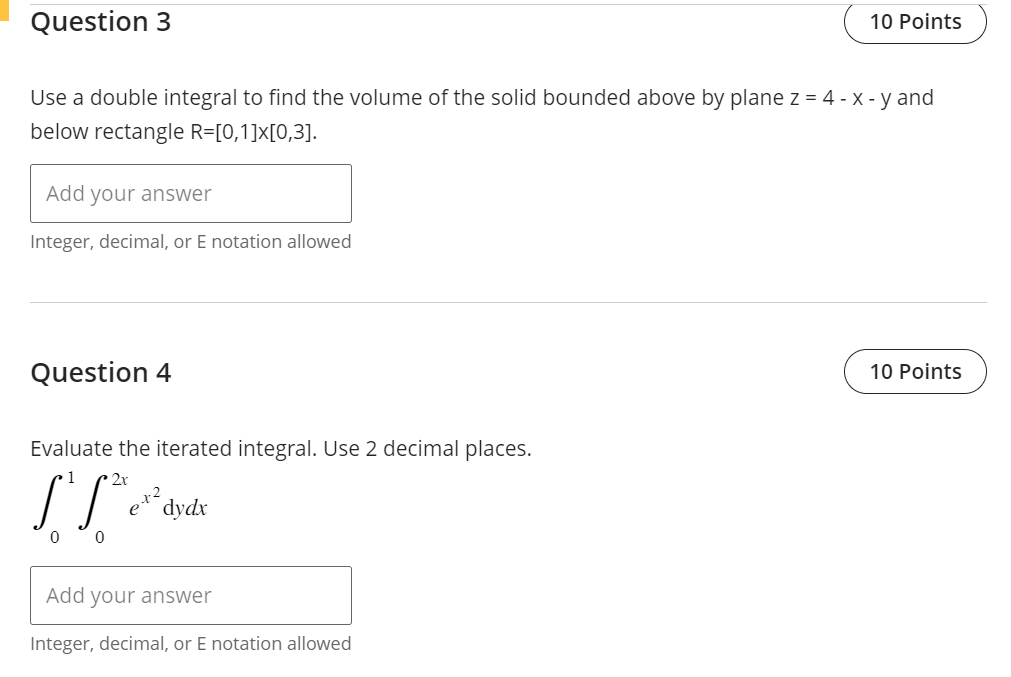 : Question 3 10 Points
Use a double integral to find the volume of the solid bounded above by plane z=4- x-y and
below rectangle R=[0,1]x[0,3].
Add your answer
Integer, decimal, or E notation allowed
Question 4 10 Points
Evaluate the iterated integral. Use 2 decimal places.
1 po
x2
/ / e" dydx
0 Yo
Add your answer
Integer, decimal, or E notation allowed
This is AI generated Response.
Asked by: gvr
Created at: 2025-07-09 07:23:44
Asked by: gvr
Created at: 2025-07-09 07:23:44
Final Answer:
Rendered
Raw Text
Did you like this answer?
Let's solve each question step by step.
---
## **Question 3**
**Use a double integral to find the volume of the solid bounded above by the plane \( z = 4 - x - y \) and below rectangle \( R = [0,1] \times [0,3] \).**
The volume \( V \) is given by the double integral:
\[
V = \iint_R (4 - x - y) \, dA
\]
where \( R = [0,1] \times [0,3] \).
Let's write this as iterated integral:
\[
V = \int_{x=0}^{1} \int_{y=0}^{3} (4 - x - y) \, dy \, dx
\]
First, integrate with respect to \( y \):
\[
\int_{y=0}^{3} (4 - x - y) \, dy = \left[ 4y - xy - \frac{y^2}{2} \right]_{y=0}^{y=3}
\]
Plug in \( y = 3 \) and \( y = 0 \):
\[
= 4(3) - x(3) - \frac{3^2}{2} - (0 - 0 - 0)
= 12 - 3x - \frac{9}{2}
= 12 - 3x - 4.5
= 7.5 - 3x
\]
Now integrate with respect to \( x \):
\[
\int_{x=0}^{1} (7.5 - 3x) \, dx = \left[ 7.5x - \frac{3x^2}{2} \right]_{x=0}^{x=1}
\]
Plug in \( x = 1 \) and \( x = 0 \):
\[
= 7.5(1) - \frac{3(1^2)}{2} - (0 - 0)
= 7.5 - 1.5
= 6
\]
**Final Answer for Question 3:**
\[
\boxed{6}
\]
---
## **Question 4**
**Evaluate the iterated integral:**
\[
\int_{0}^{1} \int_{0}^{2x} e^{x^2} \, dy \, dx
\]
First, integrate with respect to \( y \):
\( e^{x^2} \) is constant with respect to \( y \), so:
\[
\int_{0}^{2x} e^{x^2} \, dy = e^{x^2} \cdot y \Big|_{y=0}^{y=2x} = e^{x^2} \cdot (2x - 0) = 2x e^{x^2}
\]
Now, integrate with respect to \( x \):
\[
\int_{0}^{1} 2x e^{x^2} dx
\]
Let \( u = x^2 \) so \( du = 2x dx \).
When \( x = 0, u = 0 \).
When \( x = 1, u = 1 \).
So the integral becomes:
\[
\int_{u=0}^{u=1} e^u du = e^u \Big|_{u=0}^{u=1} = e^{1} - e^{0} = e - 1
\]
Approximate \( e \approx 2.71828 \):
\[
e - 1 \approx 2.72 - 1 = 1.72
\]
**Final Answer for Question 4:**
\[
\boxed{1.72}
\]
---
### **Summary**
- **Q3:** 6
- **Q4:** 1.72
Let me know if you need more explanation!
📢 Instructions:
- Ask anything relatd to above question only.
- For new Question goto :