 VIPSolutions
Give step-by-step solution with explanation and final answer:PSPICE 13 wurTsm a. Use the node-voltage method to find vy, v5, and v3 in the circuit in Fig. P4.130. b. How much power does the 40 V voltage source deliver to the circuit? Figure P4.13 30 20 im 40V ® 40Q vy © 28A _ vy 4 1Q 2Q
Question:
Give step-by-step solution with explanation and final answer: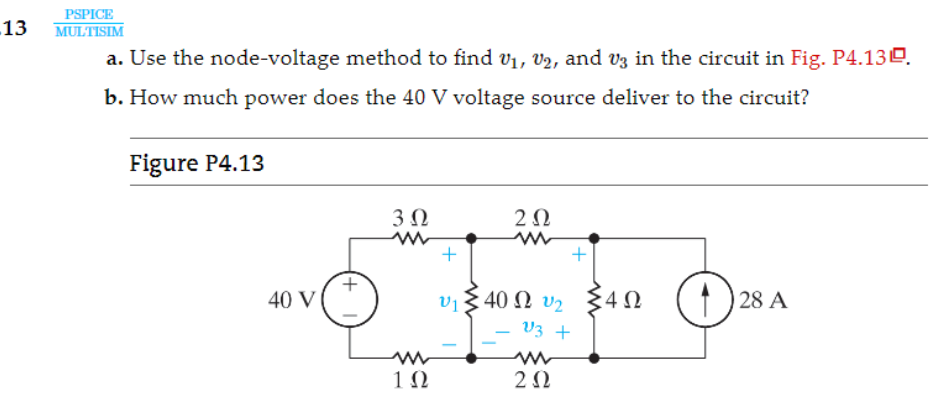 PSPICE
13 wurTsm
a. Use the node-voltage method to find vy, v5, and v3 in the circuit in Fig. P4.130.
b. How much power does the 40 V voltage source deliver to the circuit?
Figure P4.13
30 20
im
40V ® 40Q vy © 28A
_ vy 4
1Q 2Q
This is AI generated Response.
Asked by: gvr
Created at: 2025-07-07 11:05:25
Asked by: gvr
Created at: 2025-07-07 11:05:25
Final Answer:
Rendered
Raw Text
Did you like this answer?
Let's solve the problem step by step.
## a. **Node-Voltage Method**
Let’s label the node voltages as shown in the diagram:
- \( v_1 \): at the top left node (between 3 Ω, 1 Ω, and 40 Ω resistor)
- \( v_2 \): at the top middle node (between 2 Ω, 40 Ω, and 4 Ω resistor)
- \( v_3 \): at the bottom middle node (between 40 Ω, 2 Ω, and 1 Ω resistor)
Let the bottom node (connected to the negative terminal of the 40V source and the 28A source) be our reference (0 V).
### 1. **Node 1: \( v_1 \)**
At node 1, apply KCL (sum of outgoing currents = 0):
\[
\frac{v_1 - 40}{3} + \frac{v_1 - v_2}{40} + \frac{v_1 - v_3}{1} = 0
\]
### 2. **Node 2: \( v_2 \)**
At node 2, apply KCL:
\[
\frac{v_2 - v_1}{40} + \frac{v_2 - v_3}{2} + \frac{v_2}{4} = 0
\]
### 3. **Node 3: \( v_3 \)**
At node 3, apply KCL (don't forget the current source):
\[
\frac{v_3 - v_1}{1} + \frac{v_3 - v_2}{2} + \frac{v_3}{2} = -28
\]
(The current source is going **out** of the node, so it is negative.)
---
Now, let's simplify and solve the system.
---
#### **Equation 1:**
\[
\frac{v_1 - 40}{3} + \frac{v_1 - v_2}{40} + (v_1 - v_3) = 0
\]
Multiply both sides by 120 (LCM of denominators):
\[
40(v_1 - 40) + 3(v_1 - v_2) + 120(v_1 - v_3) = 0
\]
\[
40v_1 - 1600 + 3v_1 - 3v_2 + 120v_1 - 120v_3 = 0
\]
\[
(40 + 3 + 120)v_1 - 3v_2 - 120v_3 = 1600
\]
\[
163v_1 - 3v_2 - 120v_3 = 1600
\]
---
#### **Equation 2:**
\[
\frac{v_2 - v_1}{40} + \frac{v_2 - v_3}{2} + \frac{v_2}{4} = 0
\]
Multiply both sides by 40:
\[
(v_2 - v_1) + 20(v_2 - v_3) + 10v_2 = 0
\]
\[
v_2 - v_1 + 20v_2 - 20v_3 + 10v_2 = 0
\]
\[
(-v_1) + (v_2 + 20v_2 + 10v_2) - 20v_3 = 0
\]
\[
- v_1 + 31v_2 - 20v_3 = 0
\]
---
#### **Equation 3:**
\[
\frac{v_3 - v_1}{1} + \frac{v_3 - v_2}{2} + \frac{v_3}{2} = -28
\]
Multiply both sides by 2:
\[
2(v_3 - v_1) + (v_3 - v_2) + v_3 = -56
\]
\[
2v_3 - 2v_1 + v_3 - v_2 + v_3 = -56
\]
\[
(2v_3 + v_3 + v_3) - 2v_1 - v_2 = -56
\]
\[
4v_3 - 2v_1 - v_2 = -56
\]
---
Now, we have a system of three equations:
1. \(163v_1 - 3v_2 - 120v_3 = 1600\)
2. \(- v_1 + 31v_2 - 20v_3 = 0\)
3. \(-2v_1 - v_2 + 4v_3 = -56\)
---
## **Solving the System**
Let’s use equations 2 and 3 to express \(v_1\) and \(v_2\) in terms of \(v_3\):
From (2): \(-v_1 + 31v_2 - 20v_3 = 0\)
\[
v_1 = 31v_2 - 20v_3
\]
From (3): \(-2v_1 - v_2 + 4v_3 = -56\)
Plug in \(v_1\) from above:
\[
-2(31v_2 - 20v_3) - v_2 + 4v_3 = -56
\]
\[
-62v_2 + 40v_3 - v_2 + 4v_3 = -56
\]
\[
-63v_2 + 44v_3 = -56
\]
\[
63v_2 = 44v_3 + 56
\]
\[
v_2 = \frac{44v_3 + 56}{63}
\]
Now plug \(v_2\) into \(v_1\):
\[
v_1 = 31v_2 - 20v_3 = 31 \left(\frac{44v_3 + 56}{63}\right) - 20v_3
\]
\[
v_1 = \frac{31 \cdot 44v_3 + 31 \cdot 56}{63} - 20v_3
\]
\[
v_1 = \frac{1364v_3 + 1736}{63} - 20v_3
\]
\[
v_1 = \frac{1364v_3 + 1736 - 1260v_3}{63}
\]
\[
v_1 = \frac{104v_3 + 1736}{63}
\]
Now, substitute \(v_1\) and \(v_2\) in terms of \(v_3\) into equation 1:
\[
163v_1 - 3v_2 - 120v_3 = 1600
\]
\[
163 \left(\frac{104v_3 + 1736}{63}\right) - 3\left(\frac{44v_3 + 56}{63}\right) - 120v_3 = 1600
\]
\[
\frac{163 \times 104v_3 + 163 \times 1736 - 3 \times 44v_3 - 3 \times 56}{63} - 120v_3 = 1600
\]
\[
\frac{16952v_3 + 283768 - 132v_3 - 168}{63} - 120v_3 = 1600
\]
\[
\frac{16952v_3 - 132v_3 + 283768 - 168}{63} - 120v_3 = 1600
\]
\[
\frac{16820v_3 + 283600}{63} - 120v_3 = 1600
\]
Multiply both sides by 63:
\[
16820v_3 + 283600 - 120 \times 63 v_3 = 1600 \times 63
\]
\[
16820v_3 + 283600 - 7560v_3 = 100800
\]
\[
(16820 - 7560)v_3 + 283600 = 100800
\]
\[
9260v_3 = 100800 - 283600
\]
\[
9260v_3 = -182800
\]
\[
v_3 = -\frac{182800}{9260} = -19.74\, \text{V}
\]
---
Now, back to \(v_2\):
\[
v_2 = \frac{44v_3 + 56}{63} = \frac{44 \times -19.74 + 56}{63}
\]
\[
= \frac{-868.56 + 56}{63}
= \frac{-812.56}{63}
= -12.90\, \text{V}
\]
Now, \(v_1\):
\[
v_1 = \frac{104v_3 + 1736}{63} = \frac{104 \times -19.74 + 1736}{63}
\]
\[
= \frac{-2053.0 + 1736}{63}
= \frac{-317.0}{63}
= -5.03\, \text{V}
\]
---
## **Final Answers:**
\[
\boxed{
v_1 = -5.03\, \text{V}, \quad v_2 = -12.90\, \text{V}, \quad v_3 = -19.74\, \text{V}
}
\]
---
## b. **Power delivered by the 40V source**
The current delivered by the 40V source is the current through the 3Ω resistor (from 40V to \(v_1\)):
\[
I = \frac{40 - v_1}{3}
= \frac{40 - (-5.03)}{3}
= \frac{45.03}{3}
= 15.01\, \text{A}
\]
Power delivered:
\[
P = VI = 40 \times 15.01 = 600.4\, \text{W}
\]
---
### **Boxed Answers**
\[
\boxed{
\text{a) } v_1 = -5.03\, \text{V},\ v_2 = -12.90\, \text{V},\ v_3 = -19.74\, \text{V}
}
\]
\[
\boxed{
\text{b) Power delivered by 40V source:}\ 600.4\, \text{W}
}
\]
📢 Instructions:
- Ask anything relatd to above question only.
- For new Question goto :