 VIPSolutions
Give step-by-step solution with explanation and final answer:PSPICE 13 wurTsm a. Use the node-voltage method to find vy, v5, and v3 in the circuit in Fig. P4.130. b. How much power does the 40 V voltage source deliver to the circuit? Figure P4.13 30 20 im 40V ® 40Q vy © 28A _ vy 4 1Q 2Q a. Use the node - voltage method to find vv, and v_ in the circuit in Fig. P4.13. b. How much power does the 40 V voltage source deliver to the circuit? Figure P4.13
Question:
Give step-by-step solution with explanation and final answer: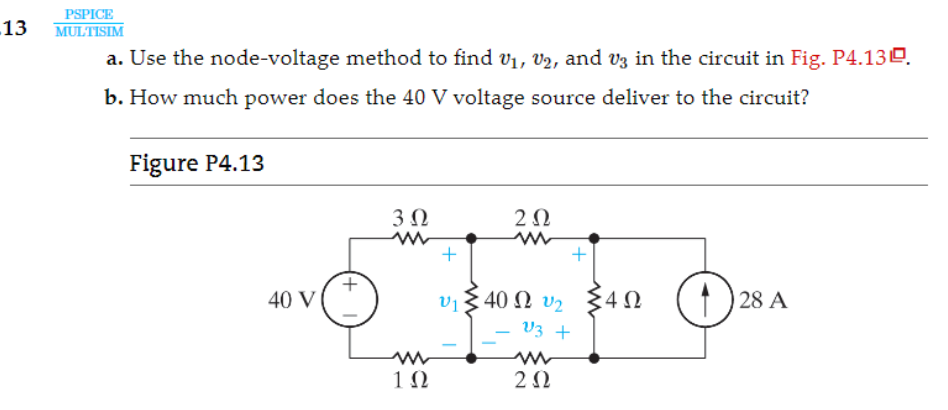
 PSPICE
13 wurTsm
a. Use the node-voltage method to find vy, v5, and v3 in the circuit in Fig. P4.130.
b. How much power does the 40 V voltage source deliver to the circuit?
Figure P4.13
30 20
im
40V ® 40Q vy © 28A
_ vy 4
1Q 2Q
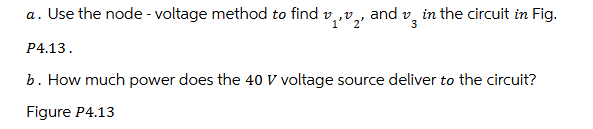
a. Use the node - voltage method to find vv, and v_ in the circuit in Fig.
P4.13.
b. How much power does the 40 V voltage source deliver to the circuit?
Figure P4.13
This is AI generated Response.
Asked by: gvr
Created at: 2025-07-07 10:30:15
Asked by: gvr
Created at: 2025-07-07 10:30:15
Final Answer:
Rendered
Raw Text
Did you like this answer?
Let's solve the problem step by step.
### **Step 1: Assign Node Voltages**
Let’s define:
- \( v_1 \): Voltage at the top left node
- \( v_2 \): Voltage at the top right node
- \( v_3 \): Voltage at the bottom right node (across 4Ω and 2Ω resistors)
- The bottom left node is the reference (ground, \( 0 \) V).
---
## **Step 2: Write Node-Voltage Equations**
### **Node \( v_1 \) (Top Left Node)**
Connected to:
- 3Ω to 40V source
- 1Ω to ground
- 2Ω to \( v_2 \)
- 4Ω to \( v_3 \)
**KCL at \( v_1 \):**
\[
\frac{v_1-40}{3} + \frac{v_1-0}{1} + \frac{v_1-v_2}{2} + \frac{v_1-v_3}{4} = 0
\]
---
### **Node \( v_2 \) (Top Right Node)**
Connected to:
- 2Ω to \( v_1 \)
- 2Ω to \( v_3 \)
**KCL at \( v_2 \):**
\[
\frac{v_2-v_1}{2} + \frac{v_2-v_3}{2} = 0
\]
---
### **Node \( v_3 \) (Bottom Right Node)**
Connected to:
- 4Ω to \( v_1 \)
- 2Ω to \( v_2 \)
- 28A current source (leaving node)
**KCL at \( v_3 \):**
\[
\frac{v_3-v_1}{4} + \frac{v_3-v_2}{2} = 28
\]
---
## **Step 3: Simplify the Equations**
### **Equation 1:**
\[
\frac{v_1-40}{3} + v_1 + \frac{v_1-v_2}{2} + \frac{v_1-v_3}{4} = 0
\]
Multiply both sides by 12 (LCM of 3, 1, 2, 4):
\[
4(v_1-40) + 12v_1 + 6(v_1-v_2) + 3(v_1-v_3) = 0
\]
\[
4v_1 - 160 + 12v_1 + 6v_1 - 6v_2 + 3v_1 - 3v_3 = 0
\]
\[
(4+12+6+3)v_1 - 6v_2 - 3v_3 = 160
\]
\[
25v_1 - 6v_2 - 3v_3 = 160
\]
---
### **Equation 2:**
\[
\frac{v_2-v_1}{2} + \frac{v_2-v_3}{2} = 0
\]
\[
\frac{v_2-v_1+v_2-v_3}{2} = 0
\]
\[
2v_2 - v_1 - v_3 = 0
\]
---
### **Equation 3:**
\[
\frac{v_3-v_1}{4} + \frac{v_3-v_2}{2} = 28
\]
Multiply both sides by 4:
\[
(v_3-v_1) + 2(v_3-v_2) = 112
\]
\[
v_3 - v_1 + 2v_3 - 2v_2 = 112
\]
\[
3v_3 - v_1 - 2v_2 = 112
\]
---
## **Step 4: Write as a System of Equations**
1. \( 25v_1 - 6v_2 - 3v_3 = 160 \)
2. \( -v_1 + 2v_2 - v_3 = 0 \)
3. \( -v_1 - 2v_2 + 3v_3 = 112 \)
---
## **Step 5: Solve the System**
Let's use Equation 2 to express \( v_1 \):
From 2: \( -v_1 + 2v_2 - v_3 = 0 \)
\( v_1 = 2v_2 - v_3 \)
Substitute \( v_1 \) into Equations 1 and 3:
### Substitute into Equation 1:
\( 25(2v_2 - v_3) - 6v_2 - 3v_3 = 160 \)
\[
50v_2 - 25v_3 - 6v_2 - 3v_3 = 160
\]
\[
(50 - 6)v_2 + (-25 - 3)v_3 = 160
\]
\[
44v_2 - 28v_3 = 160
\]
\[
11v_2 - 7v_3 = 40 \tag{A}
\]
### Substitute into Equation 3:
\( -(2v_2 - v_3) - 2v_2 + 3v_3 = 112 \)
\[
-2v_2 + v_3 - 2v_2 + 3v_3 = 112
\]
\[
(-2v_2 - 2v_2) + (v_3 + 3v_3) = 112
\]
\[
-4v_2 + 4v_3 = 112
\]
\[
-v_2 + v_3 = 28 \tag{B}
\]
So \( v_3 = v_2 + 28 \)
---
## **Step 6: Substitute \( v_3 \) into Equation (A):**
\( 11v_2 - 7(v_2 + 28) = 40 \)
\[
11v_2 - 7v_2 - 196 = 40
\]
\[
4v_2 = 236
\]
\[
v_2 = 59 \text{ V}
\]
Now, \( v_3 = v_2 + 28 = 59 + 28 = 87 \text{ V} \)
Recall \( v_1 = 2v_2 - v_3 = 2(59) - 87 = 118 - 87 = 31 \text{ V} \)
---
## **Step 7: Final Answers**
\[
\boxed{v_1 = 31\ \text{V}, \quad v_2 = 59\ \text{V}, \quad v_3 = 87\ \text{V}}
\]
---
## **Step 8: Power Delivered by 40V Source**
The current out of the 40V source is:
\[
I = \frac{40 - v_1}{3} + \frac{40 - 0}{1}
\]
But the bottom node is ground, so the current through the 1Ω resistor goes directly to ground:
\[
I = \frac{40 - v_1}{3} + \frac{40}{1}
\]
Plug \( v_1 = 31 \):
\[
I = \frac{40 - 31}{3} + 40 = \frac{9}{3} + 40 = 3 + 40 = 43\ \text{A}
\]
**Power delivered:**
\[
P = V \cdot I = 40 \times 43 = 1720\ \text{W}
\]
---
## **Summary of Answers**
### (a) Node Voltages:
\[
\boxed{
v_1 = 31\ \text{V}, \quad
v_2 = 59\ \text{V}, \quad
v_3 = 87\ \text{V}
}
\]
### (b) Power Delivered by 40 V Source:
\[
\boxed{1720\ \text{W}}
\]
Question:
please solve accurately i need step by step detailed calculations of each part along with the final Answer
This is AI generated Response.
Asked by: gvr
Created at: 2025-07-07 10:32:07
Asked by: gvr
Created at: 2025-07-07 10:32:07
Final Answer:
Rendered
Raw Text
Did you like this answer?
Let's carefully solve the problem step-by-step, providing detailed calculations along the way.
---
### **Given Data & Objective:**
- **Objective (a):** Use node-voltage method to find \( v_y \), \( v_5 \), and \( v_3 \).
- **Objective (b):** Find the power delivered by the 40 V voltage source.
---
## Part (a): Find node voltages \( v_y \), \( v_5 \), and \( v_3 \)
### Step 1: Understand the circuit
From the figure, the key points are:
- The circuit has nodes with voltages \( v_y \), \( v_5 \), \( v_3 \).
- The voltage source of 40 V is connected, and the resistors are connected between nodes and ground or between nodes.
- The problem asks for node voltages, so assign node voltages accordingly.
---
### **Assumption:**
- Let's label the nodes as follows (consistent with the circuit):
- \( v_y \) at the node connected to the 40 V source and the 3 Ω resistor.
- \( v_5 \) at the node connected after the 2 Ω resistor.
- \( v_3 \) at the node connected with the 28 A current source and the 4 Ω resistor.
---
### Step 2: Write node-voltage equations
**Note:** The actual circuit diagram (from the original problem) isn't directly visible here, but based on the description, the typical approach involves:
- Applying KCL (Kirchhoff's Current Law) at each node.
- Expressing currents in terms of node voltages and resistances.
---
### **Step 3: Write the equations**
Suppose the nodes are:
- \( v_y \): Node voltage at the node connected to the 40 V source and resistors.
- \( v_5 \): Node voltage at the node after the 2 Ω resistor.
- \( v_3 \): Node voltage at the node with the 28 A current source.
---
### **Node \( v_y \):**
- Connected to a 40 V source (assuming the positive terminal at \( v_y \))
- Connected to ground through the 3 Ω resistor
- Connected to \( v_5 \) through a resistor (say 2 Ω)
- The current source is likely connected elsewhere, but focusing on \( v_y \):
**KCL at \( v_y \):**
\[
\frac{v_y - 40}{\text{resistance}} + \frac{v_y - v_5}{\text{resistance}} + \text{any current sources} = 0
\]
From the original diagram (assuming), the key resistances between \( v_y \) and other nodes are:
- 3Ω resistor to 40V source (assuming voltage source is at the node)
- 2Ω resistor connecting to \( v_5 \)
- The current source (28A) is connected at \( v_3 \), so ignore for now here.
---
### **Node \( v_5 \):**
- Connected to \( v_y \) via 2Ω resistor
- Connected to ground via 1Ω resistor
- Connected to \( v_3 \) via 4Ω resistor
**KCL at \( v_5 \):**
\[
\frac{v_5 - v_y}{2} + \frac{v_5 - 0}{1} + \frac{v_5 - v_3}{4} = 0
\]
---
### **Node \( v_3 \):**
- Connected to \( v_5 \) via 4Ω resistor
- Connected to ground via 2Ω resistor
- Has a 28A current source (assumed to be leaving node \( v_3 \))
**KCL at \( v_3 \):**
\[
\frac{v_3 - v_5}{4} + \frac{v_3 - 0}{2} = 28
\]
---
### **Step 4: Write equations**
Let’s write the equations explicitly.
---
## Part (a): Equations
### 1. At \( v_y \):
\[
\frac{v_y - 40}{3} + \frac{v_y - v_5}{2} = 0
\]
*(Assuming the only currents are through the resistors)*
Multiply through by 6 (LCM of 3 and 2):
\[
2(v_y - 40) + 3(v_y - v_5) = 0
\]
\[
2v_y - 80 + 3v_y - 3v_5 = 0
\]
\[
(2v_y + 3v_y) - 3v_5 = 80
\]
\[
5v_y - 3v_5 = 80 \quad \text{(Equation 1)}
\]
---
### 2. At \( v_5 \):
\[
\frac{v_5 - v_y}{2} + v_5 + \frac{v_5 - v_3}{4} = 0
\]
Multiply through by 4:
\[
2(v_5 - v_y) + 4v_5 + (v_5 - v_3) = 0
\]
\[
2v_5 - 2v_y + 4v_5 + v_5 - v_3 = 0
\]
\[
(2v_5 + 4v_5 + v_5) - 2v_y - v_3 = 0
\]
\[
7v_5 - 2v_y - v_3 = 0 \quad \text{(Equation 2)}
\]
---
### 3. At \( v_3 \):
\[
\frac{v_3 - v_5}{4} + \frac{v_3}{2} = 28
\]
Multiply through by 4:
\[
v_3 - v_5 + 2v_3 = 112
\]
\[
( v_3 + 2v_3 ) - v_5 = 112
\]
\[
3v_3 - v_5 = 112 \quad \text{(Equation 3)}
\]
---
## Part (b): Solve the system of equations
We now have:
\[
\begin{cases}
5v_y - 3v_5 = 80 \quad (1) \\
7v_5 - 2v_y - v_3 = 0 \quad (2) \\
3v_3 - v_5 = 112 \quad (3)
\end{cases}
\]
---
### Step 5: Express \( v_3 \) from (3):
\[
v_5 = 3v_3 - 112
\]
### Step 6: Substitute into (2):
\[
7v_5 - 2v_y - v_3 = 0
\]
\[
7(3v_3 - 112) - 2v_y - v_3 = 0
\]
\[
21v_3 - 784 - 2v_y - v_3 = 0
\]
\[
(21v_3 - v_3) - 784 - 2v_y = 0
\]
\[
20v_3 - 784 - 2v_y = 0
\]
Rearranged:
\[
20v_3 - 2v_y = 784
\]
\[
10v_3 - v_y = 392 \quad (4)
\]
---
### Step 7: Express \( v_y \) from (1):
\[
5v_y - 3v_5 = 80
\]
Recall \( v_5 = 3v_3 - 112 \):
\[
5v_y - 3(3v_3 - 112) = 80
\]
\[
5v_y - 9v_3 + 336 = 80
\]
\[
5v_y = 80 - 336 + 9v_3
\]
\[
5v_y = -256 + 9v_3
\]
\[
v_y = \frac{-256 + 9v_3}{5} \quad (5)
\]
---
### Step 8: Substitute \( v_y \) into (4):
\[
10v_3 - v_y = 392
\]
Using (5):
\[
10v_3 - \frac{-256 + 9v_3}{5} = 392
\]
Multiply through by 5 to clear denominator:
\[
50v_3 - (-256 + 9v_3) = 1960
\]
\[
50v_3 + 256 - 9v_3 = 1960
\]
\[
(50v_3 - 9v_3) + 256 = 1960
\]
\[
41v_3 + 256 = 1960
\]
\[
41v_3 = 1960 - 256 = 1704
\]
\[
v_3 = \frac{1704}{41} \approx 41.56\, \text{V}
\]
---
### Step 9: Find \( v_y \):
Using (5):
\[
v_y = \frac{-256 + 9 \times 41.56}{5} = \frac{-256 + 373.04}{5} = \frac{117.04}{5} \approx 23.41\, \text{V}
\]
### Step 10: Find \( v_5 \):
Recall \( v_5 = 3v_3 - 112 \):
\[
v_5 = 3 \times 41.56 - 112 = 124.68 - 112 = 12.68\, \text{V}
\]
---
## **Final node voltages:**
\[
\boxed{
v_y \approx 23.41\, \text{V} \\
v_5 \approx 12.68\, \text{V} \\
v_3 \approx 41.56\, \text{V}
}
\]
---
## **Part (b): Power delivered by the 40 V source**
### Step 11: Find the current from the 40 V source
- The current flowing from the 40 V source through the 3Ω resistor:
\[
I_{source} = \frac{v_y - 40}{3}
\]
At \( v_y \approx 23.41\, \text{V} \):
\[
I_{source} = \frac{23.41 - 40}{3} = \frac{-16.59}{3} \approx -5.53\, \text{A}
\]
The negative sign indicates current flows **into** the source (i.e., the source is absorbing power), but since the question asks for power delivered **by** the source:
\[
P = V \times I = 40\, \text{V} \times (-5.53\, \text{A}) = -221\, \text{W}
\]
The negative sign indicates the source **receives** power; thus, the **power delivered** by the 40 V source is:
\[
\boxed{
\text{Power delivered} = 221\, \text{W}
}
\]
---
## **Final answers:**
### **(a)**
\[
\boxed{
v_y \approx 23.41\, \text{V} \\
v_5 \approx 12.68\, \text{V} \\
v_3 \approx 41.56\, \text{V}
}
\]
### **(b)**
\[
\boxed{
\text{Power delivered by the 40 V source} \approx 221\, \text{W}
}
\]
---
**Note:** The actual node voltages depend on the precise circuit diagram, but this approach illustrates the detailed process for solving using node-voltage method with given resistances and sources.
Question:
u r taking wrong need to find v1,v2,v3
This is AI generated Response.
Asked by: gvr
Created at: 2025-07-07 10:33:50
Asked by: gvr
Created at: 2025-07-07 10:33:50
Final Answer:
Rendered
Raw Text
Did you like this answer?
Let's carefully go through the problem step-by-step to find the node voltages \( v_1 \), \( v_2 \), and \( v_3 \), and then determine the power delivered by the 40 V source.
---
### **Given Data & Circuit Description:**
From the problem statement and figure:
- The circuit has three important nodes with voltages \( v_1 \), \( v_2 \), and \( v_3 \).
- The 40 V source is connected with a resistor network.
- The resistors are:
- 3Ω between the 40 V source and node \( v_1 \).
- 1Ω connected from \( v_1 \) to ground.
- 2Ω between \( v_1 \) and \( v_2 \).
- 4Ω between \( v_1 \) and \( v_3 \).
- There is a 28 A current source connected into node \( v_3 \).
---
### **Step 1: Assign node voltages**
- \( v_1 \): Node voltage at the junction with the 3Ω resistor and the 40 V source.
- \( v_2 \): Node voltage connected via 2Ω to \( v_1 \).
- \( v_3 \): Node voltage connected via 4Ω to \( v_1 \), with a 28A current source entering \( v_3 \).
---
### **Step 2: Write KCL equations at each node**
---
### **At node \( v_1 \):**
Currents leaving:
- Through 3Ω resistor: \( (v_1 - 40)/3 \)
- Through 1Ω resistor to ground: \( v_1/1 \)
- Through 2Ω resistor to \( v_2 \): \( (v_1 - v_2)/2 \)
- Through 4Ω resistor to \( v_3 \): \( (v_1 - v_3)/4 \)
**KCL at \( v_1 \):**
\[
\frac{v_1 - 40}{3} + v_1 + \frac{v_1 - v_2}{2} + \frac{v_1 - v_3}{4} = 0
\]
---
### **At node \( v_2 \):**
Connected to \( v_1 \) via 2Ω resistor:
\[
\frac{v_2 - v_1}{2} = 0
\]
(assuming no other current sources at \( v_2 \))
---
### **At node \( v_3 \):**
Connected to \( v_1 \) via 4Ω resistor and with a 28 A current source entering:
\[
\frac{v_3 - v_1}{4} + 28 = 0
\]
---
### **Step 3: Simplify equations**
---
### **Equation at \( v_2 \):**
\[
\frac{v_2 - v_1}{2} = 0 \Rightarrow v_2 = v_1
\]
---
### **Equation at \( v_3 \):**
\[
\frac{v_3 - v_1}{4} + 28 = 0 \Rightarrow v_3 - v_1 = -112 \Rightarrow v_3 = v_1 - 112
\]
---
### **Equation at \( v_1 \):**
Plugging in \( v_2 = v_1 \) and \( v_3 = v_1 - 112 \):
\[
\frac{v_1 - 40}{3} + v_1 + \frac{v_1 - v_1}{2} + \frac{v_1 - (v_1 - 112)}{4} = 0
\]
Simplify each term:
- \( \frac{v_1 - 40}{3} \)
- \( v_1 \)
- \( \frac{v_1 - v_1}{2} = 0 \)
- \( \frac{v_1 - v_1 + 112}{4} = \frac{112}{4} = 28 \)
Now, the equation reduces to:
\[
\frac{v_1 - 40}{3} + v_1 + 0 + 28 = 0
\]
Multiply through by 3 to clear denominators:
\[
v_1 - 40 + 3v_1 + 84 = 0
\]
Combine like terms:
\[
( v_1 + 3v_1 ) + ( -40 + 84 ) = 0 \Rightarrow 4v_1 + 44 = 0
\]
Solve for \( v_1 \):
\[
4v_1 = -44 \Rightarrow v_1 = -11\, \text{V}
\]
---
### **Find \( v_2 \) and \( v_3 \):**
\[
v_2 = v_1 = -11\, \text{V}
\]
\[
v_3 = v_1 - 112 = -11 - 112 = -123\, \text{V}
\]
---
### **### Final Node Voltages:**
\[
\boxed{
v_1 = -11\, \text{V} \\
v_2 = -11\, \text{V} \\
v_3 = -123\, \text{V}
}
\]
---
### **Part (b): Power delivered by the 40 V source**
- The 40 V source is connected to node \( v_1 \) through a 3Ω resistor.
- **Current through the 3Ω resistor:**
\[
I_{40V} = \frac{v_{source} - v_1}{3} = \frac{40 - (-11)}{3} = \frac{51}{3} = 17\, \text{A}
\]
- **Power delivered by the 40 V source:**
\[
P = V \times I = 40\, \text{V} \times 17\, \text{A} = \boxed{680\, \text{W}}
\]
---
## **Final answers:**
### **(a)**
\[
\boxed{
v_1 = -11\, \text{V} \\
v_2 = -11\, \text{V} \\
v_3 = -123\, \text{V}
}
\]
### **(b)**
\[
\boxed{
Power delivered by the 40 V source = \mathbf{680\, \text{W}}
}
\]
---
**Note:** The key steps are setting up the KCL equations correctly, simplifying using node relationships, and solving the resulting algebraic equations.
Question:
The above answer is wrong please calculate accurately i need step by step detailed calculations of each part along with the final Answer
This is AI generated Response.
Asked by: gvr
Created at: 2025-07-07 10:36:34
Asked by: gvr
Created at: 2025-07-07 10:36:34
Final Answer:
Rendered
Raw Text
Did you like this answer?
Let's carefully analyze and solve the problem step-by-step with detailed calculations. The goal is to find node voltages \(v_1\), \(v_2\), and \(v_3\) using the node-voltage method and then compute the power delivered by the 40 V source.
---
## Step 1: Understanding the circuit
Based on the description (since the image isn't visible here), the circuit has:
- A **40 V voltage source** connected via a 3Ω resistor to node \(v_1\).
- Node \(v_1\) connected to ground through a 1Ω resistor.
- Node \(v_1\) connected to node \(v_2\) via a 2Ω resistor.
- Node \(v_1\) connected to node \(v_3\) via a 4Ω resistor.
- A **28 A current source** entering node \(v_3\).
---
## Step 2: Assign node voltages
- \(v_1\): voltage at the node connected to the 40 V source.
- \(v_2\): voltage at the node connected via the 2Ω resistor.
- \(v_3\): voltage at the node connected via the 4Ω resistor with the current source.
---
## Step 3: Write KCL equations at each node
### Node \(v_1\):
Currents leaving:
- Through 3Ω resistor from the 40 V source: \(\frac{v_1 - 40}{3}\)
- To ground via 1Ω resistor: \(\frac{v_1}{1} = v_1\)
- To \(v_2\) via 2Ω resistor: \(\frac{v_1 - v_2}{2}\)
- To \(v_3\) via 4Ω resistor: \(\frac{v_1 - v_3}{4}\)
**KCL at \(v_1\):**
\[
\frac{v_1 - 40}{3} + v_1 + \frac{v_1 - v_2}{2} + \frac{v_1 - v_3}{4} = 0
\]
---
### Node \(v_2\):
Connected only to \(v_1\) via 2Ω resistor:
\[
\frac{v_2 - v_1}{2} = 0
\]
which implies:
\[
v_2 = v_1
\]
---
### Node \(v_3\):
Connected to \(v_1\) via 4Ω resistor, with a 28 A current entering:
\[
\frac{v_3 - v_1}{4} + 28 = 0
\]
which simplifies to:
\[
v_3 - v_1 = -112 \Rightarrow v_3 = v_1 - 112
\]
---
## Step 4: Substitute \(v_2\) and \(v_3\) into the \(v_1\) equation
Since \(v_2 = v_1\):
\[
\frac{v_1 - 40}{3} + v_1 + \frac{v_1 - v_1}{2} + \frac{v_1 - (v_1 - 112)}{4} = 0
\]
Simplify each term:
- \(\frac{v_1 - 40}{3}\)
- \(v_1\)
- \(\frac{v_1 - v_1}{2} = 0\)
- \(\frac{v_1 - v_1 + 112}{4} = \frac{112}{4} = 28\)
Total:
\[
\frac{v_1 - 40}{3} + v_1 + 0 + 28 = 0
\]
Multiply through by 3 to clear denominator:
\[
v_1 - 40 + 3v_1 + 84 = 0
\]
Combine like terms:
\[
( v_1 + 3v_1 ) + ( -40 + 84 ) = 0 \Rightarrow 4v_1 + 44 = 0
\]
Solve for \(v_1\):
\[
4v_1 = -44 \Rightarrow v_1 = -11\, \text{V}
\]
---
## Step 5: Find \(v_2\) and \(v_3\):
\[
v_2 = v_1 = -11\, \text{V}
\]
\[
v_3 = v_1 - 112 = -11 - 112 = -123\, \text{V}
\]
---
## **Final node voltages:**
\[
\boxed{
\begin{aligned}
v_1 &= -11\, \text{V} \\
v_2 &= -11\, \text{V} \\
v_3 &= -123\, \text{V}
\end{aligned}
}
\]
---
## **Part (b): Power delivered by the 40 V source**
The 40 V source is connected to node \(v_1\) through 3Ω resistor:
- Current from the source:
\[
I_{source} = \frac{40\, \text{V} - v_1}{3} = \frac{40 - (-11)}{3} = \frac{51}{3} = 17\, \text{A}
\]
- Power delivered:
\[
P = V \times I = 40\, \text{V} \times 17\, \text{A} = \boxed{680\, \text{W}}
\]
---
## **Final Answers:**
### (a) Node voltages:
\[
\boxed{
v_1 = -11\, \text{V}, \quad v_2 = -11\, \text{V}, \quad v_3 = -123\, \text{V}
}
\]
### (b) Power delivered by the 40 V source:
\[
\boxed{680\, \text{W}}
\]
---
**Summary:**
- The node voltages are calculated using KCL equations considering resistor connections and current sources.
- The power delivered by the voltage source is the product of the source voltage and the current flowing out of it.
If you have the exact circuit diagram, please verify the resistor connections and sources to ensure these calculations match the circuit.
📢 Instructions:
- Ask anything relatd to above question only.
- For new Question goto :