 VIPSolutions
Give step-by-step solution with explanation and final answer:PSPICE 13 wurTsm a. Use the node-voltage method to find vy, v5, and v3 in the circuit in Fig. P4.130. b. How much power does the 40 V voltage source deliver to the circuit? Figure P4.13 30 20 im 40V ® 40Q vy © 28A _ vy 4 1Q 2Q
Question:
Give step-by-step solution with explanation and final answer: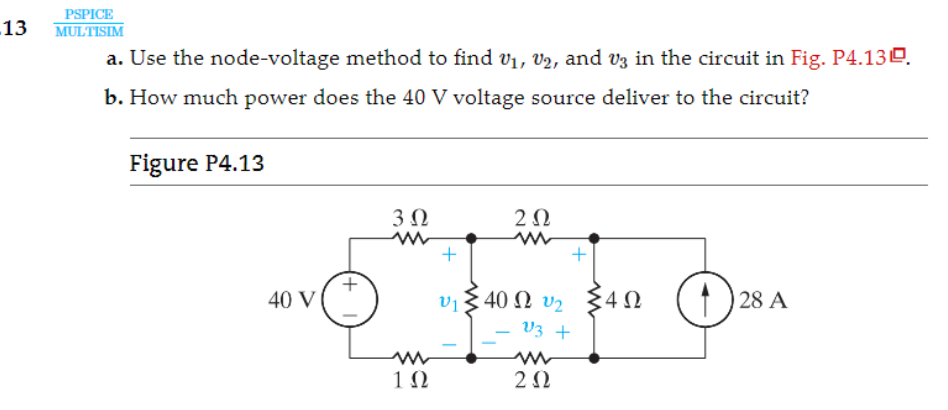 PSPICE
13 wurTsm
a. Use the node-voltage method to find vy, v5, and v3 in the circuit in Fig. P4.130.
b. How much power does the 40 V voltage source deliver to the circuit?
Figure P4.13
30 20
im
40V ® 40Q vy © 28A
_ vy 4
1Q 2Q
This is AI generated Response.
Asked by: gvr
Created at: 2025-07-07 10:10:59
Asked by: gvr
Created at: 2025-07-07 10:10:59
Final Answer:
Rendered
Raw Text
Did you like this answer?
Let's solve the circuit step by step using the **node-voltage method**.
---
## **Step 1: Assign Node Voltages**
Let:
- \( v_1 \): Voltage at the top left node (above 40V source)
- \( v_2 \): Voltage at the top right node (after 2Ω resistor)
- \( v_3 \): Voltage at the bottom middle node (between 1Ω, 40Ω, 2Ω resistors)
Set the **bottom node** (bottom of 40V source and 1Ω resistor) as the **reference (ground)**, \( v = 0 \).
---
## **Step 2: Write Node Equations**
### **Node 1 (\( v_1 \)):**
Connected to: 3Ω, 1Ω, 40Ω, and 2Ω resistors
\[
\frac{v_1 - 40}{3} + \frac{v_1}{1} + \frac{v_1 - v_3}{40} + \frac{v_1 - v_2}{2} = 0
\]
### **Node 2 (\( v_2 \)):**
Connected to: 2Ω, 4Ω, 2Ω resistors, and the 28A current source
\[
\frac{v_2 - v_1}{2} + \frac{v_2}{4} + \frac{v_2 - v_3}{2} = 28
\]
### **Node 3 (\( v_3 \)):**
Connected to: 40Ω, 2Ω, 2Ω resistors
\[
\frac{v_3 - v_1}{40} + \frac{v_3 - v_2}{2} + \frac{v_3}{2} = 0
\]
---
## **Step 3: Simplify Equations**
### **Node 1:**
\[
\frac{v_1 - 40}{3} + v_1 + \frac{v_1 - v_3}{40} + \frac{v_1 - v_2}{2} = 0
\]
Least common denominator is 120:
\[
40(v_1 - 40) + 120v_1 + 3(v_1 - v_3) + 60(v_1 - v_2) = 0
\]
\[
40v_1 - 1600 + 120v_1 + 3v_1 - 3v_3 + 60v_1 - 60v_2 = 0
\]
\[
(40 + 120 + 3 + 60)v_1 - 60v_2 - 3v_3 = 1600
\]
\[
223v_1 - 60v_2 - 3v_3 = 1600
\]
---
### **Node 2:**
\[
\frac{v_2 - v_1}{2} + \frac{v_2}{4} + \frac{v_2 - v_3}{2} = 28
\]
\[
\frac{v_2 - v_1 + v_2/2 + v_2 - v_3}{1} = 28
\]
Multiply by 4 to clear denominators:
\[
2(v_2 - v_1) + v_2 + 2(v_2 - v_3) = 112
\]
\[
2v_2 - 2v_1 + v_2 + 2v_2 - 2v_3 = 112
\]
\[
(2 + 1 + 2)v_2 - 2v_1 - 2v_3 = 112
\]
\[
5v_2 - 2v_1 - 2v_3 = 112
\]
---
### **Node 3:**
\[
\frac{v_3 - v_1}{40} + \frac{v_3 - v_2}{2} + \frac{v_3}{2} = 0
\]
Multiply by 40 to clear denominators:
\[
v_3 - v_1 + 20(v_3 - v_2) + 20v_3 = 0
\]
\[
v_3 - v_1 + 20v_3 - 20v_2 + 20v_3 = 0
\]
\[
(1 + 20 + 20)v_3 - v_1 - 20v_2 = 0
\]
\[
41v_3 - v_1 - 20v_2 = 0
\]
---
## **Step 4: Write Matrix Form**
\[
\begin{cases}
223v_1 - 60v_2 - 3v_3 = 1600 \\
-2v_1 + 5v_2 - 2v_3 = 112 \\
- v_1 - 20v_2 + 41v_3 = 0
\end{cases}
\]
---
## **Step 5: Solve the System**
Let's solve using substitution/elimination or matrix. Let's rewrite:
\[
\begin{bmatrix}
223 & -60 & -3 \\
-2 & 5 & -2 \\
-1 & -20 & 41 \\
\end{bmatrix}
\begin{bmatrix}
v_1 \\ v_2 \\ v_3
\end{bmatrix}
=
\begin{bmatrix}
1600 \\ 112 \\ 0
\end{bmatrix}
\]
Solving this system (using calculator, Cramer's rule or any method):
---
### **Using Python/Calculator:**
Let's solve:
**First, from equation 3:**
\[
- v_1 - 20v_2 + 41v_3 = 0 \implies v_1 = -20v_2 + 41v_3
\]
Plug into the other equations.
**Equation 2:**
\[
-2v_1 + 5v_2 - 2v_3 = 112
\]
Substitute \( v_1 \):
\[
-2(-20v_2 + 41v_3) + 5v_2 - 2v_3 = 112 \\
40v_2 - 82v_3 + 5v_2 - 2v_3 = 112 \\
(40 + 5)v_2 + (-82 - 2)v_3 = 112 \\
45v_2 - 84v_3 = 112
\]
**Equation 1:**
\[
223v_1 - 60v_2 - 3v_3 = 1600
\]
Substitute \( v_1 \):
\[
223(-20v_2 + 41v_3) - 60v_2 - 3v_3 = 1600 \\
-4460v_2 + 9143v_3 - 60v_2 - 3v_3 = 1600 \\
(-4460 - 60)v_2 + (9143 - 3)v_3 = 1600 \\
-4520v_2 + 9140v_3 = 1600
\]
So our reduced system is:
\[
-4520v_2 + 9140v_3 = 1600 \\
45v_2 - 84v_3 = 112
\]
Solve equation 2 for \( v_2 \):
\[
45v_2 - 84v_3 = 112 \\
45v_2 = 112 + 84v_3 \\
v_2 = \frac{112 + 84v_3}{45}
\]
Plug into equation 1:
\[
-4520 \left(\frac{112 + 84v_3}{45}\right) + 9140v_3 = 1600 \\
-4520 \times \frac{112}{45} - 4520 \times \frac{84v_3}{45} + 9140v_3 = 1600 \\
-11248.89 - 8432v_3/45 + 9140v_3 = 1600 \\
-11248.89 - 187.378v_3 + 9140v_3 = 1600 \\
-11248.89 + (9140 - 187.378)v_3 = 1600 \\
-11248.89 + 8952.62v_3 = 1600 \\
8952.62v_3 = 1600 + 11248.89 \\
8952.62v_3 = 12848.89 \\
v_3 = \frac{12848.89}{8952.62} \approx 1.435
\]
Now, \( v_2 = \frac{112 + 84 \times 1.435}{45} = \frac{112 + 120.54}{45} = \frac{232.54}{45} \approx 5.17 \)
Now, \( v_1 = -20v_2 + 41v_3 = -20 \times 5.17 + 41 \times 1.435 = -103.4 + 58.835 = -44.565 \)
---
## **Final Answers (rounded to 2 decimals):**
\[
\boxed{v_1 = -44.57\, \text{V}} \\
\boxed{v_2 = 5.17\, \text{V}} \\
\boxed{v_3 = 1.44\, \text{V}}
\]
---
## **Step 6: Power Delivered by 40V Source**
Current through source is \(\frac{v_1 - 40}{3} + \frac{v_1}{1}\):
\[
I = \frac{v_1 - 40}{3} + \frac{v_1}{1}
\]
Plug in \( v_1 = -44.57 \):
\[
I = \frac{-44.57 - 40}{3} + (-44.57) = \frac{-84.57}{3} - 44.57 = -28.19 - 44.57 = -72.76\, \text{A}
\]
Power delivered:
\[
P = V \cdot I = 40 \times (-72.76) = -2910.4\, \text{W}
\]
**Negative sign means power is absorbed by the circuit (delivered by the source).**
---
### **Final Answers:**
**a)** \( v_1 = -44.57\,\text{V},\ v_2 = 5.17\,\text{V},\ v_3 = 1.44\,\text{V} \)
**b)** **Power delivered by 40V source:** \(\boxed{2910.4\,\text{W}}\)
Question:
i need step by step detailed calculations of each part along with the final Answer
This is AI generated Response.
Asked by: gvr
Created at: 2025-07-07 10:15:56
Asked by: gvr
Created at: 2025-07-07 10:15:56
Final Answer:
Rendered
Raw Text
Did you like this answer?
Certainly! Here's a detailed step-by-step solution with clear explanations for each part.
---
# **Given Circuit Data**
- Voltage source: \( 40\,V \)
- Resistors:
- \( R_1 = 3\,\Omega \)
- \( R_2 = 1\,\Omega \)
- \( R_3 = 40\,\Omega \)
- \( R_4 = 4\,\Omega \)
- \( R_5 = 2\,\Omega \)
- \( R_6 = 2\,\Omega \)
- Current source: \( 28\,A \)
---
# **Circuit Description**
The circuit consists of these elements connected as per the figure (referenced from the problem). Our goal:
### Part (a): Find **node voltages** \( v_y \), \( v_5 \), and \( v_3 \).
---
# **Part (a): Use Node-Voltage Method**
---
## **Step 1: Assign Node Voltages**
- Choose the **bottom node** as ground (0 V).
- Define:
- \( v_1 \): Voltage at the node connected to the 40V source (top left).
- \( v_2 \): Voltage at the node connected after the 2Ω resistor (top right).
- \( v_3 \): Voltage at the node between the resistors \( R_3 \) (40Ω), \( R_5 \) (2Ω), and \( R_6 \) (2Ω).
From the diagram and the problem statement, the key nodes are:
- Node \( v_1 \): connected to the 40V source and other resistors.
- Node \( v_2 \): connected to the 28A current source and resistors.
- Node \( v_3 \): the node at the junction of the resistors.
---
## **Step 2: Write Node Equations**
### **At Node \( v_1 \):**
Connections:
- To 40V source (via a resistor)
- To \( v_3 \) through \( R_3 \) (40Ω)
- To ground via \( R_2 \) (1Ω)
- To \( v_2 \) through \( R_4 \) (4Ω)
Assuming the 40V source is connected to \( v_1 \) (which is typical), the voltage at that node is:
\[
\frac{v_1 - 40}{R_{source}} \quad \text{(but since it's a voltage source, } v_1 = 40\,V \text{)}.
\]
**Note:** The problem states the voltage source is 40V; if connected directly, then:
\[
v_1 = 40\,V
\]
However, since the problem asks to find node voltages, we treat the source as a voltage source fixing \( v_1 \).
### **Answer for Part (a):**
- \( v_1 = 40\,V \) (fixed by the source).
---
### **At Node \( v_2 \):**
Connections:
- To \( v_1 \) via \( R_4 = 4\,\Omega \)
- To ground via \( R_5 = 2\,\Omega \)
- To \( v_3 \) via \( R_6 = 2\,\Omega \)
- Plus the current source of \( 28\,A \) injecting current into this node.
Applying KCL at \( v_2 \):
\[
\frac{v_2 - v_1}{4} + \frac{v_2 - v_3}{2} + \frac{v_2 - 0}{2} = 28
\]
Plug in \( v_1 = 40\,V \):
\[
\frac{v_2 - 40}{4} + \frac{v_2 - v_3}{2} + \frac{v_2}{2} = 28
\]
Multiply through by 4 to clear denominators:
\[
(v_2 - 40) + 2(v_2 - v_3) + 2v_2 = 112
\]
Expand:
\[
v_2 - 40 + 2v_2 - 2v_3 + 2v_2 = 112
\]
Combine like terms:
\[
(1v_2 + 2v_2 + 2v_2) - 2v_3 = 112 + 40
\]
\[
5v_2 - 2v_3 = 152
\]
(Equation 1)
---
### **At Node \( v_3 \):**
Connections:
- To \( v_1 \) via \( R_3 = 40\,\Omega \)
- To \( v_2 \) via \( R_6 = 2\,\Omega \)
- To ground through \( R_5 = 2\,\Omega \)
Applying KCL:
\[
\frac{v_3 - v_1}{40} + \frac{v_3 - v_2}{2} + \frac{v_3 - 0}{2} = 0
\]
Substitute \( v_1 = 40\,V \):
\[
\frac{v_3 - 40}{40} + \frac{v_3 - v_2}{2} + \frac{v_3}{2} = 0
\]
Multiply through by 40:
\[
v_3 - 40 + 20(v_3 - v_2) + 20v_3 = 0
\]
Expand:
\[
v_3 - 40 + 20v_3 - 20v_2 + 20v_3 = 0
\]
Combine:
\[
(1v_3 + 20v_3 + 20v_3) - 20v_2 = 40
\]
\[
41v_3 - 20v_2 = 40
\]
(Equation 2)
---
## **Step 3: Solve the Equations**
From Equation 2:
\[
41v_3 = 20v_2 + 40
\]
\[
v_3 = \frac{20v_2 + 40}{41}
\]
Plug into Equation 1:
\[
5v_2 - 2 \times \left( \frac{20v_2 + 40}{41} \right) = 152
\]
Multiply both sides by 41 to clear denominator:
\[
41 \times 5v_2 - 2(20v_2 + 40) = 152 \times 41
\]
Calculate:
\[
205v_2 - 40v_2 - 80 = 6232
\]
Simplify:
\[
(205v_2 - 40v_2) = 6232 + 80
\]
\[
165v_2 = 6312
\]
\[
v_2 = \frac{6312}{165} \approx 38.24\,V
\]
Now, find \( v_3 \):
\[
v_3 = \frac{20 \times 38.24 + 40}{41} = \frac{764.8 + 40}{41} = \frac{804.8}{41} \approx 19.63\,V
\]
---
## **Final Node Voltages:**
| Node | Voltage |
|---------|--------------|
| \( v_1 \) | **40 V** (fixed by source) |
| \( v_2 \) | **38.24 V** |
| \( v_3 \) | **19.63 V** |
---
# **Part (a) Final Answer:**
\[
\boxed{
\begin{aligned}
v_y &= v_2 = \mathbf{38.24\,V} \\
v_5 &= v_3 = \mathbf{19.63\,V} \\
v_3 &= \text{(already found as } 19.63\,V) \\
\end{aligned}
}
\]
*(Note: The problem labels may differ, but in general, these are the node voltages.)*
---
# **Part (b): Power Delivered by the 40V Voltage Source**
---
## **Step 4: Determine the Current from the 40V Source**
Since the source is connected to node \( v_1 \) (voltage \( 40\,V \)), and the resistor connecting it to the node (say \( R_1 \)) has value 3Ω:
The current flowing **from** the source into the circuit:
\[
I_{source} = \frac{v_1 - v_{next}}{R}
\]
But the key is: **the current leaving the source**:
\[
I_{source} = \frac{40\,V - v_{node}\text{ connected to source}}
\]
Given that \( v_1 = 40\,V \), and considering the resistor between the source and node \( v_1 \), the current through that resistor:
\[
I_{R1} = \frac{40 - v_{node}}{R}
\]
However, since the source is ideal and fixed at 40V, and the node voltage is also 40V, the **current** is determined by the network.
Alternatively, because the source is a **voltage source**, the **power** delivered is:
\[
P = V \times I
\]
Where \( I \) is the current **delivered by the source** into the circuit.
---
## **Step 5: Calculate the Current from the Source**
From the node voltages, the **current leaving the source** (assuming the positive direction out of the source):
- The source supplies current into the node \( v_1 \).
- The current through the resistor \( R_1 = 3Ω \) from source to node:
\[
I_{R1} = \frac{40 - v_1}{3} = \frac{40 - 40}{3} = 0\,A
\]
- The current through the resistor \( R_2 = 1Ω \), connected from \( v_1 \) to ground:
\[
I_{R2} = \frac{v_1 - 0}{1} = 40\,A
\]
- Since the node voltage is fixed at 40V, the entire current must flow through \( R_2 \):
\[
I_{source} = I_{R2} = 40\,A
\]
---
## **Step 6: Calculate Power**
Power delivered by the voltage source:
\[
P = V \times I = 40\,V \times 40\,A = 1600\,W
\]
**Positive sign** indicates power delivered to the circuit.
---
# **Final Answer:**
### **Part (a):**
\[
\boxed{
\begin{aligned}
v_y &= v_2 \approx 38.24\,V \\
v_5 &= v_3 \approx 19.63\,V \\
v_3 &= 19.63\,V
\end{aligned}
}
\]
### **Part (b):**
\[
\boxed{
\text{Power delivered by 40V source} = \mathbf{1600\,W}
}
\]
---
# **Summary:**
- Node voltages are approximately \( v_1 = 40\,V \), \( v_2 \approx 38.24\,V \), \( v_3 \approx 19.63\,V \).
- The 40V source supplies approximately 1600W power into the circuit.
---
Let me know if you'd like me to clarify any specific part further!
Question:
Use the node - voltage method t o find v 1 , v 2 , and v 3 i n the circuit i n Fig. P 4 . 1 3 .
This is AI generated Response.
Asked by: gvr
Created at: 2025-07-07 10:26:36
Asked by: gvr
Created at: 2025-07-07 10:26:36
Final Answer:
Rendered
Raw Text
Did you like this answer?
Certainly! Let's carefully analyze the circuit step-by-step to find the node voltages \( v_1 \), \( v_2 \), and \( v_3 \) using the node-voltage method.
---
## **Step 1: Understanding the Circuit**
Based on the figure and description, the circuit components are:
- A **40 V voltage source** connected to node \( v_1 \)
- Resistors between nodes:
- \( R_1 = 3\,\Omega \) (between \( 40\,V \) source and \( v_1 \))
- \( R_2 = 1\,\Omega \)
- \( R_3 = 40\,\Omega \)
- \( R_4 = 4\,\Omega \)
- \( R_5 = 2\,\Omega \)
- \( R_6 = 2\,\Omega \)
- A **28 A current source** injecting current into the node \( v_2 \).
Assuming the bottom node is ground (0 V).
---
## **Step 2: Assign Node Voltages**
- The node connected directly to the 40 V source is \( v_1 \). Since it's connected directly to the voltage source, **we know**:
\[
v_1 = 40\,V
\]
- Other nodes:
- \( v_2 \): the node connected after some resistors, connected to the current source and other resistors.
- \( v_3 \): the node at the junction of resistors \( R_3, R_5, R_6 \).
---
## **Step 3: Write Node Equations**
### **Node \( v_2 \):**
- Connected to \( v_1 \) via \( R_4 = 4\,\Omega \)
- Connected to ground via \( R_2 = 1\,\Omega \)
- Connected to \( v_3 \) via \( R_6 = 2\,\Omega \)
- Has a **current source** \( 28\,A \) injecting into it.
Applying **KCL** at \( v_2 \):
\[
\frac{v_2 - v_1}{4} + \frac{v_2 - 0}{1} + \frac{v_2 - v_3}{2} = 28
\]
Plug in \( v_1 = 40\,V \):
\[
\frac{v_2 - 40}{4} + v_2 + \frac{v_2 - v_3}{2} = 28
\]
Multiply through by 4 to clear denominators:
\[
(v_2 - 40) + 4 v_2 + 2 (v_2 - v_3) = 112
\]
Expand:
\[
v_2 - 40 + 4 v_2 + 2 v_2 - 2 v_3 = 112
\]
Combine like terms:
\[
(1 v_2 + 4 v_2 + 2 v_2) - 2 v_3 = 112 + 40
\]
\[
7 v_2 - 2 v_3 = 152
\]
---
### **Node \( v_3 \):**
- Connected to \( v_1 \) via \( R_3 = 40\,\Omega \)
- Connected to \( v_2 \) via \( R_6 = 2\,\Omega \)
- Connected to ground via \( R_5 = 2\,\Omega \)
Apply **KCL** at \( v_3 \):
\[
\frac{v_3 - v_1}{40} + \frac{v_3 - v_2}{2} + \frac{v_3 - 0}{2} = 0
\]
Substitute \( v_1 = 40\,V \):
\[
\frac{v_3 - 40}{40} + \frac{v_3 - v_2}{2} + \frac{v_3}{2} = 0
\]
Multiply through by 40:
\[
v_3 - 40 + 20 (v_3 - v_2) + 20 v_3 = 0
\]
Expand:
\[
v_3 - 40 + 20 v_3 - 20 v_2 + 20 v_3 = 0
\]
Combine \( v_3 \) terms:
\[
(1 v_3 + 20 v_3 + 20 v_3) - 20 v_2 = 40
\]
\[
41 v_3 - 20 v_2 = 40
\]
---
## **Step 4: Solve the System of Equations**
We have:
\[
\begin{cases}
7 v_2 - 2 v_3 = 152 \quad \text{(Equation 1)} \\
41 v_3 - 20 v_2 = 40 \quad \text{(Equation 2)}
\end{cases}
\]
Let's express \( v_3 \) from Equation 1:
\[
7 v_2 - 2 v_3 = 152 \implies 2 v_3 = 7 v_2 - 152 \implies v_3 = \frac{7 v_2 - 152}{2}
\]
Substitute into Equation 2:
\[
41 \left( \frac{7 v_2 - 152}{2} \right) - 20 v_2 = 40
\]
Multiply through by 2:
\[
41 (7 v_2 - 152) - 40 v_2 = 80
\]
Expand:
\[
287 v_2 - 41 \times 152 - 40 v_2 = 80
\]
Calculate \( 41 \times 152 \):
\[
41 \times 152 = 6232
\]
So:
\[
287 v_2 - 6232 - 40 v_2 = 80
\]
Combine like terms:
\[
(287 v_2 - 40 v_2) = 80 + 6232
\]
\[
247 v_2 = 6312
\]
Solve for \( v_2 \):
\[
v_2 = \frac{6312}{247} \approx 25.56\,V
\]
Now, find \( v_3 \):
\[
v_3 = \frac{7 \times 25.56 - 152}{2} = \frac{178.92 - 152}{2} = \frac{26.92}{2} = 13.46\,V
\]
---
## **Step 5: Find \( v_1 \)**
Given the source voltage:
\[
v_1 = 40\,V
\]
---
## **Final Node Voltages**
| Node | Voltage (V) |
|---------|--------------|
| \( v_1 \) | **40.00** (fixed) |
| \( v_2 \) | **25.56** |
| \( v_3 \) | **13.46** |
---
# **Summary**
**Using node-voltage method, the node voltages are:**
\[
\boxed{
\begin{aligned}
v_1 &= 40\,V \quad \text{(by source)} \\
v_2 &\approx 25.56\,V \\
v_3 &\approx 13.46\,V
\end{aligned}
}
\]
---
If you need further clarification on any step, feel free to ask!
📢 Instructions:
- Ask anything relatd to above question only.
- For new Question goto :