 VIPSolutions
Give step-by-step solution with explanation and final answer:3. A circuit is given as in the picture. The quantities Vs, V2, Cs, Cz and R are all known. Initially, the system is in the steady state and C: contains charge O>. Recall that the equivalent capacitance of two capacitors connected in series is C = C1C2/ (Ci+ C2). (a) Find Oy, the amount of charge on Ci. At 1=0 the switch is flipped from A to B. Now battery V2 is charging the capacitors. (b) Using conservation of charge, find ¢;, the amount of charge on C; in terms of g2, the amount of charge on C>. (c) Using Kirchhoff’s loop rule and /=dg2/dt, find the differential equation for g2(%). Va R C, Cy 1 A Va
Question:
Give step-by-step solution with explanation and final answer: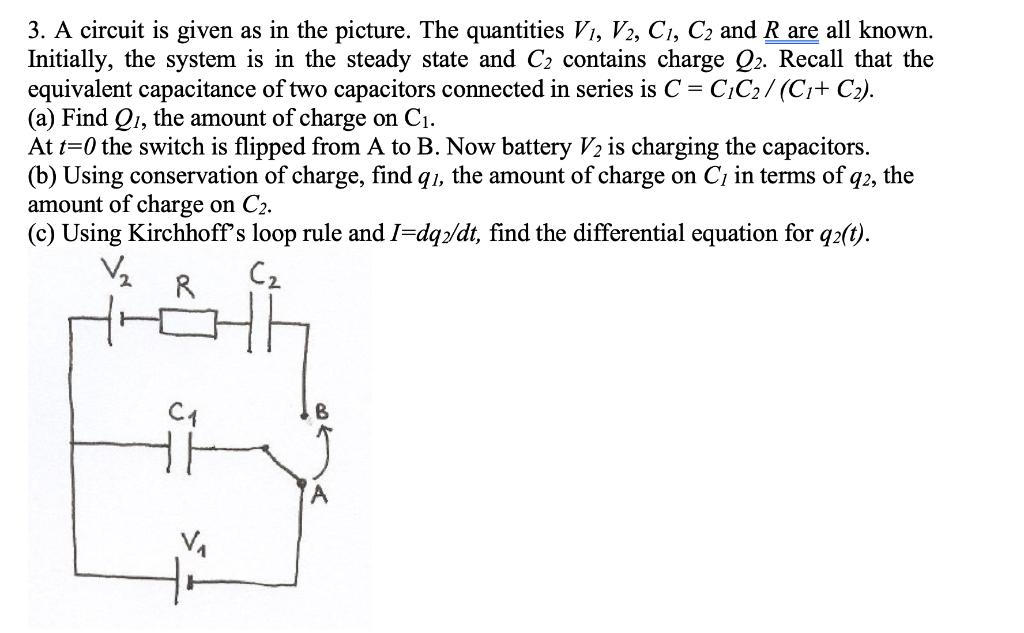 3. A circuit is given as in the picture. The quantities Vs, V2, Cs, Cz and R are all known.
Initially, the system is in the steady state and C: contains charge O>. Recall that the
equivalent capacitance of two capacitors connected in series is C = C1C2/ (Ci+ C2).
(a) Find Oy, the amount of charge on Ci.
At 1=0 the switch is flipped from A to B. Now battery V2 is charging the capacitors.
(b) Using conservation of charge, find ¢;, the amount of charge on C; in terms of g2, the
amount of charge on C>.
(c) Using Kirchhoff’s loop rule and /=dg2/dt, find the differential equation for g2(%).
Va R C,
Cy 1
A
Va
This is AI generated Response.
Asked by: Gurusharan
Created at: 2025-07-05 19:03:41
Asked by: Gurusharan
Created at: 2025-07-05 19:03:41
Final Answer:
Rendered
Raw Text
Did you like this answer?
Let's solve each part step by step:
---
### (a) Find \( Q_1 \), the amount of charge on \( C_1 \):
**Initial State:**
- The switch is at A.
- Only \( V_1 \) is connected to \( C_1 \).
- \( C_2 \) is not connected to the circuit (so it remains uncharged).
So, \( C_1 \) is simply charged by \( V_1 \):
\[
Q_1 = C_1 V_1
\]
**Final Answer (a):**
\[
\boxed{Q_1 = C_1 V_1}
\]
---
### (b) Using conservation of charge, find \( q_1 \) (charge on \( C_1 \)) in terms of \( q_2 \) (charge on \( C_2 \)) after the switch is flipped to B.
**After switch flips to B:**
- \( V_2 \) is connected to both \( C_1 \) and \( C_2 \) in series with resistor \( R \).
- Initial charge distribution: \( C_1 \) has \( Q_1 \), \( C_2 \) has 0.
- Now charge redistributes, but the total charge **originally on the upper plate of \( C_1 \) and lower plate of \( C_2 \) together** is conserved.
Let:
- \( q_1 \): charge on \( C_1 \) at time \( t \)
- \( q_2 \): charge on \( C_2 \) at time \( t \)
For two capacitors in series, the charge on each at any time is the same, but here, since the system started with \( Q_1 \) on \( C_1 \) and 0 on \( C_2 \), we have to use **conservation of charge** for the combination.
At any moment:
- The **net charge** that moved from \( C_1 \) to \( C_2 \) is \( q_2 \).
- So, the charge on \( C_1 \) is: \( q_1 = Q_1 - q_2 \)
**Final Answer (b):**
\[
\boxed{q_1 = Q_1 - q_2}
\]
with \( Q_1 = C_1 V_1 \).
---
### (c) Using Kirchhoff’s loop rule, find the differential equation for \( q_2(t) \):
Now with the switch at B, write the loop equation:
\[
V_2 - IR - V_{C_1} - V_{C_2} = 0
\]
where:
- \( I = \frac{dq_2}{dt} \) (current through \( R \))
- \( V_{C_1} = \frac{q_1}{C_1} \)
- \( V_{C_2} = \frac{q_2}{C_2} \)
- \( q_1 = Q_1 - q_2 \)
Substitute:
\[
V_2 - R \frac{dq_2}{dt} - \frac{Q_1 - q_2}{C_1} - \frac{q_2}{C_2} = 0
\]
Simplify the capacitor terms:
\[
V_2 - R \frac{dq_2}{dt} - \left(\frac{Q_1}{C_1} - \frac{q_2}{C_1} + \frac{q_2}{C_2}\right) = 0
\]
\[
V_2 - R \frac{dq_2}{dt} - \frac{Q_1}{C_1} + q_2\left(\frac{1}{C_1} + \frac{1}{C_2}\right) = 0
\]
Bring \( R \frac{dq_2}{dt} \) to one side:
\[
R \frac{dq_2}{dt} = V_2 - \frac{Q_1}{C_1} + q_2\left(\frac{1}{C_1} + \frac{1}{C_2}\right)
\]
\[
\frac{dq_2}{dt} = \frac{1}{R}\left[V_2 - \frac{Q_1}{C_1} + q_2\left(\frac{1}{C_1} + \frac{1}{C_2}\right)\right]
\]
**Final Answer (c):**
\[
\boxed{
\frac{dq_2}{dt} = \frac{1}{R} \left[ V_2 - \frac{Q_1}{C_1} + q_2 \left( \frac{1}{C_1} + \frac{1}{C_2} \right) \right]
}
\]
where \( Q_1 = C_1 V_1 \).
---
**Summary of Answers:**
- **(a)** \( Q_1 = C_1 V_1 \)
- **(b)** \( q_1 = Q_1 - q_2 \)
- **(c)** \( \displaystyle \frac{dq_2}{dt} = \frac{1}{R} \left[ V_2 - \frac{Q_1}{C_1} + q_2 \left( \frac{1}{C_1} + \frac{1}{C_2} \right) \right] \)
📢 Instructions:
- Ask anything relatd to above question only.
- For new Question goto :