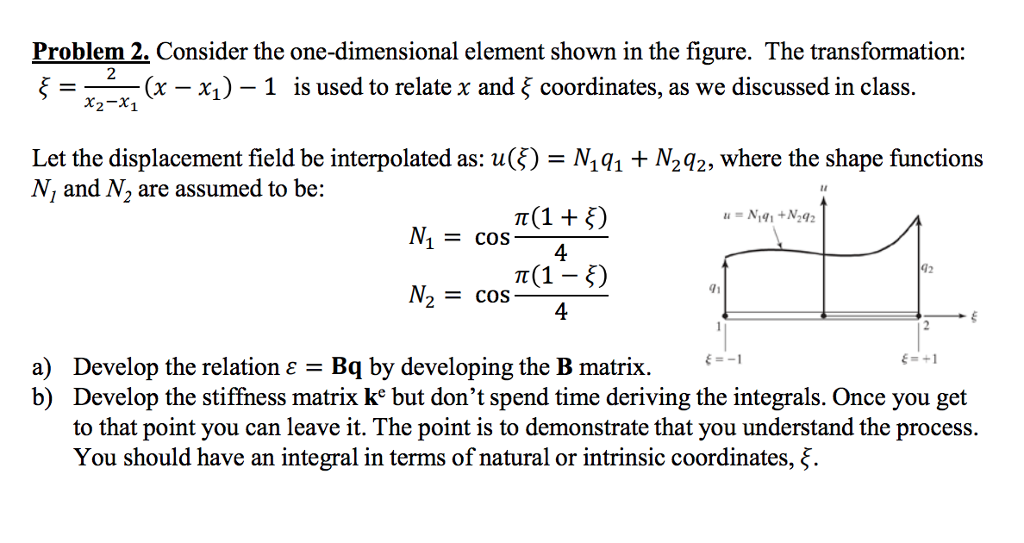
Give step-by-step solution with explanation and final answer:Problem 2. Consider the one-dimensional element shown in the figure. The transformation:
&= rr (x —x;) — 1 isused to relate x and ¢ coordinates, as we discussed in class.
27X11
Let the displacement field be interpolated as: u(¢) = N;q; + N,q,, where the shape functions
N, and N, are assumed to be: u
xl + w= Nyy +s
Ny = costEFD
at [3] i
(1 —
N, = _ ’
>= cos— i
a) Develop the relation €¢ = Bq by developing the B matrix. et ¢
b) Develop the stiffness matrix k° but don’t spend time deriving the integrals. Once you get
to that point you can leave it. The point is to demonstrate that you understand the process.
You should have an integral in terms of natural or intrinsic coordinates, ¢.
Question:
Give step-by-step solution with explanation and final answer:Problem 2. Consider the one-dimensional element shown in the figure. The transformation:
&= rr (x —x;) — 1 isused to relate x and ¢ coordinates, as we discussed in class.
27X11
Let the displacement field be interpolated as: u(¢) = N;q; + N,q,, where the shape functions
N, and N, are assumed to be: u
xl + w= Nyy +s
Ny = costEFD
at [3] i
(1 —
N, = _ ’
>= cos— i
a) Develop the relation €¢ = Bq by developing the B matrix. et ¢
b) Develop the stiffness matrix k° but don’t spend time deriving the integrals. Once you get
to that point you can leave it. The point is to demonstrate that you understand the process.
You should have an integral in terms of natural or intrinsic coordinates, ¢.
This is AI generated Response.
Asked by: gvr
Created at: 2025-07-04 11:37:03
Final Answer:
RenderedRaw Text
Did you like this answer?
Let's solve the problem step-by-step:
---
### (a) Develop the relation \( \varepsilon = Bq \) by developing the **B** matrix
#### **Step 1: Displacement interpolation**
The displacement field is:
\[
u(\xi) = N_1 q_1 + N_2 q_2
\]
where
\[
N_1 = \frac{\cos\left(\frac{\pi}{4}(1+\xi)\right)}{4}, \quad N_2 = \frac{\cos\left(\frac{\pi}{4}(1-\xi)\right)}{4}
\]
#### **Step 2: Strain-displacement relation**
Strain in 1D:
\[
\epsilon = \frac{du}{dx}
\]
But \( u \) is a function of \( \xi \), so use the chain rule:
\[
\epsilon = \frac{du}{dx} = \frac{du}{d\xi} \cdot \frac{d\xi}{dx}
\]
#### **Step 3: Compute \( \frac{du}{d\xi} \)**
\[
\frac{du}{d\xi} = \frac{dN_1}{d\xi}q_1 + \frac{dN_2}{d\xi}q_2
\]
#### **Step 4: Compute \( \frac{d\xi}{dx} \)**
Given:
\[
\xi = \frac{2}{x_2-x_1}(x-x_1) - 1
\]
\[
\frac{d\xi}{dx} = \frac{2}{x_2-x_1}
\]
So,
\[
\frac{dx}{d\xi} = \frac{x_2-x_1}{2}
\]
#### **Step 5: Assemble the B matrix**
\[
\epsilon = \frac{du}{dx} = \frac{du}{d\xi} \cdot \frac{d\xi}{dx}
\]
So,
\[
\epsilon = \left( \frac{dN_1}{d\xi}q_1 + \frac{dN_2}{d\xi}q_2 \right) \frac{d\xi}{dx}
\]
\[
\epsilon = \left[\frac{dN_1}{d\xi} \ \frac{dN_2}{d\xi}\right] \frac{d\xi}{dx} \begin{Bmatrix} q_1 \\ q_2 \end{Bmatrix}
\]
But since \( \frac{d\xi}{dx} = \frac{2}{x_2-x_1} \):
\[
\boxed{
\epsilon = \begin{bmatrix}
\frac{dN_1}{d\xi} & \frac{dN_2}{d\xi}
\end{bmatrix}
\frac{2}{x_2-x_1}
\begin{Bmatrix}
q_1 \\ q_2
\end{Bmatrix}
}
\]
Therefore, the **B matrix** is:
\[
\boxed{
B = \begin{bmatrix}
\frac{dN_1}{d\xi} & \frac{dN_2}{d\xi}
\end{bmatrix} \frac{2}{x_2-x_1}
}
\]
---
### (b) Develop the stiffness matrix \( k^e \)
For 1D, the element stiffness matrix is:
\[
k^e = \int_{x_1}^{x_2} B^T E B \, dx
\]
Transform to intrinsic (\( \xi \)) coordinates (\( dx = \frac{x_2-x_1}{2} d\xi \)), and limits \(\xi = -1\) to \(+1\):
\[
k^e = \int_{-1}^{+1} B^T E B \, \frac{x_2-x_1}{2} d\xi
\]
#### Substitute B:
\[
B = \left[\frac{dN_1}{d\xi} \ \frac{dN_2}{d\xi}\right] \frac{2}{x_2-x_1}
\]
So:
\[
k^e = \int_{-1}^{+1} \left( \frac{2}{x_2-x_1} \begin{bmatrix}
\frac{dN_1}{d\xi} \\ \frac{dN_2}{d\xi}
\end{bmatrix}
\right)
E
\left(
\begin{bmatrix}
\frac{dN_1}{d\xi} & \frac{dN_2}{d\xi}
\end{bmatrix}
\frac{2}{x_2-x_1}
\right)
\frac{x_2-x_1}{2}
d\xi
\]
\[
= \int_{-1}^{+1} E
\begin{bmatrix}
\frac{dN_1}{d\xi} \\ \frac{dN_2}{d\xi}
\end{bmatrix}
\begin{bmatrix}
\frac{dN_1}{d\xi} & \frac{dN_2}{d\xi}
\end{bmatrix}
\frac{4}{x_2-x_1}
d\xi
\]
\[
= \int_{-1}^{+1} E \frac{4}{x_2-x_1}
\begin{bmatrix}
\frac{dN_1}{d\xi}\frac{dN_1}{d\xi} & \frac{dN_1}{d\xi}\frac{dN_2}{d\xi} \\
\frac{dN_2}{d\xi}\frac{dN_1}{d\xi} & \frac{dN_2}{d\xi}\frac{dN_2}{d\xi}
\end{bmatrix}
d\xi
\]
---
### **Final Answers**
#### **Part (a):**
\[
\boxed{
\epsilon = Bq, \quad \text{where} \quad B = \begin{bmatrix}
\frac{dN_1}{d\xi} & \frac{dN_2}{d\xi}
\end{bmatrix} \frac{2}{x_2-x_1}
}
\]
#### **Part (b):**
\[
\boxed{
k^e = \int_{-1}^{+1} E \frac{4}{x_2-x_1}
\begin{bmatrix}
\left(\frac{dN_1}{d\xi}\right)^2 & \frac{dN_1}{d\xi}\frac{dN_2}{d\xi} \\
\frac{dN_2}{d\xi}\frac{dN_1}{d\xi} & \left(\frac{dN_2}{d\xi}\right)^2
\end{bmatrix}
d\xi
}
\]
The integral is written in terms of the natural coordinate \(\xi\), as required.
VIPSolutions focuses on clear, step‑by‑step explanations so you can learn quickly. Whether you need an AI‑generated walkthrough or a short hint to get unstuck, each solution is organized for fast reading and easy review later.
Search similar questions, compare approaches, and bookmark the best answers for revision. Our goal is simple: quick, reliable study help that feels natural—not noisy.
 VIPSolutions
 Problem 2. Consider the one-dimensional element shown in the figure. The transformation:
&= rr (x —x;) — 1 isused to relate x and ¢ coordinates, as we discussed in class.
27X11
Let the displacement field be interpolated as: u(¢) = N;q; + N,q,, where the shape functions
N, and N, are assumed to be: u
xl + w= Nyy +s
Ny = costEFD
at [3] i
(1 —
N, = _ ’
>= cos— i
a) Develop the relation €¢ = Bq by developing the B matrix. et ¢
b) Develop the stiffness matrix k° but don’t spend time deriving the integrals. Once you get
to that point you can leave it. The point is to demonstrate that you understand the process.
You should have an integral in terms of natural or intrinsic coordinates, ¢.