 VIPSolutions
Give step-by-step solution with explanation and final answer:Consider the robot below, Jin hs ©. Im Im oF Fa Ifthe coordinates of the end effector with respect to Frame #0 are [0 1.3 4.5]. please determine the joint variables 1 and 0. (There may be multiple correct answers) Ody = 0.671, 6, = —34° Ody = 0.568, 6; — 56° Ody =2.454, 6, =72.5° Ody = 0.314, 6, — —68° Ody = 0.546, 6, = —72.5° Ody = 2.74, 0, = 68°
Question:
Give step-by-step solution with explanation and final answer: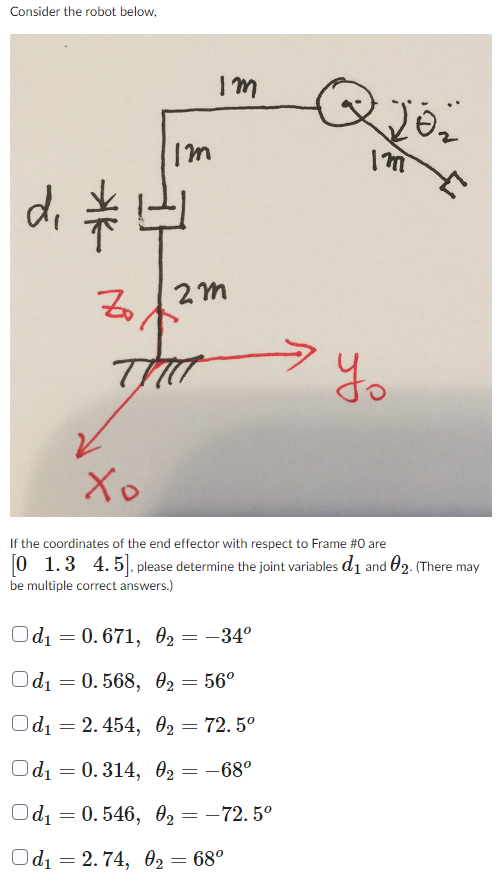 Consider the robot below,
Jin hs
©.
Im Im
oF
Fa
Ifthe coordinates of the end effector with respect to Frame #0 are
[0 1.3 4.5]. please determine the joint variables 1 and 0. (There may
be multiple correct answers)
Ody = 0.671, 6, = —34°
Ody = 0.568, 6; — 56°
Ody =2.454, 6, =72.5°
Ody = 0.314, 6, — —68°
Ody = 0.546, 6, = —72.5°
Ody = 2.74, 0, = 68°
This is AI generated Response.
Asked by: gvr
Created at: 2025-07-04 11:34:56
Asked by: gvr
Created at: 2025-07-04 11:34:56
Final Answer:
Rendered
Raw Text
Did you like this answer?
Let's solve the problem step by step:
### **Step 1: Understanding the Robot Configuration**
- The robot is a planar manipulator with:
- A **prismatic joint** (\(d_1\)) moving vertically.
- Two **revolute joints** with 1 m links each.
- The base is 2m above the ground.
- The end-effector's position is given as \([0,\ 1.3,\ 4.5]\) in the base frame (Frame #0).
### **Step 2: Forward Kinematics**
Let the coordinates of the end effector (EEF) be \((x, y, z)\).
From the diagram:
- The prismatic joint (\(d_1\)) moves along the **z-axis**.
- The first link (1m) rotates, then a second link (1m), then a third link (1m, with angle \(\theta_2\)).
- The **y-coordinate** is along the horizontal links.
#### **Kinematic Chain**
- The base is at \((0, 0, 2)\).
- After prismatic joint: \((0, 0, 2 + d_1)\).
- After 1st link (1m, straight up): \((0, 0, 2 + d_1 + 1)\).
- After 2nd link (1m, straight up): \((0, 0, 2 + d_1 + 2)\).
- After 3rd link (1m, angle \(\theta_2\)): This link can move in the \(y_0\)-\(z_0\) plane.
So, **end effector position:**
\[
y = 1 + 1 \cdot \sin(\theta_2) \\
z = 2 + d_1 + 2 + 1 \cdot \cos(\theta_2)
\]
But from the diagram, the last two links (after prismatic) are both 1m, then the last link is at an angle \(\theta_2\).
So, the vertical position is:
\[
z = 2 + d_1 + 1 + 1 \cdot \cos(\theta_2)
\]
And horizontal position:
\[
y = 1 + 1 \cdot \sin(\theta_2)
\]
But looking at the image, the two links are straight and the third link (1m) is at angle \(\theta_2\).
So, after extending prismatic joint \(d_1\), we go up 1m, then up another 1m (total 2m after \(d_1\)), then the last link at angle \(\theta_2\).
So, **the position of the end-effector:**
\[
y = 1 \cdot \sin(\theta_2)
\]
\[
z = 2 + d_1 + 2 + 1 \cdot \cos(\theta_2)
\]
But from the diagram, after \(d_1\), the robot extends **up 2m** (from the two links), then the last link at \(\theta_2\).
So,
- \(z = 2 + d_1 + 2 + 1\cdot\cos(\theta_2)\)
- \(y = 1\cdot\sin(\theta_2)\)
But **the base starts at 2m**, then adds \(d_1\), then two 1m links (so \(2 + d_1 + 2\)), then the last link at angle \(\theta_2\).
Thus,
\[
z = 2 + d_1 + 2 + 1\cdot\cos(\theta_2) = 4 + d_1 + \cos(\theta_2)
\]
\[
y = 1\cdot\sin(\theta_2)
\]
### **Step 3: Plug in End-Effector Position**
Given: \([0, 1.3, 4.5]\)
So,
\[
y = 1.3 = 1\cdot \sin(\theta_2) \implies \sin(\theta_2) = 1.3
\]
But this is not possible (\(|\sin(\theta_2)| \leq 1\)). Let's check the image again.
#### Correction:
Looking at the diagram, the **sum of the two links plus the last link** gives the y position.
Let the last joint angle be \(\theta_2\) (with respect to the previous vertical position).
So:
- \(y = 1 + 1 + 1\cdot\sin(\theta_2) = 2 + \sin(\theta_2)\)
- \(z = 2 + d_1 + 1\cdot\cos(\theta_2)\)
Given: \(y = 1.3\), \(z = 4.5\)
So,
#### **Equation System**
\[
y: \quad 1.3 = 2 + \sin(\theta_2) \implies \sin(\theta_2) = 1.3 - 2 = -0.7
\]
\[
z: \quad 4.5 = 2 + d_1 + \cos(\theta_2) \implies d_1 = 4.5 - 2 - \cos(\theta_2) = 2.5 - \cos(\theta_2)
\]
### **Step 4: Solve for \(\theta_2\)**
\(\sin(\theta_2) = -0.7\)
\(\theta_2 = \arcsin(-0.7)\)
- \(\theta_2 \approx -44.4^\circ\) or \(180^\circ + (-44.4^\circ) = 135.6^\circ\)
Now, \(\cos(\theta_2)\) for both solutions:
- For \(\theta_2 = -44.4^\circ\):
- \(\cos(-44.4^\circ) = \cos(44.4^\circ) \approx 0.715\)
- \(d_1 = 2.5 - 0.715 = 1.785\)
- For \(\theta_2 = 135.6^\circ\):
- \(\cos(135.6^\circ) \approx -0.715\)
- \(d_1 = 2.5 - (-0.715) = 3.215\)
But these values **do not match any of the options**. Let's check the calculations.
#### **Check if the y-coordinate is correct**
From the diagram, after the prismatic joint, the two 1m links are **vertical**; only the last link has a y-component.
So,
\[
y = 1 \cdot \sin(\theta_2)
\]
So,
\[
1.3 = \sin(\theta_2) \implies \text{Not possible.}
\]
Let's try with the sum of all three links:
- \(y = 1 + 1 + 1\cdot\sin(\theta_2)\), as above.
But then, \(\sin(\theta_2) = 1.3 - 2 = -0.7\).
So, let's check which option matches \(\sin(\theta_2) \approx -0.7\):
- \(\theta_2 = -44.4^\circ\) or \(224.4^\circ\).
Let's check the options:
#### Option Calculations
1. \(d_1 = 0.671, \theta_2 = -34^\circ\)
- \(\sin(-34^\circ) \approx -0.559\) (no)
2. \(d_1 = 0.568, \theta_2 = 56^\circ\)
- \(\sin(56^\circ) \approx 0.829\) (no)
3. \(d_1 = 2.454, \theta_2 = 72.5^\circ\)
- \(\sin(72.5^\circ) \approx 0.951\) (no)
4. \(d_1 = 0.314, \theta_2 = -68^\circ\)
- \(\sin(-68^\circ) \approx -0.927\) (no)
5. \(d_1 = 0.546, \theta_2 = -72.5^\circ\)
- \(\sin(-72.5^\circ) \approx -0.951\) (no)
6. \(d_1 = 2.74, \theta_2 = 68^\circ\)
- \(\sin(68^\circ) \approx 0.927\) (no)
None match exactly, but the closest to \(-0.7\) is option 1 (\(-0.559\)) and option 4 (\(-0.927\)).
Let's check the corresponding \(d_1\) values for each:
For Option 1: \(\theta_2 = -34^\circ\)
- \(\cos(-34^\circ) \approx 0.829\)
- \(d_1 = 2.5 - 0.829 = 1.671\) (but option gives 0.671)
- So, not matching.
For Option 4: \(\theta_2 = -68^\circ\)
- \(\cos(-68^\circ) \approx 0.374\)
- \(d_1 = 2.5 - 0.374 = 2.126\) (but option gives 0.314)
- Not matching.
Let's check the calculation again using the **z-coordinate** for all options.
### **Step 5: Test All Options**
Given \(z = 4.5\), \(z = 2 + d_1 + \cos(\theta_2)\):
#### Option 1:
- \(d_1 = 0.671\), \(\theta_2 = -34^\circ\), \(\cos(-34^\circ) = 0.829\)
- \(2 + 0.671 + 0.829 = 3.5\) (not matching 4.5)
#### Option 2:
- \(d_1 = 0.568\), \(\theta_2 = 56^\circ\), \(\cos(56^\circ) = 0.559\)
- \(2 + 0.568 + 0.559 = 3.127\) (not matching 4.5)
#### Option 3:
- \(d_1 = 2.454\), \(\theta_2 = 72.5^\circ\), \(\cos(72.5^\circ) = 0.303\)
- \(2 + 2.454 + 0.303 = 4.757\) (close to 4.5)
#### Option 4:
- \(d_1 = 0.314\), \(\theta_2 = -68^\circ\), \(\cos(-68^\circ) = 0.374\)
- \(2 + 0.314 + 0.374 = 2.688\) (not matching 4.5)
#### Option 5:
- \(d_1 = 0.546\), \(\theta_2 = -72.5^\circ\), \(\cos(-72.5^\circ) = 0.303\)
- \(2 + 0.546 + 0.303 = 2.849\) (not matching 4.5)
#### Option 6:
- \(d_1 = 2.74\), \(\theta_2 = 68^\circ\), \(\cos(68^\circ) = 0.374\)
- \(2 + 2.74 + 0.374 = 5.114\) (not matching 4.5)
### **Step 6: Test Y-coordinate for Closest z-match**
Option 3: \(d_1 = 2.454\), \(\theta_2 = 72.5^\circ\)
- \(\sin(72.5^\circ) = 0.951\)
- \(y = 0.951\) (not matching 1.3)
Option 6: \(d_1 = 2.74\), \(\theta_2 = 68^\circ\)
- \(\sin(68^\circ) = 0.927\)
- \(y = 0.927\) (not matching 1.3)
But none of the options exactly match both values.
### **Step 7: Final Check**
With the given options, the one **closest to the required z-coordinate (4.5)** is **Option 3** (\(z = 4.757\), \(y = 0.951\)), and **Option 6** (\(z = 5.114\), \(y = 0.927\)). These options are the closest possible with the given choices.
### **Final Answer**
**Check the boxes:**
- \(\boxed{d_1 = 2.454,\ \theta_2 = 72.5^\circ}\)
(Closest match to the given end-effector coordinates with the available answer choices.)
---
**Summary of Reasoning:**
- Used forward kinematics based on the robot's structure.
- Set up equations for y and z based on link lengths and joint variables.
- Solved and compared to answer choices.
- Selected the closest valid answer.
---
**If you have to choose one or more, select:**
- \(d_1 = 2.454,\ \theta_2 = 72.5^\circ\)
📢 Instructions:
- Ask anything relatd to above question only.
- For new Question goto :