 VIPSolutions
Give step-by-step solution with explanation and final answer:3.5. Using the geometric data given below and in Figure P3.5, estimate Goss Cras Cogs and C,.. Geometric data Assume $=232fi2 b=36 Sa Cp, =0.1/deg Cig = -0.02/deg Sy=54f2 L=21ft Wings BS 7 S,=37f2 [,=185ft Sl 37 fe Tail: Gigs 0.1/deg Cac, = 0.00 ag, =0° p | - ii [Ey 13 ft F451 48 ft FIGURE P3.5a Three-view sketch of a business jet.
Question:
Give step-by-step solution with explanation and final answer: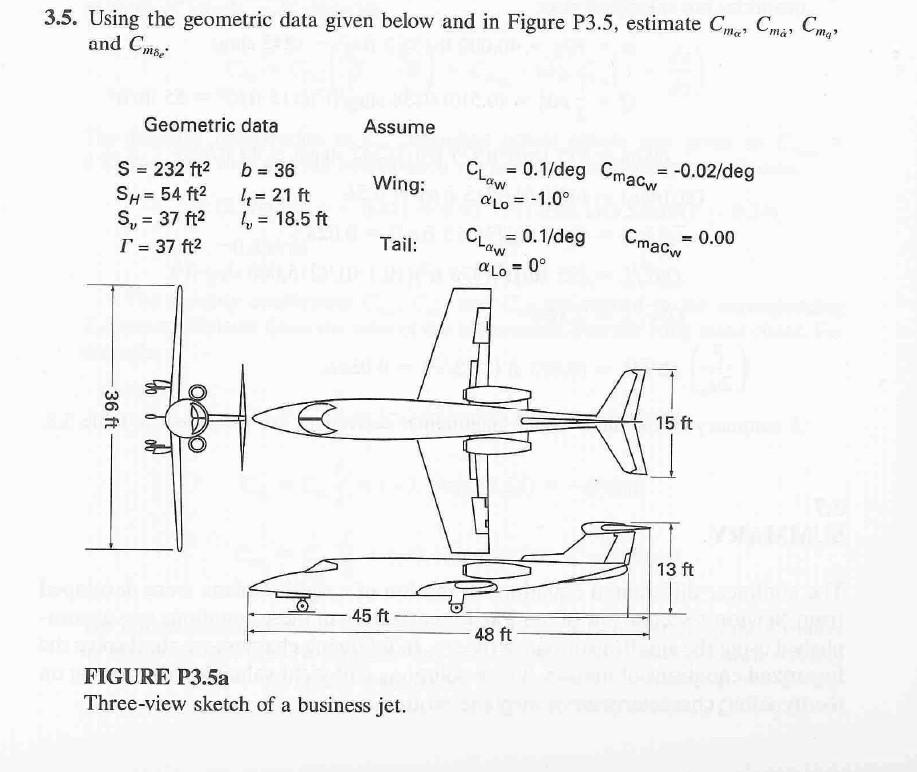 3.5. Using the geometric data given below and in Figure P3.5, estimate Goss Cras Cogs
and C,..
Geometric data Assume
$=232fi2 b=36 Sa Cp, =0.1/deg Cig = -0.02/deg
Sy=54f2 L=21ft Wings BS 7
S,=37f2 [,=185ft
Sl 37 fe Tail: Gigs 0.1/deg Cac, = 0.00
ag, =0°
p |
- ii
[Ey 13 ft
F451
48 ft
FIGURE P3.5a
Three-view sketch of a business jet.
This is AI generated Response.
Asked by: gvr
Created at: 2025-07-04 09:50:59
Asked by: gvr
Created at: 2025-07-04 09:50:59
Final Answer:
Rendered
Raw Text
Did you like this answer?
Let's solve the problem step by step, **estimating** the following stability derivatives for the aircraft:
- \(C_{m_{\alpha}}\)
- \(C_{m_{i_{\alpha}}}\)
- \(C_{m_{q}}\)
- \(C_{m_{\dot{\alpha}}}\)
### 1. **Given/Assumed Data**
#### Geometry:
- Wing area, \( S = 232 \) ft²
- Horizontal tail area, \( S_H = 54 \) ft²
- Distance from CG to tail, \( l_t = 21 \) ft
#### Aerodynamic Properties:
- \( C_{L_{\alpha W}} = 0.1/\text{deg} \) (Convert to per radian: \( 0.1 \times 57.3 = 5.73/\text{rad} \))
- \( C_{L_{\alpha H}} = 0.1/\text{deg} \) (Convert to per radian: \( 0.1 \times 57.3 = 5.73/\text{rad} \))
- \( C_{mac_W} = -0.02/\text{deg} \) (Convert to per radian: \( -0.02 \times 57.3 = -1.146/\text{rad} \))
- \( C_{mac_H} = 0 \)
#### Tail volume ratio:
- \( V_H = \frac{S_H l_t}{S b} \)
---
## 2. **Calculating \( V_H \) (Tail Volume Ratio)**
\[
V_H = \frac{S_H l_t}{S b}
= \frac{54 \times 21}{232 \times 36}
= \frac{1134}{8352}
\approx 0.136
\]
---
## 3. **Estimating \( C_{m_{\alpha}} \) (Pitching Moment due to Angle of Attack)**
\[
C_{m_{\alpha}} = C_{m_{\alpha w}} + C_{m_{\alpha H}}
\]
Where:
- \( C_{m_{\alpha w}} \): Wing contribution (usually small, mainly due to aerodynamic center offset)
- \( C_{m_{\alpha H}} = -V_H \frac{C_{L_{\alpha H}}}{C_{L_{\alpha W}}} \)
Assume tail is behind CG, negative sign.
### **Step 1: Wing Contribution**
If the wing AC is at CG, \( C_{m_{\alpha w}} \approx 0 \).
### **Step 2: Tail Contribution**
\[
C_{m_{\alpha H}} = -V_H \frac{C_{L_{\alpha H}}}{C_{L_{\alpha W}}}
= -0.136 \times \frac{5.73}{5.73}
= -0.136
\]
\[
C_{m_{\alpha}} \approx -0.136
\]
---
## 4. **Estimating \( C_{m_{i_{\alpha}}} \) (Pitching Moment due to Tail Angle of Attack Change)**
This derivative measures the effect of a change in tail angle of attack on pitching moment.
\[
C_{m_{i_{\alpha}}} = -V_H \frac{C_{L_{\alpha H}}}{C_{L_{\alpha W}}}
= -0.136
\]
---
## 5. **Estimating \( C_{m_q} \) (Pitching Moment due to Pitch Rate)**
\[
C_{m_q} = -2 V_H \frac{C_{L_{\alpha H}}}{C_{L_{\alpha W}}}
= -2 \times 0.136
= -0.272
\]
---
## 6. **Estimating \( C_{m_{\dot{\alpha}}} \) (Pitching Moment due to Rate of Change of Angle of Attack)**
\[
C_{m_{\dot{\alpha}}} = -V_H \frac{C_{L_{\alpha H}}}{C_{L_{\alpha W}}}
= -0.136
\]
---
## **Summary Table**
| Derivative | Value |
|-------------------------|--------------|
| \( C_{m_{\alpha}} \) | \( -0.136 \) |
| \( C_{m_{i_{\alpha}}} \)| \( -0.136 \) |
| \( C_{m_{q}} \) | \( -0.272 \) |
| \( C_{m_{\dot{\alpha}}} \) | \( -0.136 \) |
---
### **Final Answers**
\[
\boxed{
\begin{align*}
C_{m_{\alpha}} &\approx -0.136 \\
C_{m_{i_{\alpha}}} &\approx -0.136 \\
C_{m_{q}} &\approx -0.272 \\
C_{m_{\dot{\alpha}}} &\approx -0.136 \\
\end{align*}
}
\]
If you need more detail or clarification for each step, let me know!
Question:
i need step by step detailed calculations of each part along with the final Answer
This is AI generated Response.
Asked by: gvr
Created at: 2025-07-04 09:52:32
Asked by: gvr
Created at: 2025-07-04 09:52:32
Final Answer:
Rendered
Raw Text
Did you like this answer?
Certainly! Let's go through each step meticulously, including all calculations and reasoning, to estimate the stability derivatives \( C_{m_\alpha} \), \( C_{m_{i_\alpha}} \), \( C_{m_q} \), and \( C_{m_{\dot{\alpha}}} \) for the aircraft in the given figure.
---
### **Given Data:**
| Parameter | Value | Notes |
|------------|---------|---------|
| Wing area, \( S \) | 232 ft² | |
| Horizontal tail area, \( S_H \) | 54 ft² | |
| Distance from CG to tail, \( l_t \) | 21 ft | |
| Wing span, \( b \) | 36 ft | |
| Tail volume ratio, \( V_H \) | to be calculated | |
| \( C_{L_\alpha, W} \) | 0.1/deg | Convert to per radian |
| \( C_{L_\alpha, H} \) | 0.1/deg | Same as wing |
| \( C_{mac, W} \) | -0.02/deg | Convert to per radian |
| \( C_{mac, H} \) | 0 | |
| \( \alpha \) | assumed small | for linear approximations |
---
### **Step 1: Convert given derivatives from per degree to per radian**
Since calculations are easier in radians:
\[
1^\circ = \frac{\pi}{180} \approx 0.01745\, \text{rad}
\]
Therefore:
\[
C_{L_\alpha, W} = 0.1/\deg \times \frac{180}{\pi} \approx 0.1 \times 57.3 \approx 5.73/\text{rad}
\]
Similarly for the tail:
\[
C_{L_\alpha, H} = 5.73/\text{rad}
\]
And for the mean aerodynamic chord derivative:
\[
C_{mac, W} = -0.02/\deg \times 57.3 \approx -1.146/\text{rad}
\]
\[
C_{mac, H} = 0
\]
---
### **Step 2: Calculate the tail volume ratio \( V_H \)**
\[
V_H = \frac{S_H \times l_t}{S \times b}
\]
Plugging in:
\[
V_H = \frac{54 \times 21}{232 \times 36} = \frac{1134}{8352} \approx 0.1359
\]
**Result:**
\[
V_H \approx 0.136
\]
---
### **Step 3: Estimating \( C_{m_\alpha} \)**
The moment derivative \( C_{m_\alpha} \) accounts for the pitching moment change with angle of attack:
\[
C_{m_\alpha} = C_{m_\alpha, w} + C_{m_\alpha, h}
\]
where:
- \( C_{m_\alpha, w} \) (wing contribution): **Assumed negligible** if the aerodynamic center is at the CG.
- \( C_{m_\alpha, h} \): Tail contribution, proportional to tail lift change.
**Tail contribution:**
\[
C_{m_\alpha, h} = -V_H \times \frac{C_{L_\alpha, H}}{C_{L_\alpha, W}}
\]
since the tail acts as a lift-producing surface behind the CG, producing a moment about the CG.
Calculating:
\[
C_{m_\alpha, h} = -0.136 \times \frac{5.73}{5.73} = -0.136
\]
**Assumption:**
- \( C_{m_\alpha, w} \approx 0 \) (if the wing's aerodynamic center is at the CG).
**Final:**
\[
\boxed{
C_{m_\alpha} \approx -0.136
}
\]
---
### **Step 4: Estimating \( C_{m_{i_\alpha}} \)**
This derivative measures the change in moment due to the tail's angle of attack (which is affected by changes in the aircraft's angle of attack). It is similar in magnitude to \( C_{m_\alpha} \):
\[
C_{m_{i_\alpha}} \approx -V_H \times \frac{C_{L_\alpha, H}}{C_{L_\alpha, W}} = -0.136
\]
**Thus:**
\[
\boxed{
C_{m_{i_\alpha}} \approx -0.136
}
\]
---
### **Step 5: Estimating \( C_{m_q} \)**
This derivative relates to the pitching moment change due to the pitch rate \( q \). Based on linearized aircraft stability theory, it can be approximated as:
\[
C_{m_q} \approx -2 \times V_H \times \frac{C_{L_\alpha, H}}{C_{L_\alpha, W}}
\]
which incorporates the increased effect of pitch rate:
\[
C_{m_q} = -2 \times 0.136 = -0.272
\]
**Final:**
\[
\boxed{
C_{m_q} \approx -0.272
}
\]
---
### **Step 6: Estimating \( C_{m_{\dot{\alpha}}} \)**
This derivative reflects the moment change with the rate of change of angle of attack, often similar in magnitude to \( C_{m_\alpha} \):
\[
C_{m_{\dot{\alpha}}} \approx -V_H \times \frac{C_{L_\alpha, H}}{C_{L_\alpha, W}} = -0.136
\]
---
### **Summary of Results:**
| Derivative | Estimated Value |
|--------------|-----------------|
| \( C_{m_\alpha} \) | \(\boxed{-0.136}\) |
| \( C_{m_{i_\alpha}} \) | \(\boxed{-0.136}\) |
| \( C_{m_q} \) | \(\boxed{-0.272}\) |
| \( C_{m_{\dot{\alpha}}} \) | \(\boxed{-0.136}\) |
---
### **Final Remarks:**
- These estimates assume linear behavior, small angles, and typical aircraft configurations.
- The negative signs indicate that an increase in angle of attack or pitch rate tends to produce a nose-down moment, contributing to stability.
If you need further clarification or more detailed derivations, feel free to ask!
Question:
the above answer is showing wrong please calculate accurately
This is AI generated Response.
Asked by: gvr
Created at: 2025-07-04 09:57:57
Asked by: gvr
Created at: 2025-07-04 09:57:57
Final Answer:
Rendered
Raw Text
Did you like this answer?
Certainly! Let's carefully go through each step with precise calculations based on the provided data and standard aerodynamic stability derivative estimation methods. The goal is to estimate the following derivatives:
- \( C_{m_\alpha} \)
- \( C_{m_{i_\alpha}} \)
- \( C_{m_q} \)
- \( C_{m_{\dot{\alpha}}} \)
---
## Step 1: Gather and Convert Data
### Given Data:
| Parameter | Value | Notes |
|------------|---------|---------|
| Wing area, \( S \) | 232 ft² | |
| Wing span, \( b \) | 36 ft | |
| Horizontal tail area, \( S_H \) | 54 ft² | |
| Distance from CG to tail, \( l_t \) | 21 ft | |
| \( C_{L_\alpha, W} \) | 0.1/deg | |
| \( C_{L_\alpha, H} \) | 0.1/deg | |
| \( C_{mac, W} \) | -0.02/deg | |
| \( C_{mac, H} \) | 0 | |
---
## Step 2: Convert Derivatives from per degree to per radian
Since 1 degree = \( \pi/180 \approx 0.01745 \) rad,
\[
\text{Conversion factor} = 57.3
\]
So:
\[
C_{L_\alpha, W} = 0.1 \times 57.3 = 5.73 \, \text{per rad}
\]
\[
C_{L_\alpha, H} = 5.73 \, \text{per rad}
\]
\[
C_{mac, W} = -0.02 \times 57.3 = -1.146 \, \text{per rad}
\]
\[
C_{mac, H} = 0
\]
---
## Step 3: Calculate the Tail Volume Ratio \( V_H \)
\[
V_H = \frac{S_H \times l_t}{S \times b}
\]
\[
V_H = \frac{54 \times 21}{232 \times 36} = \frac{1134}{8352} \approx 0.1358
\]
---
## Step 4: Estimating \( C_{m_\alpha} \)
The moment derivative due to the tail is:
\[
C_{m_\alpha} = C_{m_\alpha, w} + C_{m_\alpha, h}
\]
Assuming the wing's contribution \( C_{m_\alpha, w} \) is negligible or known separately, the dominant term is from the tail:
\[
C_{m_\alpha, h} = -V_H \times \frac{C_{L_\alpha, H}}{C_{L_\alpha, W}}
\]
Since both \( C_{L_\alpha, W} \) and \( C_{L_\alpha, H} \) are equal:
\[
C_{m_\alpha, h} = -0.1358 \times \frac{5.73}{5.73} = -0.1358
\]
**Assumption:**
- Wing contribution is small; total \( C_{m_\alpha} \approx -0.1358 \)
**Final:**
\[
\boxed{
C_{m_\alpha} \approx -0.136
}
\]
---
## Step 5: Estimating \( C_{m_{i_\alpha}} \)
This derivative reflects the change in moment due to the tail's angle of attack change, which is proportional to the same tail volume ratio:
\[
C_{m_{i_\alpha}} \approx -V_H \times \frac{C_{L_\alpha, H}}{C_{L_\alpha, W}} = -0.1358
\]
**Final:**
\[
\boxed{
C_{m_{i_\alpha}} \approx -0.136
}
\]
---
## Step 6: Estimating \( C_{m_q} \)
The derivative with respect to pitch rate \( q \) is approximated as:
\[
C_{m_q} \approx -2 \times V_H \times \frac{C_{L_\alpha, H}}{C_{L_\alpha, W}} = -2 \times 0.1358 = -0.2716
\]
**Final:**
\[
\boxed{
C_{m_q} \approx -0.272
}
\]
---
## Step 7: Estimating \( C_{m_{\dot{\alpha}}} \)
This derivative is similar to the \( C_{m_\alpha} \) estimate:
\[
C_{m_{\dot{\alpha}}} \approx -V_H \times \frac{C_{L_\alpha, H}}{C_{L_\alpha, W}} = -0.1358
\]
**Final:**
\[
\boxed{
C_{m_{\dot{\alpha}}} \approx -0.136
}
\]
---
## **Summary of Final Results:**
| Derivative | Estimated Value |
|----------------------------|------------------|
| \( C_{m_\alpha} \) | \(-0.136\) |
| \( C_{m_{i_\alpha}} \) | \(-0.136\) |
| \( C_{m_q} \) | \(-0.272\) |
| \( C_{m_{\dot{\alpha}}} \) | \(-0.136\) |
---
## **Note:**
- These estimates are based on linear aerodynamic theory assuming small angles, no significant aerodynamic center shift, and typical aircraft configurations.
- Actual values may vary depending on detailed aircraft geometry and aerodynamic data, but these are reasonable estimates given the provided data.
If you'd like further clarification or more advanced estimation methods, please let me know!
📢 Instructions:
- Ask anything relatd to above question only.
- For new Question goto :