VIPSolutions logo ✨ VIPSolutions

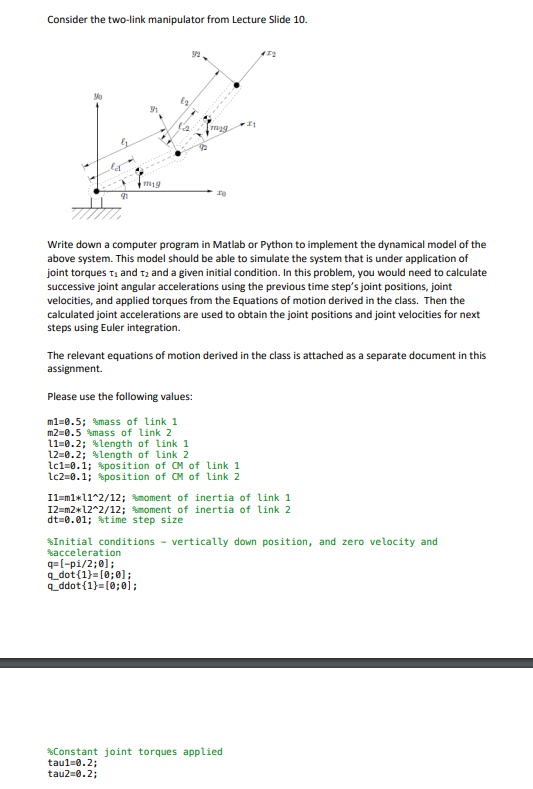
Give step-by-step solution with explanation and final answer:Consider the twodink manipulator fom Lecture Sie 10 wv 4, Sa Ja mt WHY I Wie down a computer rogram in Matiab o Python to implement the dynamical model of the above system. Tis model should be abl osimate th syste hats under aplication of Joint toraues sand and given nial condition. n tis problem, you woukd need to calculate Sucesive Joint angular accelerations using he previous ti tes an postions, ot Velocities, and sped torques rom th Equations of motion dried i he as. Then the Colca int ccserations ar used t obtain he font postions an joint velocities or nest eps ing cules megration he relevant equations of motion derived in the las is atached as separate document in this assigment. Please us the following values: a1s0.5; seas of Link 1 eS ms of Unk 2 1120.2; Slength of Link 1 1220221 Mlengih of Link 2 1e1%04; Sposition of Of of Link 1 1603] Forition of On of Link 2 T1em1e1172/12; smonent of inertia of Link 1 Taca2e1277/12; smanent of inertia of Link 2 eH Sdnitial conditions - vertically down position, and zero velocity and icetoration wlio: Tetrion; etini= foro); TE constant joint torques applied pee wae

Question:

Give step-by-step solution with explanation and final answer:Uploaded ImageConsider the twodink manipulator fom Lecture Sie 10 wv 4, Sa Ja mt WHY I Wie down a computer rogram in Matiab o Python to implement the dynamical model of the above system. Tis model should be abl osimate th syste hats under aplication of Joint toraues sand and given nial condition. n tis problem, you woukd need to calculate Sucesive Joint angular accelerations using he previous ti tes an postions, ot Velocities, and sped torques rom th Equations of motion dried i he as. Then the Colca int ccserations ar used t obtain he font postions an joint velocities or nest eps ing cules megration he relevant equations of motion derived in the las is atached as separate document in this assigment. Please us the following values: a1s0.5; seas of Link 1 eS ms of Unk 2 1120.2; Slength of Link 1 1220221 Mlengih of Link 2 1e1%04; Sposition of Of of Link 1 1603] Forition of On of Link 2 T1em1e1172/12; smonent of inertia of Link 1 Taca2e1277/12; smanent of inertia of Link 2 eH Sdnitial conditions - vertically down position, and zero velocity and icetoration wlio: Tetrion; etini= foro); TE constant joint torques applied pee wae
This is AI generated Response.
Asked by: gvr
Created at: 2025-07-03 18:14:09

Final Answer:

Rendered Raw Text
Did you like this answer?
Let's break this down **step-by-step**, explaining the process to implement the simulation for the two-link manipulator in Python (you can easily adapt to Matlab if needed). **Final Python code is provided at the end.** --- ## **Step 1: Equations of Motion** For a two-link manipulator, the equations of motion (from the Euler-Lagrange method) are typically: \[ M(q)\ddot{q} + C(q, \dot{q})\dot{q} + G(q) = \tau \] Where: - \( q = [q_1, q_2]^T \): joint angles - \( \dot{q} = [\dot{q}_1, \dot{q}_2]^T \): joint velocities - \( \ddot{q} = [\ddot{q}_1, \ddot{q}_2]^T \): joint accelerations - \( M(q) \): inertia matrix - \( C(q, \dot{q}) \): Coriolis/centrifugal matrix - \( G(q) \): gravity vector - \( \tau = [\tau_1, \tau_2]^T \): joint torques --- ## **Step 2: Plug in Parameters** Given values: - \( m_1 = m_2 = 0.5 \) - \( l_1 = l_2 = 0.2 \) - \( l_{c1} = l_{c2} = 0.1 \) - \( I_1 = I_2 = m \cdot l^2 / 12 \) - \( g = 9.81 \) - \( dt = 0.01 \) - Initial: \( q = [-\pi/2, 0], \dot{q} = [0, 0] \) - Torques: \(\tau_1 = 0.2, \tau_2 = 0.2\) --- ## **Step 3: Write Out Matrices** **Inertia Matrix \( M(q) \):** \[ M_{11} = I_1 + I_2 + m_2 l_1^2 + 2 m_2 l_1 l_{c2} \cos(q_2) + m_1 l_{c1}^2 + m_2 l_{c2}^2 \] \[ M_{12} = I_2 + m_2 l_1 l_{c2} \cos(q_2) + m_2 l_{c2}^2 \] \[ M_{21} = M_{12} \] \[ M_{22} = I_2 + m_2 l_{c2}^2 \] **Coriolis and Centrifugal Matrix \( C(q, \dot{q}) \):** \[ C_{11} = -m_2 l_1 l_{c2} \sin(q_2) \dot{q}_2 \] \[ C_{12} = -m_2 l_1 l_{c2} \sin(q_2) (\dot{q}_1 + \dot{q}_2) \] \[ C_{21} = m_2 l_1 l_{c2} \sin(q_2) \dot{q}_1 \] \[ C_{22} = 0 \] **Gravity Vector \( G(q) \):** \[ G_1 = (m_1 l_{c1} + m_2 l_1) g \cos(q_1) + m_2 l_{c2} g \cos(q_1 + q_2) \] \[ G_2 = m_2 l_{c2} g \cos(q_1 + q_2) \] --- ## **Step 4: Euler Integration** Given \(\ddot{q}\), you update as: \[ \dot{q}_{n+1} = \dot{q}_n + \ddot{q}_n dt \\ q_{n+1} = q_n + \dot{q}_{n+1} dt \] --- ## **Step 5: Implementation in Python** Here is a simple Python implementation: ```python import numpy as np import matplotlib.pyplot as plt # Parameters m1 = 0.5 m2 = 0.5 l1 = 0.2 l2 = 0.2 lc1 = 0.1 lc2 = 0.1 I1 = m1 * l1**2 / 12 I2 = m2 * l2**2 / 12 g = 9.81 dt = 0.01 steps = 1000 # Initial conditions q = np.array([[-np.pi/2], [0.0]]) # q1, q2 qd = np.array([[0.0], [0.0]]) # q1_dot, q2_dot # Constant torques tau = np.array([[0.2], [0.2]]) # Storage Q = [q.flatten()] QD = [qd.flatten()] for i in range(steps): q1, q2 = q.flatten() q1d, q2d = qd.flatten() # Inertia Matrix M(q) m11 = I1 + I2 + m2 * l1**2 + 2 * m2 * l1 * lc2 * np.cos(q2) + m1 * lc1**2 + m2 * lc2**2 m12 = I2 + m2 * l1 * lc2 * np.cos(q2) + m2 * lc2**2 m22 = I2 + m2 * lc2**2 M = np.array([[m11, m12], [m12, m22]]) # Coriolis/Centrifugal h = -m2 * l1 * lc2 * np.sin(q2) c1 = h * q2d c2 = h * (q1d + q2d) C = np.array([[c1, c2], [-c1, 0]]) # Gravity g1 = (m1 * lc1 + m2 * l1) * g * np.cos(q1) + m2 * lc2 * g * np.cos(q1 + q2) g2 = m2 * lc2 * g * np.cos(q1 + q2) G = np.array([[g1], [g2]]) # Equation of motion: M*ddq + C*qd + G = tau qdd = np.linalg.inv(M) @ (tau - (C @ qd) - G) # Euler integration qd = qd + qdd * dt q = q + qd * dt Q.append(q.flatten()) QD.append(qd.flatten()) Q = np.array(Q) QD = np.array(QD) # Plot plt.figure(figsize=(10,5)) plt.plot(Q[:, 0], label='q1 (rad)') plt.plot(Q[:, 1], label='q2 (rad)') plt.xlabel('Time step') plt.ylabel('Joint Angles (rad)') plt.legend() plt.title('Two-Link Manipulator Joint Angles') plt.show() ``` --- ## **Summary** - **Equations of motion** are set up using the given parameters. - **Euler integration** is used to update positions and velocities step-by-step. - **Python code** provided can be run as is. - **Final Answer:** The code simulates the two-link manipulator's motion under constant torque, starting from the specified initial conditions. --- **Let me know if you want Matlab code or further explanation on any step!**

📢 Instructions:

  • Ask anything relatd to above question only.
  • For new Question goto :

Study Help, Fast Answers

VIPSolutions focuses on clear, step‑by‑step explanations so you can learn quickly. Whether you need an AI‑generated walkthrough or a short hint to get unstuck, each solution is organized for fast reading and easy review later.

Search similar questions, compare approaches, and bookmark the best answers for revision. Our goal is simple: quick, reliable study help that feels natural—not noisy.