 VIPSolutions
Give step-by-step solution with explanation and final answer:1.18. For the object shown in Figure 1.46, sketch the sinogram for values of ¢ from 010360°. Re FIGURE 1.46. lustraton for Exercise 1.15.
Question:
Give step-by-step solution with explanation and final answer: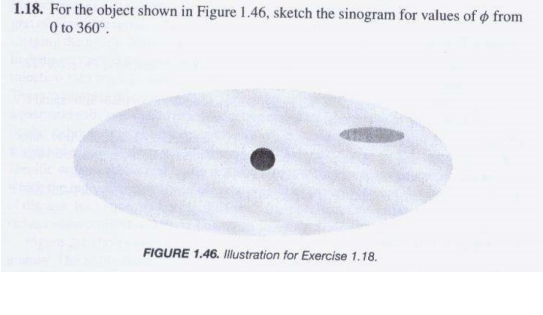 1.18. For the object shown in Figure 1.46, sketch the sinogram for values of ¢ from
010360°.
Re
FIGURE 1.46. lustraton for Exercise 1.15.
This is AI generated Response.
Asked by: gvr
Created at: 2025-07-02 11:00:47
Asked by: gvr
Created at: 2025-07-02 11:00:47
Final Answer:
Rendered
Raw Text
Did you like this answer?
Let's break down the problem and **sketch the sinogram** step by step.
---
### **Step 1: Understanding the Image**
- The image consists of:
- A large elliptical object (background).
- A small **dark circle** near the center.
- A small **dark ellipse** near the edge/off-center.
### **Step 2: What is a Sinogram?**
- A **sinogram** is a 2D plot where:
- The **horizontal axis** = Projection angle \(\phi\) (0° to 360°)
- The **vertical axis** = Detector position (distance along the projection line)
- Each point's value = Integral (sum) of object density along a line at angle \(\phi\).
### **Step 3: Analyzing Features**
- **Central Circle**: At every angle, its projection is at the center of the detector array. It will give a **horizontal straight line** in the sinogram at the central detector position.
- **Off-center Ellipse**: As you rotate, its position projected onto the detector will trace a **sinusoidal curve** (since its distance from the center varies sinusoidally with angle).
- **Background Ellipse**: If uniform, it forms a broad "background" in the sinogram, but we usually focus on the additional structures (the circle and the small ellipse).
### **Step 4: Sketching the Sinogram**
#### **a) Central Circle**
- Appears as a **horizontal line** (since it’s always in the same position w.r.t. the center for all angles).
#### **b) Off-center Ellipse**
- Appears as a **sinusoidal curve**: When the major axis of the ellipse aligns with the detector, the projection is widest; when perpendicular, it's narrowest.
- Its central position in the sinogram moves back and forth as a function of the angle, tracing a sine wave.
#### **c) Background**
- If uniform and elliptical, it forms a broad, smooth background, but in sinogram sketches, we typically emphasize the features.
---
### **Step 5: Drawing the Sinogram**
#### **Sketch Structure:**
- **Horizontal axis:** \(\phi\) from 0° to 360°
- **Vertical axis:** Detector position (centered at 0)
#### **Features:**
- **Horizontal line** at the central detector position (central circle)
- **Sinusoidal curve** (off-center ellipse)
- **Background** (optional, as a wide, light gray band filling the sinogram)
---
### **Step 6: Example Sketch**
```
| Sinogram |
|---------------------------------------------------------|
| |
| ~~~~~~~~ |
| ~ ~ |
| ~ ~ |
| ~ ~ |
| ~ ~ |
| ~ ~ |
| ~ ~ |
|---*---------------------------*-------------------------| <-- Horizontal line (central circle)
| ~ ~ |
| ~ ~ |
| ~ ~ |
| ~ ~ |
| ~ ~ |
| ~ ~ |
| ~~~~~~~~ |
|_________________________________________________________|
0 180 360
```
- The **starred line** is the horizontal line for the central circle.
- The **wavy line** is the sinusoid for the off-center ellipse.
---
## **Summary Table**
| Feature | Sinogram Appearance |
|--------------------|------------------------------------|
| Central circle | Horizontal straight line |
| Off-center ellipse | Sinusoidal curve |
| Main ellipse | Broad background (optional detail) |
---
## **Final Answer:**
- The **sinogram** consists of:
- A **horizontal straight line** (central circle).
- A **sinusoidal curve** (off-center ellipse).
- Optionally, a broad background for the main ellipse.
You can sketch it as described above, with the horizontal axis as angle (\(\phi\)) and the vertical as detector position.
📢 Instructions:
- Ask anything relatd to above question only.
- For new Question goto :