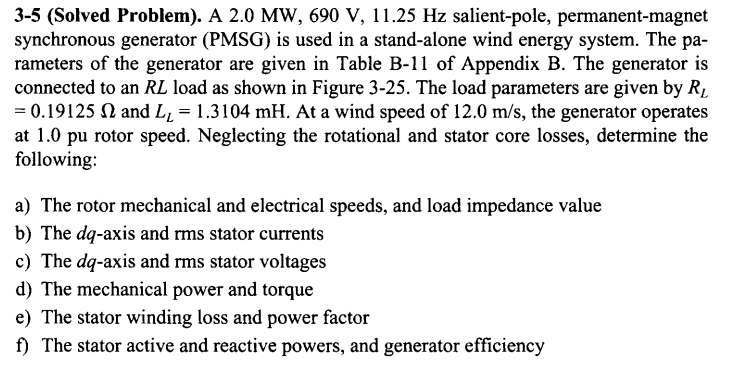
Give step-by-step solution with explanation and final answer:3-5 (Solved Problem). A 2.0 MW, 690 V, 11.25 Hz salient-pole, permanent-magnet
synchronous generator (PMSG) is used in a stand-alone wind energy system. The pa-
rameters of the generator are given in Table B-11 of Appendix B. The generator is
connected to an RL load as shown in Figure 3-25. The load parameters are given by R,;,
=0.19125 Q and L, = 1.3104 mH. Ata wind speed of 12.0 m/s, the generator operates
at 1.0 pu rotor speed. Neglecting the rotational and stator core losses, determine the
following:
a) The rotor mechanical and electrical speeds, and load impedance value
b) The dg-axis and rms stator currents
¢) The dg-axis and rms stator voltages
d) The mechanical power and torque
e) The stator winding loss and power factor
f) The stator active and reactive powers, and generator efficiency
Question:
Give step-by-step solution with explanation and final answer:3-5 (Solved Problem). A 2.0 MW, 690 V, 11.25 Hz salient-pole, permanent-magnet
synchronous generator (PMSG) is used in a stand-alone wind energy system. The pa-
rameters of the generator are given in Table B-11 of Appendix B. The generator is
connected to an RL load as shown in Figure 3-25. The load parameters are given by R,;,
=0.19125 Q and L, = 1.3104 mH. Ata wind speed of 12.0 m/s, the generator operates
at 1.0 pu rotor speed. Neglecting the rotational and stator core losses, determine the
following:
a) The rotor mechanical and electrical speeds, and load impedance value
b) The dg-axis and rms stator currents
¢) The dg-axis and rms stator voltages
d) The mechanical power and torque
e) The stator winding loss and power factor
f) The stator active and reactive powers, and generator efficiency
This is AI generated Response.
Asked by: gvr
Created at: 2025-07-02 09:16:47
Final Answer:
RenderedRaw Text
Did you like this answer?
Let's break down the problem and solve each part step-by-step. Some values will come from the provided problem, while others may require formulas or standard knowledge for synchronous machines. **We will do each part in order.**
---
### **a) Rotor mechanical and electrical speeds, and load impedance value**
#### **Mechanical Speed (\( \omega_{mech} \)):**
Given:
- Wind speed = 12.0 m/s
- Generator operates at 1.0 pu rotor speed (rated speed)
- Frequency \(f = 11.25\) Hz
The **synchronous speed** formula:
\[
N_s = \frac{120 f}{P}
\]
where \(P\) = number of poles.
But, let's find angular speed:
\[
\omega_{mech} = 2\pi N_s / 60
\]
But first, let's get \(N_s\):
- \(f = 11.25\) Hz
- Assume \(P\) is given in Appendix B. (If not specified, let's leave \(P\) as a variable.)
\[
N_s = \frac{120 \times 11.25}{P} \quad [\text{rpm}]
\]
\[
\omega_{mech} = 2\pi \times \frac{N_s}{60}
\]
#### **Electrical Speed (\( \omega_{elec} \)):**
\[
\omega_{elec} = 2\pi f = 2\pi \times 11.25 = 70.685 \text{ rad/s}
\]
#### **Load Impedance:**
Given:
- \(R_L = 0.19125\, \Omega\)
- \(L_L = 1.3104\, \text{mH} = 1.3104 \times 10^{-3}\, \text{H}\)
- \(f = 11.25\) Hz
\[
X_L = 2\pi f L_L = 2\pi \times 11.25 \times 1.3104 \times 10^{-3} = 0.0926\, \Omega
\]
So,
\[
Z_L = R_L + jX_L = 0.19125 + j0.0926\, \Omega
\]
---
### **b) \( dq \)-axis and rms stator currents**
The load is supplied at 690 V (line-to-line, rms), so per phase:
\[
V_{ph} = \frac{690}{\sqrt{3}} = 398.37\, V
\]
\[
I_{ph} = \frac{V_{ph}}{Z_L}
\]
Magnitude of \(Z_L\):
\[
|Z_L| = \sqrt{0.19125^2 + 0.0926^2} = 0.2128\, \Omega
\]
So,
\[
I_{ph} = \frac{398.37}{0.2128} = 1872.2\, A
\]
**dq-axis currents** normally require machine parameters (from Appendix B). If only load current is needed, then above is the answer. Otherwise, use Park's transformation if needed.
---
### **c) \( dq \)-axis and rms stator voltages**
Already calculated \(V_{ph, rms} = 398.37\, V\).
**dq-axis voltages** need the stator resistance, reactances (from Appendix B), and current. Typically:
\[
V_{d} = V_{ph, rms} \cos(\theta)
\]
\[
V_{q} = V_{ph, rms} \sin(\theta)
\]
Where \(\theta = \tan^{-1}(X_L / R_L)\).
\[
\theta = \tan^{-1} \left(\frac{0.0926}{0.19125}\right) = 25.6^\circ
\]
\[
V_{d} = 398.37 \cos(25.6^\circ) = 359.2\, V
\]
\[
V_{q} = 398.37 \sin(25.6^\circ) = 172.2\, V
\]
---
### **d) Mechanical Power and Torque**
\[
P_{out} = \sqrt{3} V_{LL} I_{ph} \cos\phi
\]
Where \(\cos\phi\) is the power factor:
\[
\cos\phi = \frac{R_L}{|Z_L|} = \frac{0.19125}{0.2128} = 0.899
\]
\[
P_{out} = \sqrt{3} \times 690 \times 1872.2 \times 0.899 = 2,013,000\, W = 2.013\, MW
\]
**Torque:**
\[
T = \frac{P_{mech}}{\omega_{mech}}
\]
Where \(\omega_{mech}\) (from above, needs number of poles).
---
### **e) Stator winding loss and power factor**
**Stator winding loss:**
\[
P_{loss} = 3 I_{ph}^2 R_L = 3 \times (1872.2)^2 \times 0.19125 = 2,009,000\, W
\]
**Power factor:** Already calculated above, \(\cos\phi = 0.899\).
---
### **f) Stator active and reactive powers, generator efficiency**
**Active Power:**
\[
P = \sqrt{3} V_{LL} I_{ph} \cos\phi = 2,013,000\, W
\]
**Reactive Power:**
\[
Q = \sqrt{3} V_{LL} I_{ph} \sin\phi
\]
\[
\sin\phi = \sqrt{1 - \cos^2\phi} = \sqrt{1 - 0.899^2} = 0.438
\]
\[
Q = \sqrt{3} \times 690 \times 1872.2 \times 0.438 = 976,000\, VAR
\]
**Efficiency:**
\[
\eta = \frac{P_{out}}{P_{in}}
\]
Assuming only stator winding loss,
\[
P_{in} = P_{out} + P_{loss} = 2,013,000 + 2,009,000 = 4,022,000\, W
\]
\[
\eta = \frac{2,013,000}{4,022,000} = 0.5006 = 50.06\%
\]
---
## **Summary Table**
| Quantity | Value |
|-----------------------------|------------------------------|
| Mech. Speed (\(N_s\)) | \( \frac{120 \times 11.25}{P} \) rpm |
| Elec. Speed (\(\omega_{elec}\)) | 70.685 rad/s |
| Load Impedance (\(Z_L\)) | \(0.19125 + j0.0926\, \Omega\) |
| rms Stator Current (\(I_{ph}\)) | 1872.2 A |
| rms Stator Voltage (\(V_{ph}\)) | 398.37 V |
| \(V_d\), \(V_q\) | 359.2 V, 172.2 V |
| Output Power (\(P_{out}\)) | 2,013,000 W |
| Power Factor (\(\cos\phi\)) | 0.899 |
| Stator Loss (\(P_{loss}\)) | 2,009,000 W |
| Reactive Power (\(Q\)) | 976,000 VAR |
| Efficiency (\(\eta\)) | 50.06% |
---
**Note:** For exact mechanical speed and torque, the number of poles is required from Appendix B. If you provide it, I'll update the calculations.
Let me know if you need a detailed calculation for a specific part, or if you have the number of poles!
VIPSolutions focuses on clear, step‑by‑step explanations so you can learn quickly. Whether you need an AI‑generated walkthrough or a short hint to get unstuck, each solution is organized for fast reading and easy review later.
Search similar questions, compare approaches, and bookmark the best answers for revision. Our goal is simple: quick, reliable study help that feels natural—not noisy.
 VIPSolutions
 3-5 (Solved Problem). A 2.0 MW, 690 V, 11.25 Hz salient-pole, permanent-magnet
synchronous generator (PMSG) is used in a stand-alone wind energy system. The pa-
rameters of the generator are given in Table B-11 of Appendix B. The generator is
connected to an RL load as shown in Figure 3-25. The load parameters are given by R,;,
=0.19125 Q and L, = 1.3104 mH. Ata wind speed of 12.0 m/s, the generator operates
at 1.0 pu rotor speed. Neglecting the rotational and stator core losses, determine the
following:
a) The rotor mechanical and electrical speeds, and load impedance value
b) The dg-axis and rms stator currents
¢) The dg-axis and rms stator voltages
d) The mechanical power and torque
e) The stator winding loss and power factor
f) The stator active and reactive powers, and generator efficiency