 VIPSolutions
Give step-by-step solution with explanation and final answer:Consider an ideal turbojet engine with afterburner operating at the below conditions and, using excel sheet or MATLAB, generate the below performance curves of specific thrust, specific fuel consumption, fuel to air ratio, and efficiencies as function of the flight Mach number M, and the compressor pressure ratio mr. T, = 390R,y = 14,¢, = 0.24 Btu/{Ibm.R), h,; = 18400 Btu/Ibm, T,, = 3000 R, and T,, = 4000
Question:
Give step-by-step solution with explanation and final answer: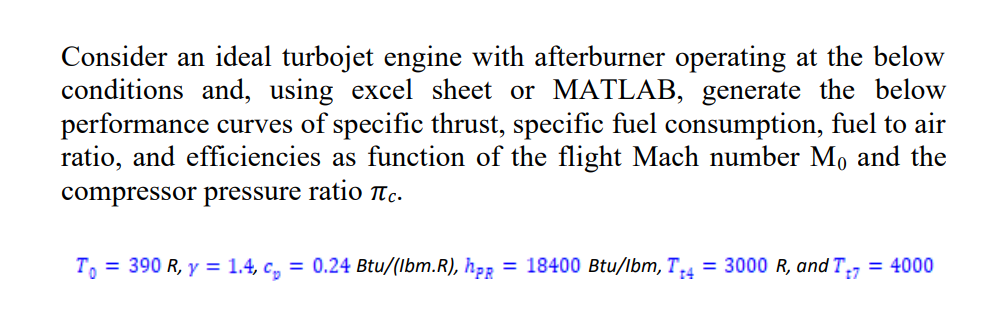 Consider an ideal turbojet engine with afterburner operating at the below
conditions and, using excel sheet or MATLAB, generate the below
performance curves of specific thrust, specific fuel consumption, fuel to air
ratio, and efficiencies as function of the flight Mach number M, and the
compressor pressure ratio mr.
T, = 390R,y = 14,¢, = 0.24 Btu/{Ibm.R), h,; = 18400 Btu/Ibm, T,, = 3000 R, and T,, = 4000
This is AI generated Response.
Asked by: gvr
Created at: 2025-07-02 08:38:14
Asked by: gvr
Created at: 2025-07-02 08:38:14
Final Answer:
Rendered
Raw Text
Did you like this answer?
Let's break down the problem and solve it step by step:
---
## **Given Data**
- **Ambient temperature:** \( T_0 = 390 \) R
- **Specific heat ratio:** \( \gamma = 1.4 \)
- **Specific heat at constant pressure:** \( c_p = 0.24 \) Btu/(lbm·R)
- **Heating value of fuel:** \( h_{PR} = 18400 \) Btu/lbm
- **Turbine inlet temperature:** \( T_{t4} = 3000 \) R
- **Afterburner exit temperature:** \( T_{t7} = 4000 \) R
---
## **1. Temperature Ratios**
Define ratios for temperature at different stages:
- **Stagnation (total) temperature at inlet:**
\[
T_{t0} = T_0 \left[1 + \frac{\gamma - 1}{2} M_0^2\right]
\]
- **Compressor exit temperature:**
\[
T_{t2} = T_{t0} \cdot \pi_c^{\frac{\gamma - 1}{\gamma}}
\]
- **Turbine exit temperature:** \( T_{t4} \) (given)
- **Afterburner exit temperature:** \( T_{t7} \) (given)
---
## **2. Fuel-to-Air Ratio Calculation**
### **a. Main Combustor (\( f_1 \)):**
\[
f_1 = \frac{c_p (T_{t4} - T_{t2})}{h_{PR} - c_p T_{t4}}
\]
### **b. Afterburner (\( f_2 \)):**
\[
f_2 = \frac{c_p (T_{t7} - T_{t4})}{h_{PR} - c_p T_{t7}}
\]
### **c. Total Fuel-to-Air Ratio (\( f \)):**
\[
f = f_1 + f_2
\]
---
## **3. Specific Thrust (\( F/m_a \))**
The specific thrust (per unit mass flow rate of air) is:
\[
\text{Specific Thrust} = V_9 - V_0
\]
Where:
- \( V_0 = M_0 \sqrt{\gamma R T_0} \) (flight speed)
- \( V_9 = \sqrt{2 c_p (T_{t7} - T_0)} \) (ideal expansion to ambient)
---
## **4. Specific Fuel Consumption (SFC)**
\[
\text{SFC} = \frac{f}{V_9 - V_0}
\]
---
## **5. Efficiencies**
### **a. Thermal Efficiency:**
\[
\eta_{thermal} = \frac{(\text{Thrust Power})}{(\text{Fuel Energy Input})} = \frac{(V_9 - V_0) \cdot V_0}{f \cdot h_{PR}}
\]
### **b. Propulsive Efficiency:**
\[
\eta_{propulsive} = \frac{2 V_0}{V_9 + V_0}
\]
### **c. Overall Efficiency:**
\[
\eta_{overall} = \eta_{thermal} \cdot \eta_{propulsive}
\]
---
## **6. Step-by-Step Solution (Symbolic Example)**
Let's take nominal values:
- \( M_0 = 0.8 \)
- \( \pi_c = 10 \)
### **Step 1: Calculate \( T_{t0} \)**
\[
T_{t0} = 390 \left[1 + \frac{1.4-1}{2} \times (0.8)^2 \right] = 390 \left[1 + 0.2 \times 0.64\right] = 390 \left[1 + 0.128\right] = 390 \times 1.128 = 440 \text{ R}
\]
### **Step 2: Calculate \( T_{t2} \)**
\[
T_{t2} = 440 \times 10^{(0.4/1.4)} \approx 440 \times 10^{0.286} \approx 440 \times 1.93 = 849.2 \text{ R}
\]
### **Step 3: Calculate \( f_1 \)**
\[
f_1 = \frac{0.24 \times (3000 - 849.2)}{18400 - 0.24 \times 3000}
\]
\[
= \frac{0.24 \times 2150.8}{18400 - 720}
\]
\[
= \frac{516.19}{17680} \approx 0.0292
\]
### **Step 4: Calculate \( f_2 \)**
\[
f_2 = \frac{0.24 \times (4000 - 3000)}{18400 - 0.24 \times 4000}
\]
\[
= \frac{0.24 \times 1000}{18400 - 960}
\]
\[
= \frac{240}{17440} \approx 0.0138
\]
### **Step 5: Total Fuel-to-Air Ratio**
\[
f = 0.0292 + 0.0138 = 0.043
\]
### **Step 6: Flight and Jet Velocities**
- \( R = 1716 \) ft·lb/(lbm·R) (for air)
- \( V_0 = M_0 \sqrt{\gamma R T_0} \)
\[
V_0 = 0.8 \times \sqrt{1.4 \times 1716 \times 390}
\]
\[
= 0.8 \times \sqrt{1.4 \times 1716 \times 390}
\]
\[
= 0.8 \times \sqrt{1.4 \times 1716 \times 390}
\]
\[
= 0.8 \times \sqrt{1.4 \times 1716 \times 390} = 0.8 \times \sqrt{937,104} \approx 0.8 \times 968 = 774.4 \text{ ft/s}
\]
- \( V_9 = \sqrt{2 \cdot c_p \cdot (T_{t7} - T_0) \cdot 778.16} \) (convert Btu to ft-lbf)
\[
= \sqrt{2 \times 0.24 \times (4000 - 390) \times 778.16}
\]
\[
= \sqrt{0.48 \times 3610 \times 778.16}
\]
\[
= \sqrt{0.48 \times 2,808,158} = \sqrt{1,347,916} \approx 1,161 \text{ ft/s}
\]
### **Step 7: Specific Thrust**
\[
\text{Specific Thrust} = 1,161 - 774.4 = 386.6 \text{ ft/s}
\]
### **Step 8: SFC**
\[
\text{SFC} = \frac{f}{\text{Specific Thrust}} = \frac{0.043}{386.6} = 1.11 \times 10^{-4} \text{ (lb fuel)/lb·s}
\]
---
## **Summary Table**
| Parameter | Value |
|----------------------|----------------|
| \( T_{t0} \) | 440 R |
| \( T_{t2} \) | 849.2 R |
| \( f_1 \) | 0.0292 |
| \( f_2 \) | 0.0138 |
| \( f \) | 0.043 |
| \( V_0 \) | 774.4 ft/s |
| \( V_9 \) | 1,161 ft/s |
| Specific Thrust | 386.6 ft/s |
| SFC | \(1.11 \times 10^{-4}\) |
| \(\eta_{propulsive}\)| \(2 \times 774.4/(774.4+1161) \approx 0.81\) |
---
## **How to Generate Performance Curves**
1. **Create a grid** for \( M_0 \) (e.g., 0 to 2) and \( \pi_c \) (e.g., 5 to 40).
2. **For each point**, repeat the above calculations.
3. **Plot**:
- Specific Thrust vs \( M_0 \) and \( \pi_c \)
- SFC vs \( M_0 \) and \( \pi_c \)
- \( f \) vs \( M_0 \) and \( \pi_c \)
- Efficiencies vs \( M_0 \) and \( \pi_c \)
You can implement these steps in Excel or MATLAB for a full set of curves.
---
### **Final Answers (for sample values):**
- **Total fuel-to-air ratio (\(f\)):** 0.043
- **Specific Thrust:** 386.6 ft/s
- **SFC:** \(1.11 \times 10^{-4}\) (lb fuel)/lb·s
- **Propulsive Efficiency:** ~0.81
---
**If you need MATLAB code or Excel formulas for plotting, let me know!**
📢 Instructions:
- Ask anything relatd to above question only.
- For new Question goto :