 VIPSolutions
Give step-by-step solution with explanation and final answer:Draw a graph that models the connecting relationships in the floorplan below. The vertices represent the rooms and the edges represent doorways connecting the rooms. Vertex F' represents the outdoors. 4 I B LL ’ 1 3 — Is it possible to find a circuit through the house that uses each doorway once? If so, enter the sequence of rooms(vertices) visited, for example ABDEA. If it is not possible, enter DNE.
Question:
Give step-by-step solution with explanation and final answer: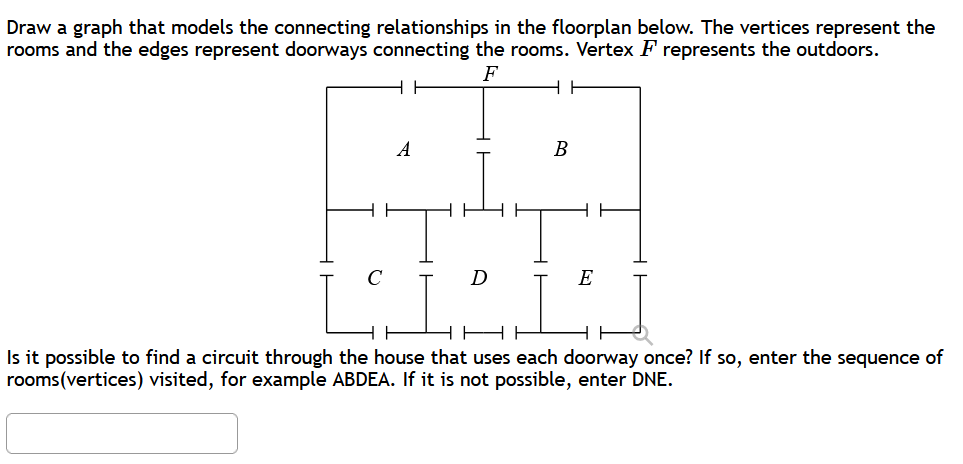 Draw a graph that models the connecting relationships in the floorplan below. The vertices represent the
rooms and the edges represent doorways connecting the rooms. Vertex F' represents the outdoors.
4 I B
LL ’ 1 3
—
Is it possible to find a circuit through the house that uses each doorway once? If so, enter the sequence of
rooms(vertices) visited, for example ABDEA. If it is not possible, enter DNE.
This is AI generated Response.
Asked by: gvr
Created at: 2025-07-02 07:03:39
Asked by: gvr
Created at: 2025-07-02 07:03:39
Final Answer:
Rendered
Raw Text
Did you like this answer?
Let's solve the problem step by step:
---
### **Step 1: Draw the Graph**
Let's label the vertices as the rooms: \(A, B, C, D, E\) and the outdoors as \(F\).
Now, let's list the connections (edges) based on the floorplan:
- \(F\) is connected to \(A\) and \(B\)
- \(A\) is connected to \(B\) and \(C\)
- \(B\) is connected to \(D\) and \(E\)
- \(A\) is connected to \(D\)
- \(C\) is connected to \(D\)
- \(D\) is connected to \(E\)
- \(C\) is connected to \(F\)
- \(E\) is connected to \(F\)
Let's write out all edges:
- \(FA, FB, FC, FE\)
- \(AB, AD, BC, BD, BE, CD, DE\)
But from the diagram, let's clarify the actual connections:
1. \(F\)–\(A\)
2. \(F\)–\(B\)
3. \(F\)–\(E\)
4. \(F\)–\(C\)
5. \(A\)–\(B\)
6. \(A\)–\(D\)
7. \(A\)–\(C\)
8. \(B\)–\(E\)
9. \(B\)–\(D\)
10. \(C\)–\(D\)
11. \(D\)–\(E\)
12. \(C\)–\(E\) (This doesn't exist)
From the image, there is **no direct edge** from \(C\) to \(E\).
---
### **Step 2: Check for an Eulerian Circuit**
Recall the rule:
- **Eulerian Circuit**: All vertices must have even degree.
Let's count the degree of each vertex:
- **A:** Connected to \(F, B, C, D\) ⇒ degree **4** (even)
- **B:** Connected to \(F, A, D, E\) ⇒ degree **4** (even)
- **C:** Connected to \(F, A, D\) ⇒ degree **3** (odd)
- **D:** Connected to \(A, B, C, E\) ⇒ degree **4** (even)
- **E:** Connected to \(F, B, D\) ⇒ degree **3** (odd)
- **F:** Connected to \(A, B, C, E\) ⇒ degree **4** (even)
So, **C** and **E** have odd degrees (3 each).
---
### **Step 3: Conclusion**
Since there are more than 0 vertices with odd degree (in fact, there are 2), **it is NOT possible to find a circuit through the house that uses each doorway once** (i.e., an Eulerian circuit).
If there are exactly 2 vertices of odd degree, an **Eulerian path** (not a circuit) exists. But the problem asks for a circuit.
---
### **Final Answer**
\[
\boxed{\text{DNE}}
\]
**Explanation:** There are two vertices (C and E) with odd degree, so an Eulerian circuit does not exist.
Question:
Is it possible to find a circuit through the house that uses each doorway once? If so, enter the sequence of rooms(vertices) visited, for example ABDEA. If it is not possible, enter DNE.
This is AI generated Response.
Asked by: gvr
Created at: 2025-07-02 07:05:41
Asked by: gvr
Created at: 2025-07-02 07:05:41
Final Answer:
Rendered
Raw Text
Did you like this answer?
Let's analyze the problem step-by-step to determine whether an Eulerian circuit exists in the graph representing the house's rooms and doorways.
---
### **Step 1: Understand the problem**
- **Vertices:** Rooms \(A, B, C, D, E\) and outdoors \(F\).
- **Edges:** Doorways connecting rooms.
- **Goal:** Find a path that uses each doorway exactly once and starts and ends at the same vertex (Eulerian circuit).
---
### **Step 2: Draw and identify the graph**
Based on the floorplan, the connections are:
- \(F\) connected to \(A, B, C, E\)
- \(A\) connected to \(F, B, C, D\)
- \(B\) connected to \(F, A, D, E\)
- \(C\) connected to \(F, A, D\)
- \(D\) connected to \(A, B, C, E\)
- \(E\) connected to \(F, B, D\)
### **Step 3: List all edges**
- \(F - A\)
- \(F - B\)
- \(F - C\)
- \(F - E\)
- \(A - B\)
- \(A - C\)
- \(A - D\)
- \(B - D\)
- \(B - E\)
- \(C - D\)
- \(D - E\)
---
### **Step 4: Count degrees of each vertex**
Number of edges incident to each vertex:
- \(A\): connected to \(F, B, C, D\) → degree **4** (even)
- \(B\): connected to \(F, A, D, E\) → degree **4** (even)
- \(C\): connected to \(F, A, D\) → degree **3** (odd)
- \(D\): connected to \(A, B, C, E\) → degree **4** (even)
- \(E\): connected to \(F, B, D\) → degree **3** (odd)
- \(F\): connected to \(A, B, C, E\) → degree **4** (even)
### **Step 5: Determine the existence of an Eulerian circuit**
- **Eulerian circuit exists if and only if**:
- All vertices have **even degree**.
- The graph is connected.
In our case:
- Vertices \(C\) and \(E\) have **odd degrees** (3).
- The other vertices have **even degrees**.
Since **not all vertices have even degrees**, **an Eulerian circuit does not exist**.
---
### **Step 6: Check for Eulerian path**
- **Eulerian path exists if**:
- Exactly **two** vertices have **odd degree**.
- The graph is connected.
Our graph has **two vertices with odd degree (C and E)**, and the graph is connected.
**Therefore**, an **Eulerian path** (a path that uses each doorway exactly once, but does not necessarily start and end at the same vertex) **exists**.
---
### **Step 7: Final answer**
Since the question asks specifically for a **circuit** (which requires starting and ending at the same vertex), and our graph does **not** meet the criteria for an Eulerian circuit, the answer is:
\[
\boxed{\text{DNE}}
\]
---
### **Final conclusion:**
**It is not possible to find a circuit through the house that uses each doorway once.**
**Answer: DNE**
📢 Instructions:
- Ask anything relatd to above question only.
- For new Question goto :