 VIPSolutions
Give step-by-step solution with explanation and final answer:Problem 2: Consider a general uniform source panel of the total length / lying atan angle ® c[0, 27] as shown in Fig. 3. The center 0’ of the panel i at (x,, ,): LY vo v vie 5 Pog) ¥ w_ Ths forces A g - Fig. 3. A straight source panel of uniform strength along the horizontal direction, 1. Following the lectures, starting from the standard results for Fig. 2, write down the formulas for u(x, ) and v(x, ) in Fig. 3 by using the transformation relations 50 that the results can be expressed as w= fl) 2r 2) 2 @ Ed ACHR RX) Vo LBD) 2. Subsequently, compute the numerical vakies of (1) for the following case: 5 oa ® Ko=hemhi=a md
Question:
Give step-by-step solution with explanation and final answer: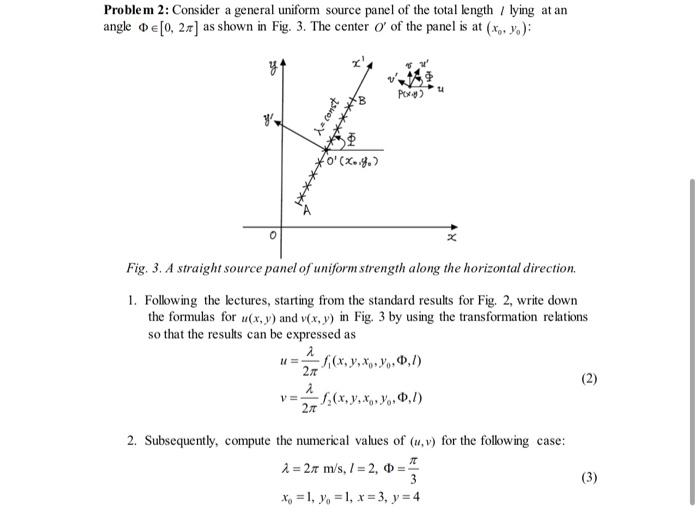 Problem 2: Consider a general uniform source panel of the total length / lying atan
angle ® c[0, 27] as shown in Fig. 3. The center 0’ of the panel i at (x,, ,):
LY vo
v vie
5 Pog) ¥
w_
Ths
forces
A
g -
Fig. 3. A straight source panel of uniform strength along the horizontal direction,
1. Following the lectures, starting from the standard results for Fig. 2, write down
the formulas for u(x, ) and v(x, ) in Fig. 3 by using the transformation relations
50 that the results can be expressed as
w= fl)
2r 2)
2 @
Ed ACHR RX)
Vo LBD)
2. Subsequently, compute the numerical vakies of (1) for the following case:
5
oa ®
Ko=hemhi=a md
This is AI generated Response.
Asked by: gvr
Created at: 2025-07-02 06:27:47
Asked by: gvr
Created at: 2025-07-02 06:27:47
Final Answer:
Rendered
Raw Text
Did you like this answer?
Let's solve the problem **step by step**:
### **Step 1: Express \( u \) and \( v \) in Terms of the Panel Parameters**
We are to express the velocity components \((u, v)\) at a point \((x, y)\) due to a **uniform source panel** of strength \( \lambda \), length \( l \), oriented at angle \( \Phi \), with center at \((x_0, y_0)\).
For a horizontal panel (from lectures or standard sources), the induced velocity components at a field point \((x', y')\) in the panel-local coordinates are:
\[
u' = \frac{\lambda}{2\pi} \ln\left(\frac{R_2}{R_1}\right)
\]
\[
v' = \frac{\lambda}{2\pi} (\theta_2 - \theta_1)
\]
where:
- \( R_1 \), \( R_2 \) are distances from the point to the ends of the panel,
- \( \theta_1 \), \( \theta_2 \) are angles from the panel to the point.
### **Transformation to Global Coordinates**
The panel is not necessarily horizontal. Its local axes are rotated by angle \( \Phi \). The transformation from global coordinates \((x, y)\) to panel-local coordinates \((x', y')\) is:
\[
\begin{pmatrix}
x' \\
y'
\end{pmatrix}
=
\begin{pmatrix}
\cos\Phi & \sin\Phi \\
-\sin\Phi & \cos\Phi
\end{pmatrix}
\begin{pmatrix}
x - x_0 \\
y - y_0
\end{pmatrix}
\]
So,
\[
x' = (x-x_0)\cos\Phi + (y-y_0)\sin\Phi
\]
\[
y' = -(x-x_0)\sin\Phi + (y-y_0)\cos\Phi
\]
The panel spans from \( x' = -l/2 \) to \( x' = +l/2 \).
#### **Distances to Panel Ends**
- Endpoint 1: \( (x_1', y_1') = (-l/2, 0) \)
- Endpoint 2: \( (x_2', y_2') = (l/2, 0) \)
Thus,
\[
R_1 = \sqrt{(x' + l/2)^2 + (y')^2}
\]
\[
R_2 = \sqrt{(x' - l/2)^2 + (y')^2}
\]
\[
\theta_1 = \arctan\left(\frac{y'}{x' + l/2}\right)
\]
\[
\theta_2 = \arctan\left(\frac{y'}{x' - l/2}\right)
\]
#### **Transforming \( (u', v') \) to \( (u, v) \):**
The induced velocities in global coordinates are:
\[
\begin{pmatrix}
u \\
v
\end{pmatrix}
=
\begin{pmatrix}
\cos\Phi & -\sin\Phi \\
\sin\Phi & \cos\Phi
\end{pmatrix}
\begin{pmatrix}
u' \\
v'
\end{pmatrix}
\]
---
### **Step 2: Plug in the Given Values**
Given:
- \( \lambda = 2\pi \) m/s
- \( l = 2 \)
- \( \Phi = \pi/3 \)
- \( x_0 = 1, y_0 = 1 \)
- \( x = 3, y = 4 \)
#### **Compute local coordinates:**
\[
x' = (3-1)\cos\left(\frac{\pi}{3}\right) + (4-1)\sin\left(\frac{\pi}{3}\right) \\
x' = (2)\left(\frac{1}{2}\right) + (3)\left(\frac{\sqrt{3}}{2}\right) \\
x' = 1 + \frac{3\sqrt{3}}{2} \approx 1 + 2.598 = 3.598
\]
\[
y' = -(3-1)\sin\left(\frac{\pi}{3}\right) + (4-1)\cos\left(\frac{\pi}{3}\right) \\
y' = -2\left(\frac{\sqrt{3}}{2}\right) + 3\left(\frac{1}{2}\right) \\
y' = -\sqrt{3} + 1.5 \approx -1.732 + 1.5 = -0.232
\]
#### **Compute \( R_1, R_2 \):**
\[
R_1 = \sqrt{(x' + l/2)^2 + (y')^2} = \sqrt{(3.598 + 1)^2 + (-0.232)^2} = \sqrt{(4.598)^2 + 0.0538}
\]
\[
(4.598)^2 \approx 21.134
\]
\[
R_1 \approx \sqrt{21.134 + 0.0538} = \sqrt{21.1878} \approx 4.602
\]
\[
R_2 = \sqrt{(x' - l/2)^2 + (y')^2} = \sqrt{(3.598 - 1)^2 + (-0.232)^2} = \sqrt{(2.598)^2 + 0.0538}
\]
\[
(2.598)^2 \approx 6.748
\]
\[
R_2 \approx \sqrt{6.748 + 0.0538} = \sqrt{6.8018} \approx 2.609
\]
#### **Compute \( \theta_1, \theta_2 \):**
\[
\theta_1 = \arctan\left(\frac{-0.232}{3.598 + 1}\right) = \arctan\left(\frac{-0.232}{4.598}\right) \approx \arctan(-0.0505) \approx -0.0505\ \text{rad}
\]
\[
\theta_2 = \arctan\left(\frac{-0.232}{3.598 - 1}\right) = \arctan\left(\frac{-0.232}{2.598}\right) \approx \arctan(-0.0893) \approx -0.0891\ \text{rad}
\]
#### **Plug into \( u', v' \):**
\[
u' = \frac{2\pi}{2\pi}\ln\left(\frac{4.602}{2.609}\right) = \ln(1.763) \approx 0.567
\]
\[
v' = \frac{2\pi}{2\pi}(-0.0505 + 0.0891) = 0.0386
\]
#### **Transform back to global coordinates:**
\[
u = u'\cos\Phi - v'\sin\Phi
\]
\[
v = u'\sin\Phi + v'\cos\Phi
\]
\[
\cos\Phi = \cos\left(\frac{\pi}{3}\right) = 0.5,\ \sin\Phi = \frac{\sqrt{3}}{2} \approx 0.866
\]
\[
u = 0.567 \cdot 0.5 - 0.0386 \cdot 0.866 \approx 0.284 - 0.0334 = 0.2506
\]
\[
v = 0.567 \cdot 0.866 + 0.0386 \cdot 0.5 \approx 0.491 + 0.0193 = 0.5103
\]
---
### **Final Answer**
\[
\boxed{
u \approx 0.25, \quad v \approx 0.51
}
\]
---
#### **Summary of Steps:**
1. **Transform** the field point \((x, y)\) to panel coordinates \((x', y')\).
2. **Calculate** \(R_1, R_2, \theta_1, \theta_2\).
3. **Compute** \(u', v'\) in panel coordinates.
4. **Transform** \(u', v'\) back to global coordinates \(u, v\).
5. **Plug in** the given values and evaluate numerically.
📢 Instructions:
- Ask anything relatd to above question only.
- For new Question goto :