 VIPSolutions
Give step-by-step solution with explanation and final answer:Sketch the derivative of the following graphs. Make sure you remember what you've learned about local maxima, local minima, and concavity while you draw your graph. Every point on the derivative graph should correspond to the slope of the original function. y y I 43 1 % 1 y 1 i x
Question:
Give step-by-step solution with explanation and final answer: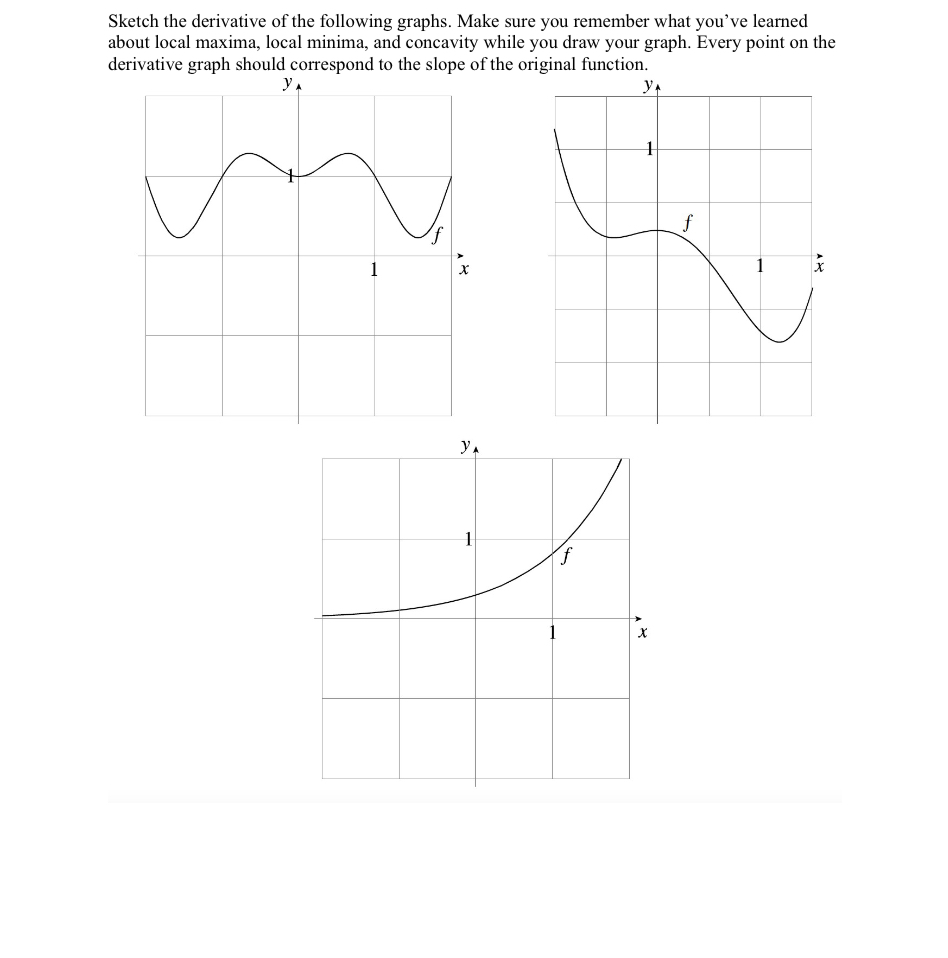 Sketch the derivative of the following graphs. Make sure you remember what you've learned
about local maxima, local minima, and concavity while you draw your graph. Every point on the
derivative graph should correspond to the slope of the original function.
y y
I
43
1 % 1
y
1
i
x
This is AI generated Response.
Asked by: gvr
Created at: 2025-07-01 16:45:58
Asked by: gvr
Created at: 2025-07-01 16:45:58
Final Answer:
Rendered
Raw Text
Did you like this answer?
Let's analyze each graph step by step and sketch their derivatives:
---
### **Top Left Graph**
#### **Step-by-Step Solution:**
1. **Identify Critical Points (where slope = 0):**
- Local maxima/minima: The derivative will cross the x-axis at these points.
2. **Look at Intervals:**
- Where the original function is increasing, the derivative is positive.
- Where the original function is decreasing, the derivative is negative.
3. **Look at Concavity:**
- The steepness of the function tells you how large/small the derivative should be.
#### **Explanation:**
- There are three critical points: one minimum (left), one maximum (middle), and one minimum (right).
- The derivative is positive when the curve is increasing and negative when decreasing.
- At the peaks and troughs, the derivative crosses the x-axis.
#### **Sketch:**
The derivative will look like a wave crossing the x-axis at each max/min, with positive values where the function is rising and negative where it is falling.
---
### **Top Right Graph**
#### **Step-by-Step Solution:**
1. **Identify Critical Points:**
- Two minima (where the slope is 0).
2. **Intervals:**
- Curve starts decreasing (negative slope), flattens out, increases (positive slope), flattens, then decreases (negative slope).
3. **Concavity:**
- Note how steeply it rises/falls.
#### **Explanation:**
- Derivative starts negative, goes to zero at the first minimum, becomes positive, then zero at the next minimum, then negative again.
#### **Sketch:**
The derivative will have two zeros (one at each minimum), with a positive peak between them and negative elsewhere.
---
### **Bottom Graph**
#### **Step-by-Step Solution:**
1. **Shape:**
- This is a monotonic increasing curve, becoming steeper.
2. **Derivative:**
- Always positive, increasing as you move to the right (because the slope is getting steeper).
#### **Explanation:**
- The derivative starts small and increases rapidly.
#### **Sketch:**
The derivative will be an increasing curve, starting low and rising steeply.
---
### **Final Answer (Summary Sketches):**
Here are qualitative sketches for each derivative:
---
#### **Top Left:**
- Starts positive, crosses zero (at minimum), becomes negative (at maximum), crosses zero again (at minimum), becomes positive.
- Shape: Classic cubic derivative (looks like a parabola or a wave crossing x-axis at each critical point).
#### **Top Right:**
- Starts negative, zero at minimum, positive, zero at next minimum, negative.
- Shape: Looks like an "M" or "W" (depending on orientation).
#### **Bottom:**
- Always positive, increasing rapidly.
- Shape: Exponential-like (if original was exponential), or quadratic-like if original was a parabola.
---
**If you want, I can draw these derivative sketches for you! Would you like a visual sketch?**
📢 Instructions:
- Ask anything relatd to above question only.
- For new Question goto :