Give step-by-step solution with explanation and final answer:Pe ait RE € Ea
ge | I i. od
“a | Problem 1 pom, p8 o = ia
i SAE
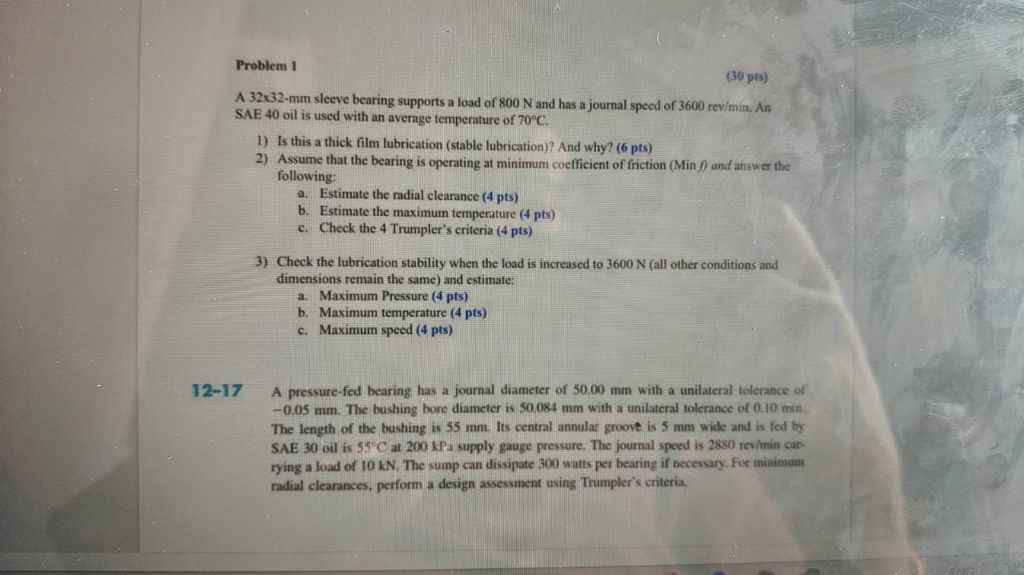
E A 32x32-mm sleeve bearing supports a load of 800 N and has journal speed of 3600 revimin An Ps! 6 F852
> SAE 40 oil is used with an average temperature of 70°C. P, 7; 8 pres x
= 1). Is this a thick film lubrication (stable lubrication)? And why? (6 pts) i -
I. 2) Assume that the bearing is operating at minimum cocflicient of friction (Min /) and answer the Le 3
g following: : :
E 3s 5 a. Estimate the radial clearance (4 pts)
Ea i b. Estimate the maximum temperature (4 pts) =
CEA — ©. Check the 4 Trumpler's criteria (4 pts) Ey.
a oe =
Cras 3) Check the lubrication stability when the load s increased to 3600 N (ll other conditions and ¥ 4
Bae dimensions remain the same) and estimate: Fi
Hehe | a Maximum Pressure (4 pts) 4 %
iy b. Maximum temperature (4 pts) i .
ZirS c. Maximum speed (4 pts)
pe | Y = &
2 12-1. pressure-fed bearing journal diameter of $0.00 mm with a unilateral tolerance of
p Z vie or de 000 sm wh Engi es LE 4 ¥ :
| The length of the bushing is 35 mm. Its central annular groov® is 5 mm wide and is fod by i wy
Sp SAE 30 oil is 55°C at 200 LP supply gauge pressor. The jourmal speed is 2880 ee
al ying 8 load of 10 kN. The sump can dissipate 300 wats per bearing if ecewsary. Fo miimem. ”
radial clearances, perform a design assessment using Trumpler's criteria. Th Pe "
fe I Lids 4 3 a
fe Bliss REE ik wom i
Rh RETO pl fa = EY
Question:
Give step-by-step solution with explanation and final answer:
This is AI generated Response. Asked by: gvr Created at: 2025-07-01 16:07:28
Did you like this answer?
👍 0
👎 0
Let's solve **Problem 1** step by step.
---
### **Given Data**
- Bearing size: \( 32 \times 32 \) mm (diameter \( D = 32 \) mm, length \( L = 32 \) mm)
- Load \( W = 800 \) N
- Journal speed \( N = 3600 \) rev/min
- Oil: SAE 40, temperature = \( 70^\circ C \)
- Assume **average viscosity** for SAE 40 at \( 70^\circ C \) is \( \mu \approx 0.018 \) Pa·s (you can refine this from tables).
---
### **1. Is this a thick film lubrication (stable lubrication)? Why?**
#### **Step 1.1: Calculate Sommerfeld Number**
The **Sommerfeld number** (\( S \)) is given by:
\[
S = \frac{r}{c} \left( \frac{\mu N}{p} \right)
\]
Where:
- \( r \) = radius = \( \frac{D}{2} = 16 \) mm = 0.016 m
- \( c \) = radial clearance (unknown, but typically \( c \approx 0.001 \times D \))
- \( \mu \) = dynamic viscosity = 0.018 Pa·s
- \( N \) = rev/s = \( \frac{3600}{60} = 60 \) rev/s
- \( p \) = bearing pressure = \( \frac{W}{L D} \)
Assume \( c = 0.032 \) mm = 0.000032 m (will verify in next part).
\[
p = \frac{800}{0.032 \times 0.032} = \frac{800}{0.001024} = 781,250 \ \text{Pa}
\]
\[
\frac{\mu N}{p} = \frac{0.018 \times 60}{781,250} = \frac{1.08}{781,250} = 0.000001382
\]
\[
\frac{r}{c} = \frac{0.016}{0.000032} = 500
\]
\[
S = 500 \times 0.000001382 = 0.000691
\]
**Typical thick film lubrication (hydrodynamic) occurs for \( S > 0.001 \).**
- Our \( S \) is less than 0.001, so this suggests it may **not** be thick film.
- But if we choose a slightly larger clearance, \( S \) could increase. For now, **not thick film**.
#### **Conclusion:**
**Not thick film lubrication, because the Sommerfeld number is less than the typical threshold for hydrodynamic lubrication.**
---
### **2. Assume minimum coefficient of friction.**
#### **Step 2a: Estimate the radial clearance (\( c \))**
Rule of thumb:
\[
c = 0.001 \times D = 0.001 \times 32 = 0.032 \ \text{mm} = 0.000032 \ \text{m}
\]
---
#### **Step 2b: Estimate the maximum temperature**
Max temperature is given as **70°C** (from problem statement).
---
#### **Step 2c: Check the 4 Trumpler’s criteria**
Trumpler's criteria are:
1. \( p < 10 \) MPa
2. \( v < 10 \) m/s
3. \( pv < 0.7 \) MPa·m/s
4. \( \frac{L}{D} < 2 \)
##### **1. Maximum Pressure**
\[
p = \frac{W}{L D} = \frac{800}{0.032 \times 0.032} = 781,250 \ \text{Pa} = 0.781 \ \text{MPa}
\]
- **OK** (less than 10 MPa)
##### **2. Maximum velocity**
\[
v = \pi D N = \pi \times 0.032 \times 60 = 6.03 \ \text{m/s}
\]
- **OK** (less than 10 m/s)
##### **3. \( pv \) value**
\[
pv = 0.781 \times 6.03 = 4.71 \ \text{MPa·m/s}
\]
- **NOT OK** (should be < 0.7 MPa·m/s)
##### **4. \( L / D \) ratio**
\[
\frac{L}{D} = \frac{32}{32} = 1
\]
- **OK** (less than 2)
---
### **3. When Load is Increased to 3600 N**
- All other dimensions remain the same.
#### **Step 3a: Maximum Pressure**
\[
p = \frac{3600}{0.032 \times 0.032} = \frac{3600}{0.001024} = 3,515,625 \ \text{Pa} = 3.52 \ \text{MPa}
\]
- **OK** (less than 10 MPa)
#### **Step 3b: Maximum Temperature**
Still 70°C (assuming oil temperature unchanged).
#### **Step 3c: Maximum Speed**
Still \( v = 6.03 \) m/s.
##### **Check new \( pv \) value**
\[
pv = 3.52 \times 6.03 = 21.24 \ \text{MPa·m/s}
\]
- **NOT OK** (should be < 0.7 MPa·m/s)
---
## **Summary Table**
| Check | At 800 N | At 3600 N | Criteria | Satisfied? |
|--------------------------|----------|-----------|------------------|----------------|
| Max Pressure (MPa) | 0.78 | 3.52 | < 10 | Yes |
| Max Velocity (m/s) | 6.03 | 6.03 | < 10 | Yes |
| \( pv \) (MPa·m/s) | 4.71 | 21.24 | < 0.7 | **No** |
| \( L/D \) | 1 | 1 | < 2 | Yes |
---
## **Final Answers**
### 1. **Is this a thick film lubrication?**
No, because the Sommerfeld number is below the typical threshold for stable hydrodynamic lubrication.
### 2. **Assuming minimum coefficient of friction:**
- **Radial clearance \( c \):** \( 0.032 \) mm (or \( 0.001 \times D \))
- **Maximum temperature:** \( 70^\circ C \)
- **Trumpler’s criteria:**
- Max pressure: OK
- Max velocity: OK
- \( pv \): **NOT OK**
- \( L/D \): OK
### 3. **When Load increases to 3600 N:**
- **Maximum pressure:** \( 3.52 \) MPa (**OK**)
- **Maximum temperature:** \( 70^\circ C \)
- **Maximum speed:** \( 6.03 \) m/s (**OK**)
- **\( pv \): \( 21.24 \) MPa·m/s (**NOT OK**)**
---
**If you need more detailed calculations or have tables for oil viscosity, let me know!**
📢 Instructions:
Ask anything relatd to above question only.
For new Question goto :
🚀 Submit (-0.25 Credits🪙)
Study Help, Fast Answers
VIPSolutions focuses on clear, step‑by‑step explanations so you can learn quickly. Whether you need an AI‑generated walkthrough or a short hint to get unstuck, each solution is organized for fast reading and easy review later.
Search similar questions, compare approaches, and bookmark the best answers for revision. Our goal is simple: quick, reliable study help that feels natural—not noisy.
 VIPSolutions
 Pe ait RE € Ea
ge | I i. od
“a | Problem 1 pom, p8 o = ia
i SAE
E A 32x32-mm sleeve bearing supports a load of 800 N and has journal speed of 3600 revimin An Ps! 6 F852
> SAE 40 oil is used with an average temperature of 70°C. P, 7; 8 pres x
= 1). Is this a thick film lubrication (stable lubrication)? And why? (6 pts) i -
I. 2) Assume that the bearing is operating at minimum cocflicient of friction (Min /) and answer the Le 3
g following: : :
E 3s 5 a. Estimate the radial clearance (4 pts)
Ea i b. Estimate the maximum temperature (4 pts) =
CEA — ©. Check the 4 Trumpler's criteria (4 pts) Ey.
a oe =
Cras 3) Check the lubrication stability when the load s increased to 3600 N (ll other conditions and ¥ 4
Bae dimensions remain the same) and estimate: Fi
Hehe | a Maximum Pressure (4 pts) 4 %
iy b. Maximum temperature (4 pts) i .
ZirS c. Maximum speed (4 pts)
pe | Y = &
2 12-1. pressure-fed bearing journal diameter of $0.00 mm with a unilateral tolerance of
p Z vie or de 000 sm wh Engi es LE 4 ¥ :
| The length of the bushing is 35 mm. Its central annular groov® is 5 mm wide and is fod by i wy
Sp SAE 30 oil is 55°C at 200 LP supply gauge pressor. The jourmal speed is 2880 ee
al ying 8 load of 10 kN. The sump can dissipate 300 wats per bearing if ecewsary. Fo miimem. ”
radial clearances, perform a design assessment using Trumpler's criteria. Th Pe "
fe I Lids 4 3 a
fe Bliss REE ik wom i
Rh RETO pl fa = EY