Give step-by-step solution with explanation and final answer:S. Extend the analysis for Problem 7 in Section 2.4 (HW Set 2) to a “coupled oscillator” in which there are
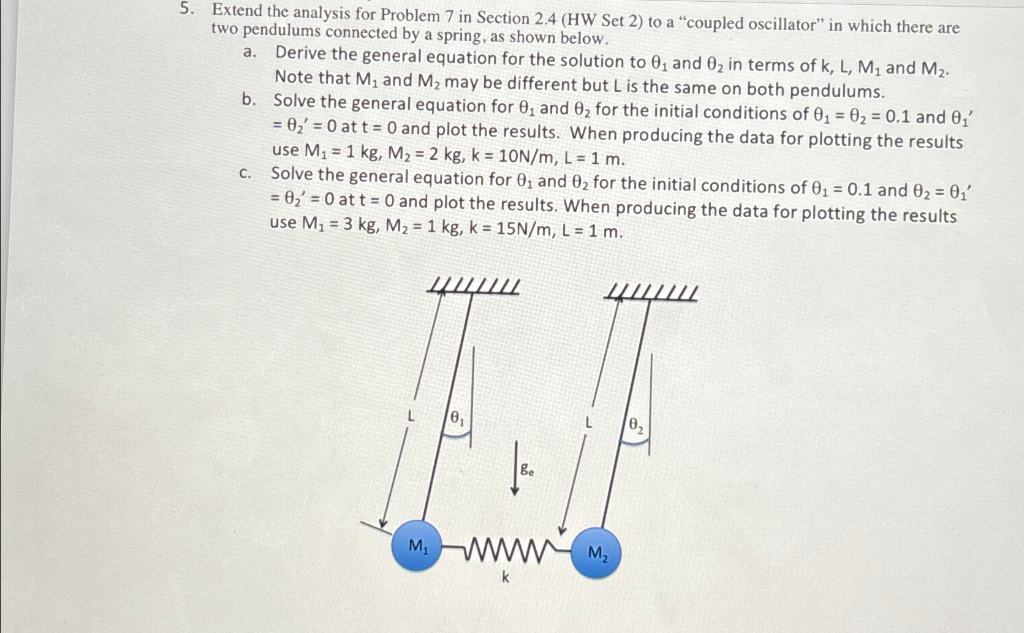
two pendulums connected by a spring, as shown below.
a. Derive the general equation for the solution to 6; and 6, in terms of k, L, Ms and M,.
Note that M; and M, may be different but L is the same on both pendulums.
b. Solve the general equation for 8, and 6, for the initial conditions of 0:=6,=0.1and 8,’
=6,'=0att=0and plot the results. When producing the data for plotting the results
use M;=1kg, M,=2 kg, k=10N/m, L=1m,
C. Solve the general equation for 01 and 6; for the initial conditions of 6:=0.1and 6,=0,
=0y'=0att=0and plot the results. When producing the data for plotting the results
use My =3 kg, M;=1kg, k= 15N/m, L=1m.
I
Lo fo, L fo,
¢ /
k
Question:
Give step-by-step solution with explanation and final answer:S. Extend the analysis for Problem 7 in Section 2.4 (HW Set 2) to a “coupled oscillator” in which there are
two pendulums connected by a spring, as shown below.
a. Derive the general equation for the solution to 6; and 6, in terms of k, L, Ms and M,.
Note that M; and M, may be different but L is the same on both pendulums.
b. Solve the general equation for 8, and 6, for the initial conditions of 0:=6,=0.1and 8,’
=6,'=0att=0and plot the results. When producing the data for plotting the results
use M;=1kg, M,=2 kg, k=10N/m, L=1m,
C. Solve the general equation for 01 and 6; for the initial conditions of 6:=0.1and 6,=0,
=0y'=0att=0and plot the results. When producing the data for plotting the results
use My =3 kg, M;=1kg, k= 15N/m, L=1m.
I
Lo fo, L fo,
¢ /
k
This is AI generated Response.
Asked by: gvr
Created at: 2025-07-01 15:05:53
Final Answer:
RenderedRaw Text
Did you like this answer?
Let's break down and solve the problem step by step:
---
## **Step 5a: Derive the general equation for θ₁ and θ₂**
We have **two pendulums** (masses \( M_1 \) and \( M_2 \)), each of length \( L \), coupled by a spring (spring constant \( k \)), as shown in the diagram.
### **Equations of Motion**
Assume small angles so \( \sin \theta \approx \theta \).
#### **Restoring torque for each pendulum:**
- Due to gravity: \( -M_i g L \theta_i \) (for small angles)
- Due to the spring: The extension of the spring is \( L(\theta_2 - \theta_1) \). The force on mass \( M_1 \) due to the spring is \( k L (\theta_2 - \theta_1) \), and torque is \( k L^2 (\theta_2 - \theta_1) \).
#### **Equations:**
For \( M_1 \):
\[
M_1 L^2 \ddot{\theta}_1 = -M_1 g L \theta_1 + k L^2 (\theta_2 - \theta_1)
\]
For \( M_2 \):
\[
M_2 L^2 \ddot{\theta}_2 = -M_2 g L \theta_2 + k L^2 (\theta_1 - \theta_2)
\]
Divide both sides by \( M_1 L^2 \) and \( M_2 L^2 \) respectively:
\[
\ddot{\theta}_1 + \frac{g}{L} \theta_1 - \frac{k}{M_1} (\theta_2 - \theta_1) = 0
\]
\[
\ddot{\theta}_2 + \frac{g}{L} \theta_2 - \frac{k}{M_2} (\theta_1 - \theta_2) = 0
\]
Rewrite:
\[
\ddot{\theta}_1 + \left( \frac{g}{L} + \frac{k}{M_1} \right)\theta_1 - \frac{k}{M_1}\theta_2 = 0
\]
\[
\ddot{\theta}_2 + \left( \frac{g}{L} + \frac{k}{M_2} \right)\theta_2 - \frac{k}{M_2}\theta_1 = 0
\]
---
## **Step 5b: Solve for θ₁ and θ₂ (Given Initial Conditions)**
Given:
- \( \theta_1 = \theta_2 = 0.1 \)
- \( \dot{\theta}_1 = \dot{\theta}_2 = 0 \) at \( t = 0 \)
- \( M_1 = 1\,\text{kg}, M_2 = 2\,\text{kg}, k = 10\,\text{N/m}, L = 1\,\text{m} \)
Let's denote \( \omega_{1}^2 = \frac{g}{L} + \frac{k}{M_1} \), \( \omega_{2}^2 = \frac{g}{L} + \frac{k}{M_2} \), and \( \alpha_1 = \frac{k}{M_1} \), \( \alpha_2 = \frac{k}{M_2} \).
Thus, the equations are:
\[
\ddot{\theta}_1 + \omega_1^2 \theta_1 - \alpha_1 \theta_2 = 0
\]
\[
\ddot{\theta}_2 + \omega_2^2 \theta_2 - \alpha_2 \theta_1 = 0
\]
#### **Decoupling: Normal Modes**
Assume solutions of the form \( \theta_1 = A \cos(\Omega t), \theta_2 = B \cos(\Omega t) \):
Plug into equations:
\[
(-\Omega^2 + \omega_1^2)A - \alpha_1 B = 0
\]
\[
(-\Omega^2 + \omega_2^2)B - \alpha_2 A = 0
\]
Write as matrix:
\[
\begin{pmatrix}
-\Omega^2 + \omega_1^2 & -\alpha_1 \\
-\alpha_2 & -\Omega^2 + \omega_2^2
\end{pmatrix}
\begin{pmatrix}
A \\ B
\end{pmatrix}
= 0
\]
Non-trivial solution if determinant is zero:
\[
(-\Omega^2 + \omega_1^2)(-\Omega^2 + \omega_2^2) - \alpha_1 \alpha_2 = 0
\]
\[
(\Omega^2 - \omega_1^2)(\Omega^2 - \omega_2^2) - \alpha_1 \alpha_2 = 0
\]
\[
\Omega^4 - (\omega_1^2 + \omega_2^2)\Omega^2 + \omega_1^2 \omega_2^2 - \alpha_1 \alpha_2 = 0
\]
This is a quadratic in \( \Omega^2 \):
\[
\Omega^2 = \frac{\omega_1^2 + \omega_2^2 \pm \sqrt{(\omega_1^2 - \omega_2^2)^2 + 4\alpha_1\alpha_2}}{2}
\]
Plug in numbers:
- \( g = 9.8\,\text{m/s}^2 \), \( L = 1 \)
- \( \omega_1^2 = 9.8 + 10/1 = 19.8 \)
- \( \omega_2^2 = 9.8 + 10/2 = 9.8 + 5 = 14.8 \)
- \( \alpha_1 = 10 \), \( \alpha_2 = 5 \)
- \( \alpha_1 \alpha_2 = 50 \)
\[
\Omega^2 = \frac{19.8 + 14.8 \pm \sqrt{(19.8 - 14.8)^2 + 4 \times 50}}{2}
\]
\[
= \frac{34.6 \pm \sqrt{25 + 200}}{2}
= \frac{34.6 \pm \sqrt{225}}{2}
= \frac{34.6 \pm 15}{2}
\]
So,
- \( \Omega_+^2 = \frac{34.6 + 15}{2} = 24.8 \Rightarrow \Omega_+ = \sqrt{24.8} \approx 4.98 \)
- \( \Omega_-^2 = \frac{34.6 - 15}{2} = 9.8 \Rightarrow \Omega_- = \sqrt{9.8} \approx 3.13 \)
#### **Normal Modes:**
For each mode frequency, find the amplitude ratio:
\[
(-\Omega^2 + \omega_1^2)A - \alpha_1 B = 0 \implies \frac{A}{B} = \frac{\alpha_1}{\Omega^2 - \omega_1^2}
\]
**For \( \Omega_+^2 = 24.8 \):**
\[
\frac{A}{B} = \frac{10}{24.8 - 19.8} = \frac{10}{5} = 2
\]
So, \( A = 2B \).
**For \( \Omega_-^2 = 9.8 \):**
\[
\frac{A}{B} = \frac{10}{9.8 - 19.8} = \frac{10}{-10} = -1
\]
So, \( A = -B \).
#### **General Solution:**
\[
\theta_1(t) = C_1 \cos(\Omega_+ t) + C_2 \cos(\Omega_- t)
\]
\[
\theta_2(t) = \frac{1}{2}C_1 \cos(\Omega_+ t) - C_2 \cos(\Omega_- t)
\]
#### **Apply Initial Conditions**
At \( t = 0 \):
- \( \theta_1(0) = 0.1 = C_1 + C_2 \)
- \( \theta_2(0) = 0.1 = \frac{1}{2}C_1 - C_2 \)
- \( \dot{\theta}_1(0) = 0 = -C_1 \Omega_+ - C_2 \Omega_- \)
- \( \dot{\theta}_2(0) = 0 = -\frac{1}{2}C_1\Omega_+ + C_2\Omega_- \)
Solve the first two:
\[
0.1 = C_1 + C_2 \tag{1}
\]
\[
0.1 = \frac{1}{2}C_1 - C_2 \tag{2}
\]
Add (1) and (2):
\[
0.2 = C_1 + \frac{1}{2}C_1 = \frac{3}{2}C_1 \implies C_1 = \frac{0.2}{1.5} = \frac{2}{15} \approx 0.1333
\]
Plug back to (1):
\[
C_2 = 0.1 - 0.1333 = -0.0333
\]
**Final answer for (b):**
\[
\boxed{
\begin{align*}
\theta_1(t) &= 0.1333 \cos(4.98 t) - 0.0333 \cos(3.13 t) \\
\theta_2(t) &= 0.0667 \cos(4.98 t) + 0.0333 \cos(3.13 t)
\end{align*}
}
\]
---
## **Step 5c: Solve for \( M_1 = 3\,\text{kg} \), \( M_2 = 1\,\text{kg} \), \( k = 15\,\text{N/m} \), \( L = 1\,\text{m} \), \( \theta_1 = 0.1, \theta_2' = 0.1 \), \( \theta_2 = \theta_1' = 0 \) at \( t = 0 \)**
**Set up the same way:**
- \( \omega_1^2 = 9.8 + \frac{15}{3} = 9.8 + 5 = 14.8 \)
- \( \omega_2^2 = 9.8 + \frac{15}{1} = 24.8 \)
- \( \alpha_1 = \frac{15}{3} = 5 \)
- \( \alpha_2 = \frac{15}{1} = 15 \)
- \( \alpha_1 \alpha_2 = 75 \)
\[
\Omega^2 = \frac{14.8 + 24.8 \pm \sqrt{(24.8 - 14.8)^2 + 4 \cdot 75}}{2}
= \frac{39.6 \pm \sqrt{100 + 300}}{2}
= \frac{39.6 \pm \sqrt{400}}{2}
= \frac{39.6 \pm 20}{2}
\]
So,
- \( \Omega_+^2 = 59.6/2 = 29.8 \implies \Omega_+ \approx 5.46 \)
- \( \Omega_-^2 = 19.6/2 = 9.8 \implies \Omega_- \approx 3.13 \)
Find amplitude ratios:
**For \( \Omega_+^2 = 29.8 \):**
\[
\frac{A}{B} = \frac{5}{29.8 - 14.8} = \frac{5}{15} = \frac{1}{3}
\]
So, \( A = \frac{1}{3}B \).
**For \( \Omega_-^2 = 9.8 \):**
\[
\frac{A}{B} = \frac{5}{9.8 - 14.8} = \frac{5}{-5} = -1
\]
So, \( A = -B \).
**General solution:**
\[
\theta_1(t) = C_1 \cos(5.46t) + C_2 \cos(3.13t)
\]
\[
\theta_2(t) = 3C_1 \cos(5.46t) - C_2 \cos(3.13t)
\]
**Initial conditions:**
- \( \theta_1(0) = 0.1 = C_1 + C_2 \)
- \( \theta_2(0) = 0 = 3C_1 - C_2 \)
- \( \dot{\theta}_1(0) = 0 = -C_1 \cdot 5.46 - C_2 \cdot 3.13 \)
- \( \dot{\theta}_2(0) = 0.1 = -3C_1 \cdot 5.46 + C_2 \cdot 3.13 \)
From the first two:
\[
0 = 3C_1 - C
VIPSolutions focuses on clear, step‑by‑step explanations so you can learn quickly. Whether you need an AI‑generated walkthrough or a short hint to get unstuck, each solution is organized for fast reading and easy review later.
Search similar questions, compare approaches, and bookmark the best answers for revision. Our goal is simple: quick, reliable study help that feels natural—not noisy.
 VIPSolutions
 S. Extend the analysis for Problem 7 in Section 2.4 (HW Set 2) to a “coupled oscillator” in which there are
two pendulums connected by a spring, as shown below.
a. Derive the general equation for the solution to 6; and 6, in terms of k, L, Ms and M,.
Note that M; and M, may be different but L is the same on both pendulums.
b. Solve the general equation for 8, and 6, for the initial conditions of 0:=6,=0.1and 8,’
=6,'=0att=0and plot the results. When producing the data for plotting the results
use M;=1kg, M,=2 kg, k=10N/m, L=1m,
C. Solve the general equation for 01 and 6; for the initial conditions of 6:=0.1and 6,=0,
=0y'=0att=0and plot the results. When producing the data for plotting the results
use My =3 kg, M;=1kg, k= 15N/m, L=1m.
I
Lo fo, L fo,
¢ /
k