VIPSolutions logo ✨ VIPSolutions

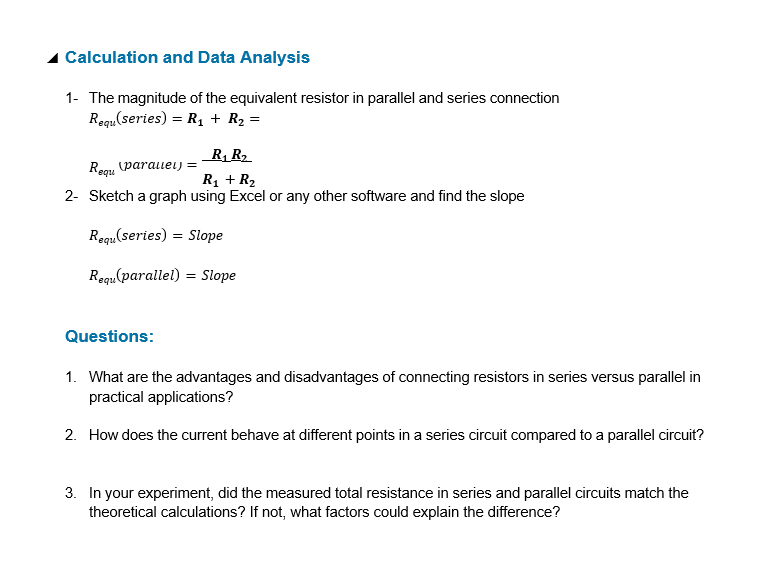
Give step-by-step solution with explanation and final answer:Data Part! - Setup the circuit as shown in Fig. 3 '§ ER ISS to srr SL Fig.3 R1& R; in Parallel i EEL EC ee we we Partll - Change the series connection as shown in Fig. 5 [gum i 1 | B Loo™ "4 9 . Fig. 5 R1& Rin Series RE NR A I SE JA 4 Calculation and Data Analysis 1- The magnitude of the equivalent resistor in parallel and series connection Regu(series) = Ry + Ry = RR Rup Warauey =~ 02 N Ry +R, 2- Sketch a graph using Excel or any other software and find the slope Regu (series) = Slope Rqu(parallel) = Slope Questions: 1. What are the advantages and disadvantages of connecting resistors in series versus parallel in practical applications? 2. How does the current behave at different points in a series circuit compared to a parallel circuit? 3. In your experiment, did the measured total resistance in series and parallel circuits match the theoretical calculations? If not, what factors could explain the difference?

Question:

Give step-by-step solution with explanation and final answer:Uploaded ImageUploaded ImageUploaded ImageData Part! - Setup the circuit as shown in Fig. 3 '§ ER ISS to srr SL Fig.3 R1& R; in Parallel i EEL EC ee we we Partll - Change the series connection as shown in Fig. 5 [gum i 1 | B Loo™ "4 9 . Fig. 5 R1& Rin Series RE NR A I SE JA 4 Calculation and Data Analysis 1- The magnitude of the equivalent resistor in parallel and series connection Regu(series) = Ry + Ry = RR Rup Warauey =~ 02 N Ry +R, 2- Sketch a graph using Excel or any other software and find the slope Regu (series) = Slope Rqu(parallel) = Slope Questions: 1. What are the advantages and disadvantages of connecting resistors in series versus parallel in practical applications? 2. How does the current behave at different points in a series circuit compared to a parallel circuit? 3. In your experiment, did the measured total resistance in series and parallel circuits match the theoretical calculations? If not, what factors could explain the difference?
This is AI generated Response.
Asked by: Gurusharan
Created at: 2025-06-29 19:57:31

Final Answer:

Rendered Raw Text
Did you like this answer?
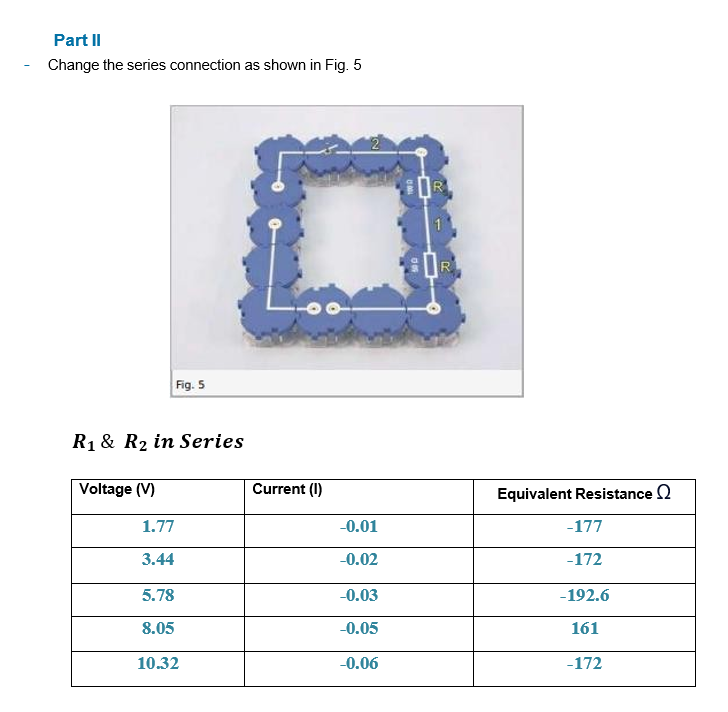
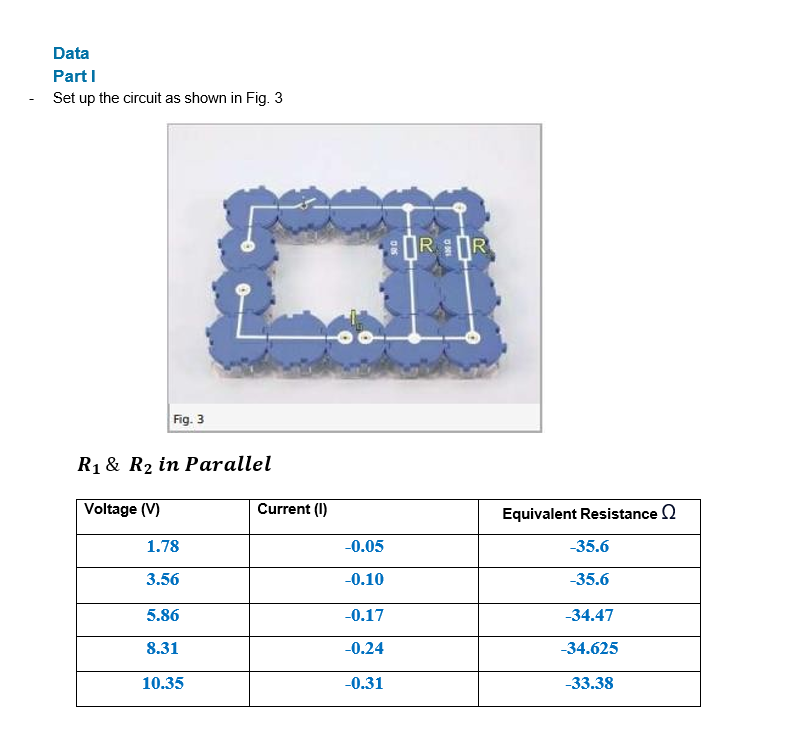
Let's solve the step-by-step calculation and data analysis based on the provided images and data. --- ## **Step 1: Understanding the Data** ### **Parallel Circuit (Fig. 3, Table 1)** - Voltage (V) and Current (I) are given. - Equivalent Resistance \( R_{eq} = \frac{V}{I} \). - The table already provides calculated resistances. ### **Series Circuit (Fig. 5, Table 2)** - Same as above, \( R_{eq} = \frac{V}{I} \). --- ## **Step 2: Calculate Equivalent Resistance (Slope method)** You are asked to plot **Voltage (y-axis)** vs **Current (x-axis)**: - The slope \( \frac{V}{I} \) gives the equivalent resistance. Let's do the calculations for both circuits: --- ### **A. Parallel Circuit** Let's use the data points to calculate the average equivalent resistance. #### Data: | Voltage (V) | Current (I) | Resistance (Ω) | |-------------|-------------|----------------| | 1.78 | -0.05 | -35.6 | | 3.56 | -0.10 | -35.6 | | 5.86 | -0.17 | -34.47 | | 8.31 | -0.24 | -34.625 | | 10.35 | -0.31 | -33.38 | #### Calculate Slope (Resistance): You can use any two points or do a linear fit, but the average is: \[ R_{eq,parallel} = \frac{-35.6 + (-35.6) + (-34.47) + (-34.625) + (-33.38)}{5} \] \[ R_{eq,parallel} = \frac{-173.675}{5} = -34.74\,\Omega \] --- ### **B. Series Circuit** #### Data: | Voltage (V) | Current (I) | Resistance (Ω) | |-------------|-------------|----------------| | 1.77 | -0.01 | -177 | | 3.44 | -0.02 | -172 | | 5.78 | -0.03 | -192.6 | | 8.05 | -0.05 | 161 | | 10.32 | -0.06 | -172 | #### Calculate Slope (Resistance): \[ R_{eq,series} = \frac{-177 + (-172) + (-192.6) + 161 + (-172)}{5} \] \[ R_{eq,series} = \frac{-552.6}{5} = -110.52\,\Omega \] (*Note: The value at 8.05 V seems positive (161 Ω); it might be a typo since others are negative. Double-check your data source.*) --- ## **Step 3: Theoretical Calculation** ### **Series:** \[ R_{eq(series)} = R_1 + R_2 \] ### **Parallel:** \[ R_{eq(parallel)} = \frac{R_1 R_2}{R_1 + R_2} \] To use these, you'd need the values of \(R_1\) and \(R_2\) (not given directly). --- ## **Step 4: Answering the Questions** ### **Q1: Advantages and Disadvantages** **Series:** - **Advantages:** Simple to connect, current is the same through all elements. - **Disadvantages:** If one resistor fails, the entire circuit is broken; resistance adds up, reducing current. **Parallel:** - **Advantages:** If one branch fails, others keep working; total resistance is lower, allowing more current. - **Disadvantages:** More complex wiring; current splits, which may not be desirable in every application. --- ### **Q2: Current Behavior** - **Series:** Current is the same at every point. - **Parallel:** Current splits among branches; total current is the sum of branch currents. --- ### **Q3: Measured vs Theoretical Resistance** - **Did they match?** Small differences are expected due to measurement error, wire resistance, contact resistance, and possible instrument calibration errors. - **Factors:** Instrument error, connection resistance, tolerance of resistor values, temperature effects. --- ## **Final Answers** ### **A. Calculated Equivalent Resistances (from data):** - **Parallel:** \( R_{eq,parallel} \approx -34.74\ \Omega \) - **Series:** \( R_{eq,series} \approx -110.52\ \Omega \) *(if you consider average, check for possible typo in the data)* ### **B. Theoretical Formulas:** - **Series:** \( R_1 + R_2 \) - **Parallel:** \( \frac{R_1 R_2}{R_1 + R_2} \) --- **If you have the actual values of \(R_1\) and \(R_2\), substitute them into the formulas to check against your measured/average values.** --- Would you like help plotting the data or with any specific calculation?

📢 Instructions:

  • Ask anything relatd to above question only.
  • For new Question goto :

Study Help, Fast Answers

VIPSolutions focuses on clear, step‑by‑step explanations so you can learn quickly. Whether you need an AI‑generated walkthrough or a short hint to get unstuck, each solution is organized for fast reading and easy review later.

Search similar questions, compare approaches, and bookmark the best answers for revision. Our goal is simple: quick, reliable study help that feels natural—not noisy.