Give step-by-step solution with explanation and final answer:Question 4 25 Points
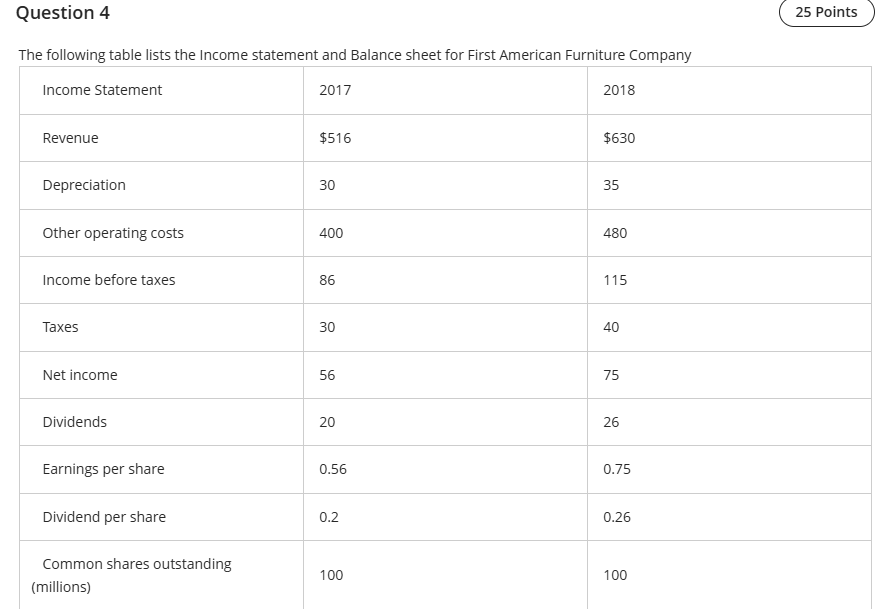
The following table lists the Income statement and Balance sheet for First American Furniture Company
Income Statement 2017 2018
Revenue $516 $630
Depreciation 30 35
Other operating costs 400 480
Income before taxes 86 115
Taxes 30 40
Net income 56 7s
Dividends 20 26
Earnings per share 056 075
Dividend per share 02 026
Common shares outstanding
(millions) 1° 1°
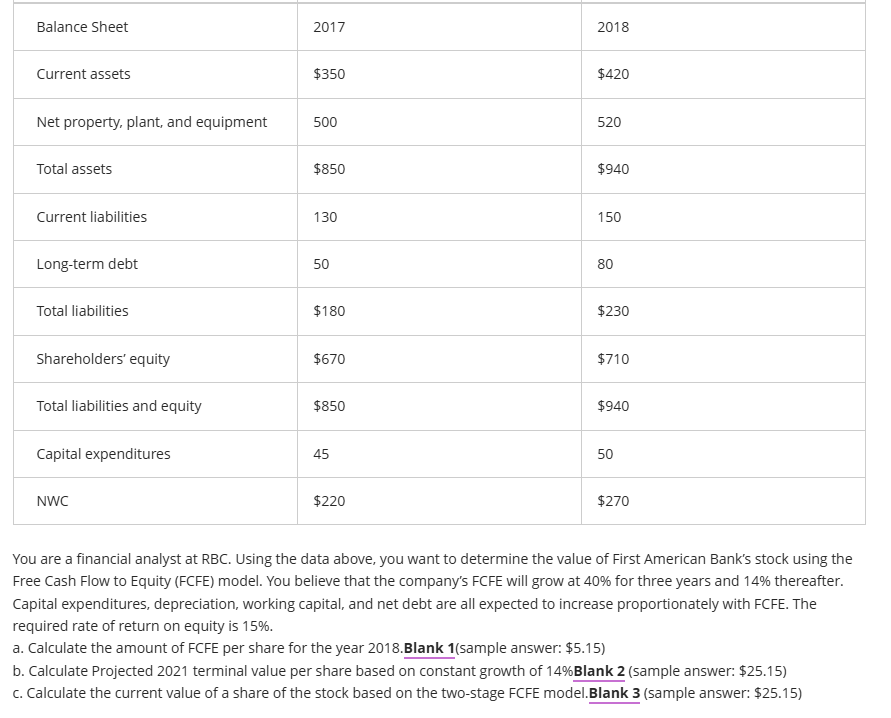
Balance Sheet 2017 2018
Current assets $350 $420
Net property, plant, and equipment 500 520
Total assets $850 $940
Current liabilities 130 150
Long-term debt 50 80
Total liabilities $180 $230
Shareholders’ equity $670 $710
Total liabilities and equity $850 $940
Capital expenditures 5 50
NWC $220 $270
You are a financial analyst at RBC. Using the data above, you want to determine the value of First American Bank's stock using the
Free Cash Flow to Equity (FCFE) model. You believe that the company’s FCFE will grow at 40% for three years and 14% thereafter.
Capital expenditures, depreciation, working capital, and net debt are all expected to increase proportionately with FCFE. The
required rate of return on equity is 15%
a. Calculate the amount of FCFE per share for the year 2018. Blank 1(sample answer: $5.15)
b. Calculate Projected 2021 terminal value per share based on constant growth of 14%Blank 2 (sample answer: $25.15)
c. Calculate the current value of a share of the stock based on the two-stage FCFE model. Blank 3 (sample answer: $25.15)
Question:
Give step-by-step solution with explanation and final answer:Question 4 25 Points
The following table lists the Income statement and Balance sheet for First American Furniture Company
Income Statement 2017 2018
Revenue $516 $630
Depreciation 30 35
Other operating costs 400 480
Income before taxes 86 115
Taxes 30 40
Net income 56 7s
Dividends 20 26
Earnings per share 056 075
Dividend per share 02 026
Common shares outstanding
(millions) 1° 1°
Balance Sheet 2017 2018
Current assets $350 $420
Net property, plant, and equipment 500 520
Total assets $850 $940
Current liabilities 130 150
Long-term debt 50 80
Total liabilities $180 $230
Shareholders’ equity $670 $710
Total liabilities and equity $850 $940
Capital expenditures 5 50
NWC $220 $270
You are a financial analyst at RBC. Using the data above, you want to determine the value of First American Bank's stock using the
Free Cash Flow to Equity (FCFE) model. You believe that the company’s FCFE will grow at 40% for three years and 14% thereafter.
Capital expenditures, depreciation, working capital, and net debt are all expected to increase proportionately with FCFE. The
required rate of return on equity is 15%
a. Calculate the amount of FCFE per share for the year 2018. Blank 1(sample answer: $5.15)
b. Calculate Projected 2021 terminal value per share based on constant growth of 14%Blank 2 (sample answer: $25.15)
c. Calculate the current value of a share of the stock based on the two-stage FCFE model. Blank 3 (sample answer: $25.15)
This is AI generated Response.
Asked by: Gurusharan
Created at: 2025-06-29 09:12:41
Final Answer:
RenderedRaw Text
Did you like this answer?
Let's solve each part step-by-step:
---
### **a. Calculate the amount of FCFE per share for the year 2018.**
**Formula for FCFE:**
\[
\text{FCFE} = \text{Net Income} + \text{Depreciation} - \text{Capital Expenditures} - \text{Increase in NWC} + \text{Net Borrowing}
\]
Where:
- **Increase in NWC** = NWC\(_{2018}\) - NWC\(_{2017}\)
- **Net Borrowing** = (Long-term debt\(_{2018}\) + Short-term debt\(_{2018}\)) - (Long-term debt\(_{2017}\) + Short-term debt\(_{2017}\))
- *Short-term debt is not listed separately, assume zero or all is in current liabilities; we'll use long-term debt only as net borrowing.*
#### **Step 1: Find values from the table for 2018**
- Net Income = **$75 million**
- Depreciation = **$35 million**
- Capital Expenditures = **$50 million**
- NWC\(_{2017}\) = **$220 million**
- NWC\(_{2018}\) = **$270 million**
- Long-term debt\(_{2017}\) = **$50 million**
- Long-term debt\(_{2018}\) = **$80 million**
#### **Step 2: Calculate each component**
- **Increase in NWC** = $270M - $220M = **$50M**
- **Net Borrowing** = $80M - $50M = **$30M**
#### **Step 3: Plug into FCFE formula**
\[
\text{FCFE} = 75 + 35 - 50 - 50 + 30 = 75 + 35 - 100 + 30 = 140 - 100 = 40 + 30 = \boxed{70\, \text{million}}
\]
#### **Step 4: Calculate FCFE per share**
- Common shares outstanding = **100 million**
\[
\text{FCFE per share} = \frac{70\, \text{million}}{100\, \text{million}} = \boxed{\$0.70}
\]
---
### **b. Calculate Projected 2021 Terminal Value per share based on constant growth of 14%**
#### **Step 1: Project FCFE for 2019, 2020, 2021**
- 2018 FCFE = $70M
- Growth for next 3 years = 40%
\[
\begin{align*}
\text{2019 FCFE} &= 70 \times 1.4 = 98 \\
\text{2020 FCFE} &= 98 \times 1.4 = 137.2 \\
\text{2021 FCFE} &= 137.2 \times 1.4 = 192.08 \\
\end{align*}
\]
#### **Step 2: Terminal Value formula (Gordon Growth Model)**
\[
\text{Terminal Value}_{2021} = \frac{\text{FCFE}_{2021} \times (1+g)}{r - g}
\]
Where:
- \( \text{FCFE}_{2021} = \$192.08 \) million
- \( g = 14\% = 0.14 \)
- \( r = 15\% = 0.15 \)
\[
\text{Terminal Value}_{2021} = \frac{192.08 \times 1.14}{0.15 - 0.14} = \frac{218.97}{0.01} = \$21,897 \text{ million}
\]
#### **Step 3: Per share value**
- Shares outstanding = 100 million
\[
\text{Terminal Value per share} = \frac{21,897}{100} = \boxed{\$218.97}
\]
---
### **c. Calculate the current value of a share of the stock based on the two-stage FCFE model.**
#### **Step 1: Discount FCFE and Terminal Value to present**
\[
\text{Value} = \sum_{t=1}^{3} \frac{\text{FCFE}_t}{(1+r)^t} + \frac{\text{Terminal Value}_{2021}}{(1+r)^3}
\]
- \( \text{FCFE}_1 = 98 \)
- \( \text{FCFE}_2 = 137.2 \)
- \( \text{FCFE}_3 = 192.08 \)
- \( \text{Terminal Value}_{2021} = 21,897 \)
- \( r = 0.15 \)
\[
\begin{align*}
\text{PV(FCFE}_1) &= \frac{98}{1.15} = 85.22 \\
\text{PV(FCFE}_2) &= \frac{137.2}{(1.15)^2} = \frac{137.2}{1.3225} = 103.75 \\
\text{PV(FCFE}_3) &= \frac{192.08}{(1.15)^3} = \frac{192.08}{1.520875} = 126.33 \\
\text{PV(Terminal)} &= \frac{21,897}{1.520875} = 14,393.98 \\
\end{align*}
\]
Total PV = 85.22 + 103.75 + 126.33 + 14,393.98 = **14,709.28 million**
#### **Step 2: Per share value**
\[
\text{Per Share Value} = \frac{14,709.28}{100} = \boxed{\$147.09}
\]
---
## **Summary of Answers**
**a. FCFE per share for 2018:**
\[
\boxed{\$0.70}
\]
**b. Projected 2021 terminal value per share:**
\[
\boxed{\$218.97}
\]
**c. Current value of a share (two-stage FCFE):**
\[
\boxed{\$147.09}
\]
---
**If you need further breakdown or more explanation, let me know!**
VIPSolutions focuses on clear, step‑by‑step explanations so you can learn quickly. Whether you need an AI‑generated walkthrough or a short hint to get unstuck, each solution is organized for fast reading and easy review later.
Search similar questions, compare approaches, and bookmark the best answers for revision. Our goal is simple: quick, reliable study help that feels natural—not noisy.
 VIPSolutions
 Question 4 25 Points
The following table lists the Income statement and Balance sheet for First American Furniture Company
Income Statement 2017 2018
Revenue $516 $630
Depreciation 30 35
Other operating costs 400 480
Income before taxes 86 115
Taxes 30 40
Net income 56 7s
Dividends 20 26
Earnings per share 056 075
Dividend per share 02 026
Common shares outstanding
(millions) 1° 1°
Balance Sheet 2017 2018
Current assets $350 $420
Net property, plant, and equipment 500 520
Total assets $850 $940
Current liabilities 130 150
Long-term debt 50 80
Total liabilities $180 $230
Shareholders’ equity $670 $710
Total liabilities and equity $850 $940
Capital expenditures 5 50
NWC $220 $270
You are a financial analyst at RBC. Using the data above, you want to determine the value of First American Bank's stock using the
Free Cash Flow to Equity (FCFE) model. You believe that the company’s FCFE will grow at 40% for three years and 14% thereafter.
Capital expenditures, depreciation, working capital, and net debt are all expected to increase proportionately with FCFE. The
required rate of return on equity is 15%
a. Calculate the amount of FCFE per share for the year 2018. Blank 1(sample answer: $5.15)
b. Calculate Projected 2021 terminal value per share based on constant growth of 14%Blank 2 (sample answer: $25.15)
c. Calculate the current value of a share of the stock based on the two-stage FCFE model. Blank 3 (sample answer: $25.15)