 VIPSolutions
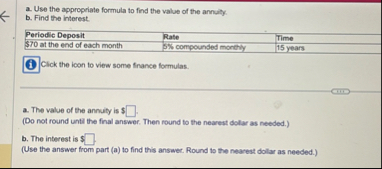
Give step-by-step solution with explanation and final answer: a . Use the appropriate formula to find the value of the annuity. b . Find the interest. \ table [ [ Periodic Deposit,Rate,Time ] , [ $ 7 0 at the end of each month, 5 % compounded monthy, 1 5 years ] ] Click the icon to view some finance formulas. a . The value of the annuity is $ ( Do not round until the final answer. Then round to the nearest dollar as needed. ) b . The interest is : ( Use the answer from part ( a ) to find this answer. Round to the nearest dollar as needed. )| bn re oat bo de vee of ow sty. rr —— [Tr ——— tect sent 1] Darin od To rd pt kr re) Py on reer 50) se en so ed)
Question:
Give step-by-step solution with explanation and final answer:
a
.
Use the appropriate formula to find the value of the annuity.
b
.
Find the interest.
\
table
[
[
Periodic Deposit,Rate,Time
]
,
[
$
7
0
at the end of each month,
5
%
compounded monthy,
1
5
years
]
]
Click the icon to view some finance formulas.
a
.
The value of the annuity is $
(
Do not round until the final answer. Then round to the nearest dollar as needed.
)
b
.
The interest is :
(
Use the answer from part
(
a
)
to find this answer. Round to the nearest dollar as needed.
) | bn re oat bo de vee of ow sty.
rr ——
[Tr ———
tect sent 1]
Darin od To rd pt kr re)
Py
on reer 50) se en so ed)
This is AI generated Response.
Asked by: Alok Kumar
Created at: 2025-06-29 07:44:59
Asked by: Alok Kumar
Created at: 2025-06-29 07:44:59
Final Answer:
Rendered
Raw Text
Did you like this answer?
Let's solve the problem step-by-step.
### **Given:**
- **Periodic Deposit (\(PMT\))**: $70 (at the end of each month)
- **Rate (\(r\))**: 5% compounded monthly
- **Time (\(t\))**: 15 years
### **Part a: Find the value of the annuity (\(F\))**
The formula for the future value of an ordinary annuity (deposits at the end of each period) is:
\[
F = PMT \times \frac{(1 + \frac{r}{n})^{nt} - 1}{\frac{r}{n}}
\]
Where:
- \( PMT = \$70 \)
- \( r = 0.05 \) (annual rate)
- \( n = 12 \) (compounded monthly)
- \( t = 15 \) years
#### **Step 1: Plug in the values**
\[
F = 70 \times \frac{(1 + \frac{0.05}{12})^{12 \times 15} - 1}{\frac{0.05}{12}}
\]
#### **Step 2: Calculate \(\frac{0.05}{12}\)**
\[
\frac{0.05}{12} = 0.0041667
\]
#### **Step 3: Calculate \(12 \times 15 = 180\)**
#### **Step 4: Calculate \(1 + 0.0041667 = 1.0041667\)**
#### **Step 5: Raise to the power of 180**
\[
(1.0041667)^{180}
\]
Using a calculator:
\[
(1.0041667)^{180} \approx 2.11357
\]
#### **Step 6: Subtract 1**
\[
2.11357 - 1 = 1.11357
\]
#### **Step 7: Divide by 0.0041667**
\[
\frac{1.11357}{0.0041667} \approx 267.34
\]
#### **Step 8: Multiply by 70**
\[
70 \times 267.34 = 18,713.8
\]
#### **Step 9: Round to the nearest dollar**
\[
\boxed{\$18,714}
\]
---
### **Part b: Find the Interest**
Interest earned is the difference between the future value and the total deposits.
\[
\text{Total deposited} = PMT \times n \times t = 70 \times 12 \times 15 = 70 \times 180 = \$12,600
\]
\[
\text{Interest earned} = F - \text{Total deposited} = 18,714 - 12,600 = \boxed{\$6,114}
\]
---
## **Final Answers**
**a. The value of the annuity is** **\$18,714.**
**b. The interest is** **\$6,114.**
📢 Instructions:
- Ask anything relatd to above question only.
- For new Question goto :