 VIPSolutions
Give step-by-step solution with explanation and final answer:NE 4.The series > ———7 is convergent and satisfies the hypotheses of the integral test. ZirT Find f — =e), wen b. Find s, for the series, and use the result from part (a) to estimate the sum of the series. Round your answer to 5 decimal places. Section 11.4: 5. Determine whether the series converges or diverges. 3 2n+1 PD WL, =Vomt =n? < 3Usin?n DX Fan = M RE) WR
Question:
Give step-by-step solution with explanation and final answer: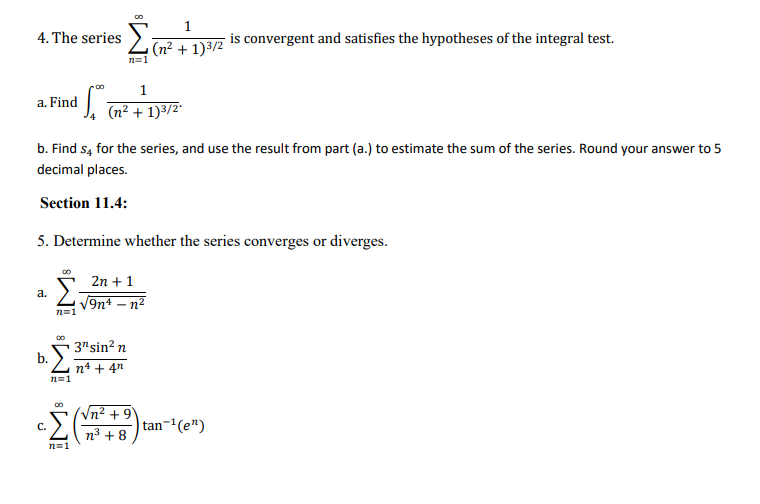 NE
4.The series > ———7 is convergent and satisfies the hypotheses of the integral test.
ZirT
Find f —
=e), wen
b. Find s, for the series, and use the result from part (a) to estimate the sum of the series. Round your answer to 5
decimal places.
Section 11.4:
5. Determine whether the series converges or diverges.
3 2n+1
PD WL,
=Vomt =n?
< 3Usin?n
DX Fan
=
M RE) WR
This is AI generated Response.
Asked by: gvr
Created at: 2025-06-27 04:53:36
Asked by: gvr
Created at: 2025-06-27 04:53:36
Final Answer:
Rendered
Raw Text
Did you like this answer?
Let's solve each part step by step:
---
### **4. The series \(\sum_{n=1}^\infty \frac{1}{(n^2+1)^{3/2}}\) is convergent and satisfies the hypotheses of the integral test.**
#### **a. Find \(\int_{4}^{\infty} \frac{1}{(x^2+1)^{3/2}} dx\).**
Let’s compute the improper integral:
\[
\int_{4}^{\infty} \frac{1}{(x^2+1)^{3/2}} dx
\]
Let’s use the substitution \(x = \tan \theta\), so \(dx = \sec^2\theta d\theta\), and \(x^2+1 = \tan^2\theta + 1 = \sec^2\theta\):
\[
(x^2+1)^{3/2} = (\sec^2\theta)^{3/2} = \sec^3\theta
\]
Therefore,
\[
\int \frac{1}{(x^2+1)^{3/2}} dx = \int \frac{1}{\sec^3\theta} \cdot \sec^2\theta d\theta = \int \cos\theta d\theta = \sin\theta + C
\]
Now, \(x = \tan\theta \implies \theta = \arctan x\):
So,
\[
\int_{4}^{\infty} \frac{1}{(x^2+1)^{3/2}} dx = \left. \sin(\arctan x) \right|_{x=4}^{x \to \infty}
\]
Recall that \(\sin(\arctan x) = \frac{x}{\sqrt{x^2+1}}\).
So,
\[
\int_{4}^{\infty} \frac{1}{(x^2+1)^{3/2}} dx = \left. \frac{x}{\sqrt{x^2+1}} \right|_{4}^{\infty}
\]
As \(x \to \infty\), \(\frac{x}{\sqrt{x^2+1}} \to 1\), and at \(x = 4\), \(\frac{4}{\sqrt{17}}\):
\[
\int_{4}^{\infty} \frac{1}{(x^2+1)^{3/2}} dx = 1 - \frac{4}{\sqrt{17}}
\]
Now, \(\sqrt{17} \approx 4.12311\):
\[
\frac{4}{\sqrt{17}} \approx \frac{4}{4.12311} \approx 0.97014
\]
So,
\[
1 - 0.97014 = 0.02986
\]
**Final answer for (a):**
\[
\boxed{0.02986}
\]
---
#### **b. Find \(s_4\) for the series, and use the result from part (a) to estimate the sum of the series. Round your answer to 5 decimal places.**
First, calculate \(s_4\):
\[
s_4 = \sum_{n=1}^4 \frac{1}{(n^2+1)^{3/2}}
\]
Let's compute each term:
- \(n=1\): \(\frac{1}{(1^2+1)^{3/2}} = \frac{1}{2^{3/2}} = \frac{1}{2\sqrt{2}} \approx 0.35355\)
- \(n=2\): \(\frac{1}{(4+1)^{3/2}} = \frac{1}{5^{3/2}} = \frac{1}{5\sqrt{5}} \approx 0.08944\)
- \(n=3\): \(\frac{1}{(9+1)^{3/2}} = \frac{1}{10^{3/2}} = \frac{1}{10\sqrt{10}} \approx 0.03162\)
- \(n=4\): \(\frac{1}{(16+1)^{3/2}} = \frac{1}{17^{3/2}} = \frac{1}{17\sqrt{17}} \approx 0.01419\)
Sum:
\[
s_4 \approx 0.35355 + 0.08944 + 0.03162 + 0.01419 \approx 0.48880
\]
Now, estimate the sum of the series using the integral test estimate:
\[
\text{Sum} \approx s_4 + \int_{4}^{\infty} \frac{1}{(x^2+1)^{3/2}} dx
\]
\[
\approx 0.48880 + 0.02986 = 0.51866
\]
**Final answer for (b):**
\[
\boxed{0.51866}
\]
---
### **5. Determine whether the series converges or diverges.**
#### **a. \(\sum_{n=1}^\infty \frac{2n+1}{\sqrt{9n^4 - n^2}}\)**
For large \(n\):
- Numerator: \(2n+1 \sim 2n\)
- Denominator: \(\sqrt{9n^4 - n^2} \approx \sqrt{9n^4} = 3n^2\)
So, term behaves like:
\[
\frac{2n}{3n^2} = \frac{2}{3n}
\]
\(\sum \frac{1}{n}\) diverges (harmonic series), so this series **diverges**.
---
#### **b. \(\sum_{n=1}^\infty \frac{3^n \sin^2 n}{n^4 + 4n}\)**
For large \(n\):
- Numerator: \(3^n \sin^2 n\), which is bounded between \(0\) and \(3^n\)
- Denominator: \(n^4 + 4n \sim n^4\)
But \(3^n\) grows much faster than \(n^4\). The terms do **not** go to zero; in fact, they grow exponentially.
So, this series **diverges**.
---
#### **c. \(\sum_{n=1}^\infty \frac{\sqrt{n^2+9}}{n^3+8} \tan^{-1}(e^n)\)**
For large \(n\):
- \(\sqrt{n^2+9} \sim n\)
- \(n^3+8 \sim n^3\)
- \(\tan^{-1}(e^n) \to \frac{\pi}{2}\) as \(n \to \infty\)
So, for large \(n\), the term behaves like:
\[
\frac{n}{n^3} \cdot \frac{\pi}{2} = \frac{\pi}{2n^2}
\]
\(\sum \frac{1}{n^2}\) converges, so this series **converges**.
---
## **Summary of Answers:**
### **4a.** \(\boxed{0.02986}\)
### **4b.** \(\boxed{0.51866}\)
### **5a.** Diverges
### **5b.** Diverges
### **5c.** Converges
Let me know if you want detailed working for any step!
📢 Instructions:
- Ask anything relatd to above question only.
- For new Question goto :