 VIPSolutions
Give step-by-step solution with explanation and final answer:Consider the following system. (Assume X = (2) Enter any column vector as a row vector.) 2 dx Gre Barry Find the eigenvalues of the coefficient matrix A(t). (Enter your answers as a comma-separated list.) A= ‘Amazing work. Find an eigenvector for the corresponding eigenvalues. (Enter your answers from smallest eigenvalue to largest eigenvalue.) Find the general solution of the given system. X(t) = Capitalization of variable(s) Is important. Check that your upper and lower case match the question. Need Help? [Rasa] [Evens]
Question:
Give step-by-step solution with explanation and final answer: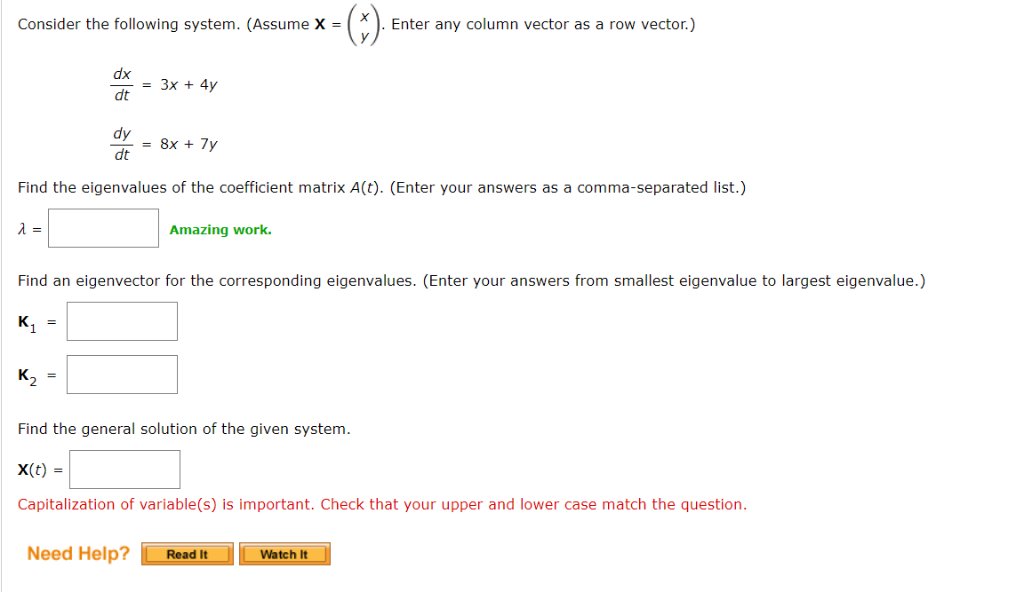 Consider the following system. (Assume X = (2) Enter any column vector as a row vector.)
2
dx
Gre
Barry
Find the eigenvalues of the coefficient matrix A(t). (Enter your answers as a comma-separated list.)
A= ‘Amazing work.
Find an eigenvector for the corresponding eigenvalues. (Enter your answers from smallest eigenvalue to largest eigenvalue.)
Find the general solution of the given system.
X(t) =
Capitalization of variable(s) Is important. Check that your upper and lower case match the question.
Need Help? [Rasa] [Evens]
This is AI generated Response.
Asked by: gvr
Created at: 2025-06-27 04:25:07
Asked by: gvr
Created at: 2025-06-27 04:25:07
Final Answer:
Rendered
Raw Text
Did you like this answer?
Let's solve the system step by step:
### 1. **Write the system in matrix form**
Let \( \mathbf{X} = \begin{pmatrix} x \\ y \end{pmatrix} \), then:
\[
\frac{d\mathbf{X}}{dt} = A\mathbf{X}
\]
where
\[
A = \begin{pmatrix} 3 & 4 \\ 8 & 7 \end{pmatrix}
\]
---
### 2. **Find the eigenvalues of \(A\)**
The eigenvalues \( \lambda \) satisfy:
\[
\det(A - \lambda I) = 0
\]
\[
\det\begin{pmatrix} 3-\lambda & 4 \\ 8 & 7-\lambda \end{pmatrix} = 0
\]
\[
(3-\lambda)(7-\lambda) - 32 = 0
\]
\[
21 - 3\lambda - 7\lambda + \lambda^2 - 32 = 0
\]
\[
\lambda^2 - 10\lambda - 11 = 0
\]
Solve the quadratic equation:
\[
\lambda^2 - 10\lambda - 11 = 0
\]
\[
\lambda = \frac{10 \pm \sqrt{(-10)^2 - 4 \cdot 1 \cdot (-11)}}{2}
\]
\[
= \frac{10 \pm \sqrt{100 + 44}}{2}
\]
\[
= \frac{10 \pm \sqrt{144}}{2}
\]
\[
= \frac{10 \pm 12}{2}
\]
So,
\[
\lambda_1 = \frac{10 - 12}{2} = -1
\]
\[
\lambda_2 = \frac{10 + 12}{2} = 11
\]
**Eigenvalues:**
\[
\boxed{-1, 11}
\]
---
### 3. **Find eigenvectors**
#### For \( \lambda_1 = -1 \):
Solve \( (A - (-1)I)\mathbf{K}_1 = 0 \):
\[
A + I = \begin{pmatrix} 4 & 4 \\ 8 & 8 \end{pmatrix}
\]
Let \( \mathbf{K}_1 = \begin{pmatrix} a \\ b \end{pmatrix} \):
\[
4a + 4b = 0 \implies a = -b
\]
So one eigenvector is:
\[
\mathbf{K}_1 = \begin{pmatrix} 1 \\ -1 \end{pmatrix}
\]
---
#### For \( \lambda_2 = 11 \):
Solve \( (A - 11I)\mathbf{K}_2 = 0 \):
\[
A - 11I = \begin{pmatrix} 3-11 & 4 \\ 8 & 7-11 \end{pmatrix} = \begin{pmatrix} -8 & 4 \\ 8 & -4 \end{pmatrix}
\]
\[
-8a + 4b = 0 \implies b = 2a
\]
So one eigenvector is:
\[
\mathbf{K}_2 = \begin{pmatrix} 1 \\ 2 \end{pmatrix}
\]
---
### 4. **General Solution**
The general solution is:
\[
\mathbf{X}(t) = c_1 \mathbf{K}_1 e^{\lambda_1 t} + c_2 \mathbf{K}_2 e^{\lambda_2 t}
\]
\[
= c_1 \begin{pmatrix} 1 \\ -1 \end{pmatrix} e^{-t} + c_2 \begin{pmatrix} 1 \\ 2 \end{pmatrix} e^{11t}
\]
---
## **Final Answers**
**Eigenvalues:**
\[
\boxed{-1, 11}
\]
**Eigenvectors:**
\[
\mathbf{K}_1 = \begin{pmatrix} 1 \\ -1 \end{pmatrix}
\]
\[
\mathbf{K}_2 = \begin{pmatrix} 1 \\ 2 \end{pmatrix}
\]
**General solution:**
\[
\boxed{
\mathbf{X}(t) = c_1 \begin{pmatrix} 1 \\ -1 \end{pmatrix} e^{-t} + c_2 \begin{pmatrix} 1 \\ 2 \end{pmatrix} e^{11t}
}
\]
📢 Instructions:
- Ask anything relatd to above question only.
- For new Question goto :