Give step-by-step solution with explanation and final answer:Week 1: Practice sketching in 2D and 3D. In R?, using the coordinates x1, 72, sketch the following
making a new sketch for each part (a)-(b):
(a) sketch two random lines in R? and label cach line with the equation describing it,
and draw and label the point of intersection,
(b) sketch one random line and a parallel line and label each line with the equation
describing it.
In R?, using the coordinates 1, z, 73, sketch the following making a new sketch for each part
(a)-(e):
(a) use the exact same equations from part (a) above in R? above, but with the variables
1, 23,73 and understanding that the coefficient of z3 should be understood to be
zero; sketch the two planes and the line of intersection,
(b) the plane consisting of points satisfying the condition that z; = 0 (the back wall),
(c) the plane #3 = 0 and the plane z; = 0 on the same axes, and sketch and label the
line of intersection of these two planes,
(d) a line passing through the origin which is not contained in any of the three coordinate
planes, include and label at least three points on the line,
(e) the plane defined by 2z + 3y + z = 6, include and label at least four points in this
plane no three of which are colinear, and at least one of the points should not lie in
any of the coordinate axes or coordinate planes.
In cach case, you are practicing drawing an accurate, representative graph of the plane of
points which satisfy the given equation in the variables zy, 75, and z;.
Question:
Give step-by-step solution with explanation and final answer:Week 1: Practice sketching in 2D and 3D. In R?, using the coordinates x1, 72, sketch the following
making a new sketch for each part (a)-(b):
(a) sketch two random lines in R? and label cach line with the equation describing it,
and draw and label the point of intersection,
(b) sketch one random line and a parallel line and label each line with the equation
describing it.
In R?, using the coordinates 1, z, 73, sketch the following making a new sketch for each part
(a)-(e):
(a) use the exact same equations from part (a) above in R? above, but with the variables
1, 23,73 and understanding that the coefficient of z3 should be understood to be
zero; sketch the two planes and the line of intersection,
(b) the plane consisting of points satisfying the condition that z; = 0 (the back wall),
(c) the plane #3 = 0 and the plane z; = 0 on the same axes, and sketch and label the
line of intersection of these two planes,
(d) a line passing through the origin which is not contained in any of the three coordinate
planes, include and label at least three points on the line,
(e) the plane defined by 2z + 3y + z = 6, include and label at least four points in this
plane no three of which are colinear, and at least one of the points should not lie in
any of the coordinate axes or coordinate planes.
In cach case, you are practicing drawing an accurate, representative graph of the plane of
points which satisfy the given equation in the variables zy, 75, and z;.
This is AI generated Response.
Asked by: gvr
Created at: 2025-06-27 03:26:19
Final Answer:
RenderedRaw Text
Did you like this answer?
Let's solve each part step by step, providing both the explanation and the final answer, including sample equations and sketches (where possible using text).
---
## **In \(\mathbb{R}^2\):**
### **(a) Sketch two random lines, label equations, and intersection**
**Step 1:** Choose two random linear equations in \(x_1, x_2\).
Let’s pick:
- \(L_1: x_2 = 2x_1 + 1\)
- \(L_2: x_2 = -x_1 + 4\)
**Step 2:** Find the intersection:
Set \(2x_1 + 1 = -x_1 + 4\):
\[
2x_1 + 1 = -x_1 + 4 \implies 3x_1 = 3 \implies x_1 = 1
\]
Plug back into \(L_1\): \(x_2 = 2(1) + 1 = 3\)
**Intersection point:** \((1, 3)\)
**Final answer:**
- Sketch two lines, label as \(x_2 = 2x_1 + 1\) and \(x_2 = -x_1 + 4\), mark intersection at \((1, 3)\).
---
### **(b) Sketch one random line and a parallel line, label equations**
**Step 1:** Pick a line and a parallel line (same slope, different intercept).
Let’s take:
- \(L_1: x_2 = x_1 + 2\)
- \(L_2: x_2 = x_1 - 1\)
**Final answer:**
- Sketch both lines, label as \(x_2 = x_1 + 2\) and \(x_2 = x_1 - 1\). They are parallel (slope = 1).
---
## **In \(\mathbb{R}^3\):**
### **(a) Use equations from \(\mathbb{R}^2\) part (a), now in 3D (planes)**
Let’s use:
- \(P_1: x_2 = 2x_1 + 1\) \(\implies x_2 - 2x_1 - 1 = 0\)
- \(P_2: x_2 = -x_1 + 4\) \(\implies x_2 + x_1 - 4 = 0\)
Now, **in 3D**, these are planes:
- \(x_2 - 2x_1 - 1 = 0\)
- \(x_2 + x_1 - 4 = 0\)
**Step 2:** Find line of intersection:
Solve the system:
\[
\begin{cases}
x_2 - 2x_1 - 1 = 0 \\
x_2 + x_1 - 4 = 0
\end{cases}
\]
Subtract the first from the second:
\[
[x_2 + x_1 - 4] - [x_2 - 2x_1 - 1] = (x_1 + 2x_1) + (-4 + 1) = 3x_1 - 3 = 0 \implies x_1 = 1
\]
Plug \(x_1 = 1\) into either equation:
\(x_2 = 2x_1 + 1 = 2(1) + 1 = 3\)
So, for any \(x_3\):
\[
(x_1, x_2, x_3) = (1, 3, t), \quad t \in \mathbb{R}
\]
**Final answer:**
- Sketch two planes \(x_2 - 2x_1 - 1 = 0\) and \(x_2 + x_1 - 4 = 0\).
- Label the line of intersection: \((1, 3, t)\).
---
### **(b) Plane \(x_1 = 0\) (back wall)**
This is the plane where all points have \(x_1 = 0\).
**Final answer:**
- Sketch the \(x_2 x_3\)-plane (vertical plane at \(x_1 = 0\)), label as \(x_1 = 0\).
---
### **(c) Planes \(x_3 = 0\) and \(x_1 = 0\), and their intersection**
- \(x_3 = 0\): the \(x_1 x_2\)-plane (the "floor").
- \(x_1 = 0\): the \(x_2 x_3\)-plane (the "back wall").
**Their intersection:**
Both \(x_1 = 0\) and \(x_3 = 0\) \(\implies\) line where \(x_1 = 0, x_3 = 0\), i.e., the \(x_2\)-axis.
**Final answer:**
- Sketch both planes, label as \(x_1 = 0\) and \(x_3 = 0\).
- Their intersection is the \(x_2\)-axis (\((0, t, 0)\), \(t \in \mathbb{R}\)), label it.
---
### **(d) Line through origin not in any coordinate plane (include 3 points)**
Choose a direction not parallel to any axis.
Pick parametric: \((1, 2, 3)t\).
Three points:
- At \(t = 0\): \((0, 0, 0)\)
- At \(t = 1\): \((1, 2, 3)\)
- At \(t = -1\): \((-1, -2, -3)\)
**Final answer:**
- Sketch line through \((0,0,0)\), \((1,2,3)\), and \((-1,-2,-3)\). Label these points.
---
### **(e) Plane \(2x_1 + 3x_2 + x_3 = 6\), at least 4 points**
Find 4 points, none collinear, not all on coordinate axes/planes.
Set two variables to zero for intercepts:
- \(x_1\)-intercept: \(x_2 = 0, x_3 = 0 \implies 2x_1 = 6 \implies x_1 = 3\) → \((3,0,0)\)
- \(x_2\)-intercept: \(x_1 = 0, x_3 = 0 \implies 3x_2 = 6 \implies x_2 = 2\) → \((0,2,0)\)
- \(x_3\)-intercept: \(x_1 = 0, x_2 = 0 \implies x_3 = 6\) → \((0,0,6)\)
Choose one more point (not on axes):
Let \(x_1 = 1, x_2 = 1\):
\[
2(1) + 3(1) + x_3 = 6 \implies 5 + x_3 = 6 \implies x_3 = 1
\]
So, \((1, 1, 1)\).
**Final answer:**
- Sketch plane \(2x_1 + 3x_2 + x_3 = 6\).
- Plot and label points: \((3,0,0)\), \((0,2,0)\), \((0,0,6)\), \((1,1,1)\).
---
## **Summary Table**
| Part | Equation(s) | Objects | Intersection/Points |
|------|-------------|---------|---------------------|
| 2D(a) | \(x_2 = 2x_1 + 1\), \(x_2 = -x_1 + 4\) | Lines | \((1,3)\) |
| 2D(b) | \(x_2 = x_1 + 2\), \(x_2 = x_1 - 1\) | Parallel Lines | - |
| 3D(a) | \(x_2 - 2x_1 - 1 = 0\), \(x_2 + x_1 - 4 = 0\) | Planes | Line: \((1,3,t)\) |
| 3D(b) | \(x_1 = 0\) | Plane | - |
| 3D(c) | \(x_1=0\), \(x_3=0\) | Planes | Line: \((0, t, 0)\) |
| 3D(d) | \((t, 2t, 3t)\) | Line | \((0,0,0), (1,2,3), (-1,-2,-3)\) |
| 3D(e) | \(2x_1 + 3x_2 + x_3 = 6\) | Plane | \((3,0,0), (0,2,0), (0,0,6), (1,1,1)\) |
---
If you would like to see the **sketches** or have further clarification on any part, let me know!
Question:
i need all parts sketches need
This is AI generated Response.
Asked by: gvr
Created at: 2025-06-27 03:29:12
Final Answer:
RenderedRaw Text
Did you like this answer?
Certainly! Below are detailed step-by-step instructions along with sketches for each part. Since I can't produce actual images directly here, I'll describe how you can draw each sketch accurately. You can follow these instructions to sketch on paper or using graphing software like R or GeoGebra.
---
## **In \(\mathbb{R}^2\):**
### **(a) Two random lines and their intersection**
**Equations:**
- \(L_1: x_2 = 2x_1 + 1\)
- \(L_2: x_2 = -x_1 + 4\)
**Steps to sketch:**
1. Draw axes \(x_1\) (horizontal) and \(x_2\) (vertical).
2. Plot \(L_1\):
- When \(x_1=0\), \(x_2=1\).
- When \(x_1=1\), \(x_2=3\).
- Draw a straight line through these points.
3. Plot \(L_2\):
- When \(x_1=0\), \(x_2=4\).
- When \(x_1=1\), \(x_2=3\).
- Draw this line.
4. Find intersection:
- Set \(2x_1 + 1 = -x_1 + 4 \Rightarrow 3x_1=3 \Rightarrow x_1=1\).
- \(x_2=2(1)+1=3\).
- Mark the intersection point \((1,3)\).
5. Label each line with their equations.
---
### **(b) One line and a parallel line**
**Equations:**
- \(L_1: x_2 = x_1 + 2\)
- \(L_2: x_2 = x_1 - 1\)
**Steps:**
1. Draw axes.
2. Plot \(L_1\):
- \(x_1=0\), \(x_2=2\).
- \(x_1=1\), \(x_2=3\).
3. Plot \(L_2\):
- \(x_1=0\), \(x_2=-1\).
- \(x_1=1\), \(x_2=0\).
4. Draw both lines parallel, label with equations.
5. No intersection (parallel).
---
## **In \(\mathbb{R}^3\):**
### **(a) Two planes and their line of intersection**
**Equations:**
- \(P_1: x_2 = 2x_1 + 1\) \(\Rightarrow\) \(x_2 - 2x_1 - 1=0\)
- \(P_2: x_2 = -x_1 + 4\) \(\Rightarrow\) \(x_2 + x_1 - 4=0\)
**Steps to sketch:**
1. Draw the three axes: \(x_1\), \(x_2\), \(x_3\).
2. Sketch plane \(P_1\):
- For various \(x_1\), find \(x_2\): e.g., at \(x_1=0\), \(x_2=1\).
- Draw a plane passing through points \((0,1,0)\) and \((1,3,0)\).
- Extend it in the \(x_3\) direction.
3. Sketch plane \(P_2\):
- For \(x_1=0\), \(x_2=4\).
- For \(x_1=1\), \(x_2=3\).
- Draw this second plane.
4. Find the line of intersection:
- From the algebra above, the intersection line is \((x_1, x_2) = (1,3)\) with any \(x_3\).
- Draw a line through points \((1,3, t)\) for \(t \in \mathbb{R}\).
---
### **(b) Plane \(x_1=0\) (Back wall)**
- Draw the plane parallel to the \(x_2 x_3\) axes at \(x_1=0\).
- Label it.
---
### **(c) Two planes \(x_3=0\) and \(x_1=0\)**
- \(x_3=0\): the \(x_1 x_2\) plane.
- \(x_1=0\): the \(x_2 x_3\) plane.
- Their intersection: the \(x_2\)-axis, a line along \((0, t, 0)\).
- Sketch both planes intersecting along the line.
---
### **(d) Line passing through the origin not in coordinate planes**
- Choose parametric form:
\[
(x_1, x_2, x_3) = (t, 2t, 3t)
\]
- Plot points:
- \(t=0\): (0,0,0)
- \(t=1\): (1,2,3)
- \(t=-1\): (-1,-2,-3)
- Draw the line passing through these points.
---
### **(e) Plane \(2x_1 + 3x_2 + x_3=6\)**
**Points to plot:**
- \(x_1=3, x_2=0, x_3=0\) (intercept on \(x_1\))
- \(x_1=0, x_2=2, x_3=0\) (intercept on \(x_2\))
- \(x_1=0, x_2=0, x_3=6\) (intercept on \(x_3\))
- Additional point, e.g., \(x_1=1, x_2=1\):
\[
2(1)+3(1)+x_3=6 \Rightarrow 2+3+x_3=6 \Rightarrow x_3=1
\]
So point: \((1,1,1)\).
- Sketch the plane through these points:
- Draw coordinate axes.
- Mark these points clearly.
- Connect them to visualize the plane.
---
## **Summary**
- Use the axes to position your lines/planes.
- Mark key points (intercepts, intersection points).
- Label each object with its equation.
- For 3D sketches, indicate the orientation of planes and lines clearly, and show intersections explicitly.
---
**Tip:** Using graphing software like GeoGebra 3D can help produce accurate visualizations based on these instructions.
---
If you'd like, I can also help generate R code to plot these objects for precise visualization!
VIPSolutions focuses on clear, step‑by‑step explanations so you can learn quickly. Whether you need an AI‑generated walkthrough or a short hint to get unstuck, each solution is organized for fast reading and easy review later.
Search similar questions, compare approaches, and bookmark the best answers for revision. Our goal is simple: quick, reliable study help that feels natural—not noisy.
 VIPSolutions
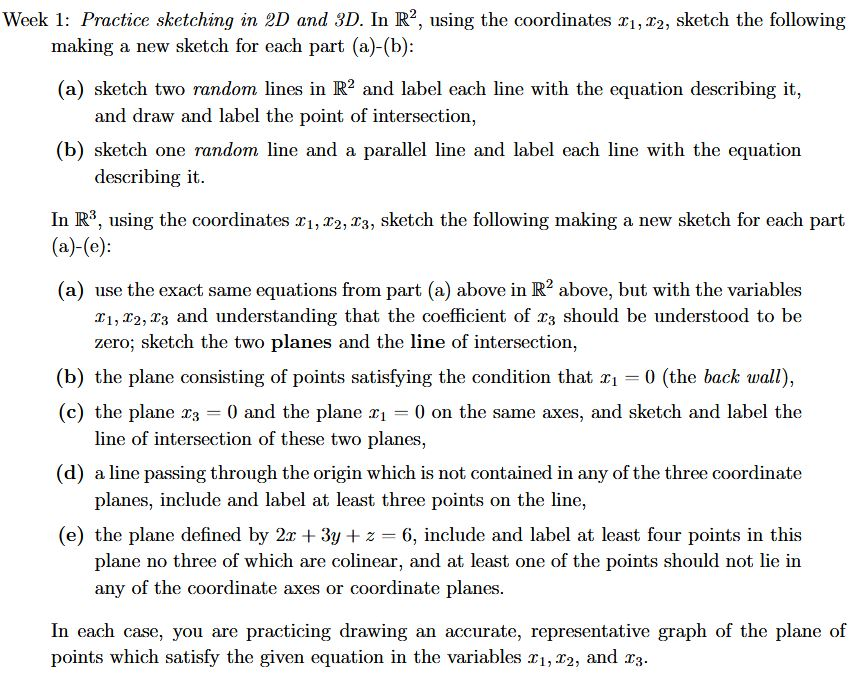 Week 1: Practice sketching in 2D and 3D. In R?, using the coordinates x1, 72, sketch the following
making a new sketch for each part (a)-(b):
(a) sketch two random lines in R? and label cach line with the equation describing it,
and draw and label the point of intersection,
(b) sketch one random line and a parallel line and label each line with the equation
describing it.
In R?, using the coordinates 1, z, 73, sketch the following making a new sketch for each part
(a)-(e):
(a) use the exact same equations from part (a) above in R? above, but with the variables
1, 23,73 and understanding that the coefficient of z3 should be understood to be
zero; sketch the two planes and the line of intersection,
(b) the plane consisting of points satisfying the condition that z; = 0 (the back wall),
(c) the plane #3 = 0 and the plane z; = 0 on the same axes, and sketch and label the
line of intersection of these two planes,
(d) a line passing through the origin which is not contained in any of the three coordinate
planes, include and label at least three points on the line,
(e) the plane defined by 2z + 3y + z = 6, include and label at least four points in this
plane no three of which are colinear, and at least one of the points should not lie in
any of the coordinate axes or coordinate planes.
In cach case, you are practicing drawing an accurate, representative graph of the plane of
points which satisfy the given equation in the variables zy, 75, and z;.