 VIPSolutions
Give step-by-step solution with explanation and final answer:Fife «Ny Required information 3 | Socks and Bur ss om ste te ng vhs Oc Aros ms mAh iE =7 N/m. All sources of fri 0kg, an || shown and the cor connecting And Bi saan, ole Assume et 4 ere A k 2 I= 5 MN p Li ) othe mass of block &such that Bhas a speed vg = 15 m/s after moving 1.2 m downward. kBis[_Jkg. ’
Question:
Give step-by-step solution with explanation and final answer: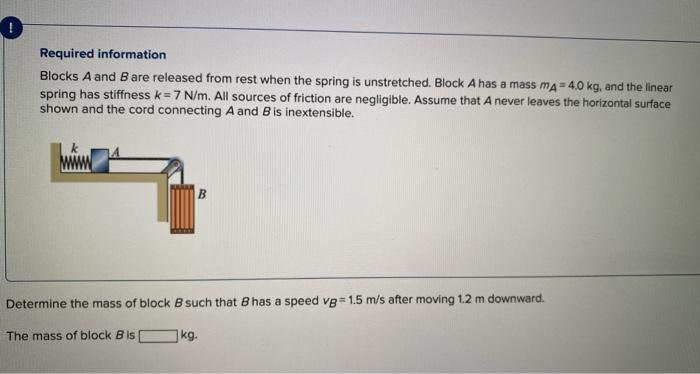 Fife «Ny
Required information 3
| Socks and Bur ss om ste te ng vhs Oc Aros ms mAh
iE =7 N/m. All sources of fri 0kg, an
|| shown and the cor connecting And Bi saan, ole Assume et 4 ere
A k
2
I= 5
MN p
Li )
othe mass of block &such that Bhas a speed vg = 15 m/s after moving 1.2 m downward.
kBis[_Jkg. ’
This is AI generated Response.
Asked by: gvr
Created at: 2025-06-24 14:07:30
Asked by: gvr
Created at: 2025-06-24 14:07:30
Final Answer:
Rendered
Raw Text
Did you like this answer?
Let's break down the problem step by step:
### **Given Data**
- Mass of block A, \( m_A = 4.0 \) kg
- Spring constant, \( k = 7 \) N/m
- Block B moves down \( h = 1.2 \) m and has speed \( v_B = 1.5 \) m/s
- The spring is initially unstretched.
- No friction, inextensible cord.
We are to **find the mass of block B, \( m_B \),** so that block B reaches the given speed after moving down 1.2 m.
---
## **Step 1: Apply Conservation of Energy**
Initial total energy = Final total energy
### **Initial Energy (when released from rest)**
- Both blocks at rest, so \( KE_{initial} = 0 \)
- Spring is unstretched, so \( PE_{spring, initial} = 0 \)
- Block B is at some initial height (call this the reference level for gravitational potential energy).
### **Final Energy (after B has moved down 1.2 m)**
- Block B has speed \( v_B \)
- Block A has same speed \( v_A = v_B \) (since the cord is inextensible)
- Spring is stretched by 1.2 m (since A moves horizontally by 1.2 m)
- Block B has lost height by 1.2 m
So:
- \( KE_{final} = \frac{1}{2} m_A v^2 + \frac{1}{2} m_B v^2 \)
- \( PE_{spring, final} = \frac{1}{2} k x^2 = \frac{1}{2} k (1.2)^2 \)
- Change in \( PE_{gravity} = - m_B g (1.2) \) (since B moves down)
---
### **Step 2: Write the Energy Conservation Equation**
\[
\text{Initial Total Energy} = \text{Final Total Energy}
\]
\[
0 = \frac{1}{2} m_A v^2 + \frac{1}{2} m_B v^2 + \frac{1}{2} k x^2 - m_B g h
\]
where:
- \( v = 1.5 \) m/s
- \( k = 7 \) N/m
- \( x = 1.2 \) m
- \( g = 9.81 \) m/s²
---
### **Step 3: Substitute Values**
\[
0 = \frac{1}{2} (4.0) (1.5)^2 + \frac{1}{2} m_B (1.5)^2 + \frac{1}{2} (7) (1.2)^2 - m_B (9.81) (1.2)
\]
Calculate each term:
- \(\frac{1}{2} \times 4.0 \times (1.5)^2 = 2.0 \times 2.25 = 4.5\)
- \(\frac{1}{2} \times 1.5^2 = 0.5 \times 2.25 = 1.125\) (this multiplies \(m_B\))
- \(\frac{1}{2} \times 7 \times (1.2)^2 = 3.5 \times 1.44 = 5.04\)
- \(9.81 \times 1.2 = 11.772\) (this multiplies \(m_B\))
Plug these in:
\[
0 = 4.5 + 1.125 m_B + 5.04 - 11.772 m_B
\]
\[
0 = (4.5 + 5.04) + (1.125 m_B - 11.772 m_B)
\]
\[
0 = 9.54 - 10.647 m_B
\]
---
### **Step 4: Solve for \( m_B \)**
\[
10.647 m_B = 9.54
\]
\[
m_B = \frac{9.54}{10.647}
\]
\[
m_B \approx 0.90 \text{ kg}
\]
---
## **Final Answer**
\[
\boxed{0.90\ \text{kg}}
\]
---
### **Summary of Steps**
1. Apply conservation of energy.
2. Write out all potential and kinetic energy terms.
3. Plug in the provided numbers.
4. Solve for \( m_B \).
Let me know if you'd like a breakdown of any specific step!
Question:
i need detailed calculations along with the final Answer
This is AI generated Response.
Asked by: gvr
Created at: 2025-06-24 14:09:37
Asked by: gvr
Created at: 2025-06-24 14:09:37
Final Answer:
Rendered
Raw Text
Did you like this answer?
Let's carefully analyze and solve the problem step-by-step with detailed calculations.
---
### **Given Data:**
- Mass of block A: \( m_A = 4.0\,kg \)
- Spring constant: \( k = 7\,N/m \)
- Displacement of block B downward: \( h = 1.2\,m \)
- Speed of block B after moving downward: \( v_B = 1.5\,m/s \)
- Gravitational acceleration: \( g = 9.81\,m/s^2 \)
- Initial positions: spring unstretched, blocks at rest.
---
### **Objective:**
Find the mass of block B, \( m_B \), such that after moving downward 1.2 m, block B attains speed 1.5 m/s.
---
### **Step 1: Understand the energy transformations**
- Initially:
- Both blocks are at rest.
- Spring is unstretched: initial elastic potential energy = 0.
- Block B is at some initial height, but since only relative changes matter, we set the initial gravitational potential energy as reference.
- After moving downward by 1.2 m:
- Block B has gained kinetic energy.
- Block B has descended 1.2 m, losing gravitational potential energy.
- Spring is stretched by 1.2 m, storing elastic potential energy.
- Block A moves horizontally, but since the cord is inextensible, it moves 1.2 m horizontally. Its kinetic energy is based on its velocity, which equals block B's velocity due to the cord.
---
### **Step 2: Write the energy conservation equation**
Total initial energy = total final energy
Since initial kinetic and elastic energies are zero, initial energy is zero.
Final energies include:
- Kinetic energy of blocks A and B (moving at same speed \( v = 1.5\,m/s \))
- Elastic potential energy stored in the spring
- Change in gravitational potential energy of block B
Expressed mathematically:
\[
0 = \text{Kinetic energy} + \text{Spring potential energy} - \text{Loss in gravitational potential energy}
\]
\[
0 = \frac{1}{2} m_A v^2 + \frac{1}{2} m_B v^2 + \frac{1}{2} k x^2 - m_B g h
\]
where:
- \( v = 1.5\,m/s \)
- \( x = 1.2\,m \)
- \( h = 1.2\,m \)
---
### **Step 3: Substitute known values**
Calculate each term:
1. Kinetic energy of block A:
\[
\frac{1}{2} \times 4.0\,kg \times (1.5)^2\,m^2/s^2 = 2.0 \times 2.25 = 4.5\,J
\]
2. Kinetic energy of block B:
\[
\frac{1}{2} \times m_B \times (1.5)^2 = 0.5 \times m_B \times 2.25 = 1.125\,m_B\,J
\]
3. Elastic potential energy stored in the spring:
\[
\frac{1}{2} \times 7\,N/m \times (1.2)^2\,m^2 = 3.5 \times 1.44 = 5.04\,J
\]
4. Gravitational potential energy lost by block B:
\[
m_B \times 9.81\,m/s^2 \times 1.2\,m = 11.772\,m_B\,J
\]
---
### **Step 4: Set up the energy balance**
\[
0 = 4.5 + 1.125\,m_B + 5.04 - 11.772\,m_B
\]
Simplify:
\[
0 = (4.5 + 5.04) + (1.125\,m_B - 11.772\,m_B)
\]
\[
0 = 9.54 - 10.647\,m_B
\]
---
### **Step 5: Solve for \( m_B \)**
\[
10.647\,m_B = 9.54
\]
\[
m_B = \frac{9.54}{10.647} \approx 0.896\,kg
\]
**Rounded to two decimal places:**
\[
\boxed{
\textbf{Final answer: } \quad m_B \approx \mathbf{0.90\,kg}
}
\]
---
### **Summary:**
- The mass of block B should be approximately **0.90 kg** for it to reach 1.5 m/s after descending 1.2 m, given the spring constant and other parameters.
---
If you'd like any further clarifications or details, feel free to ask!
Question:
i need 2 lines pure theory for explanation
This is AI generated Response.
Asked by: gvr
Created at: 2025-06-24 14:14:27
Asked by: gvr
Created at: 2025-06-24 14:14:27
Final Answer:
Rendered
Raw Text
Did you like this answer?
The problem applies conservation of mechanical energy, considering kinetic, elastic, and gravitational potential energies, to determine the mass of block B. It assumes no energy losses due to friction or air resistance, allowing the initial energy to equal the final energy after the block moves downward.
📢 Instructions:
- Ask anything relatd to above question only.
- For new Question goto :