 VIPSolutions
Give step-by-step solution with explanation and final answer:eo Thought Experiment: Explain what is physically happening to the charge in the RC circuit during charging and discharging cycles (i.e. Why does the capacitor charge/discharge quickly at first but slows down with more time? Where is the charge going?). In the DC Electrical Circuits lab, we used the analogy of water flowing through a pipe to visualize Ohm's law — can you extend that analogy to the RC circuit?
Question:
Give step-by-step solution with explanation and final answer: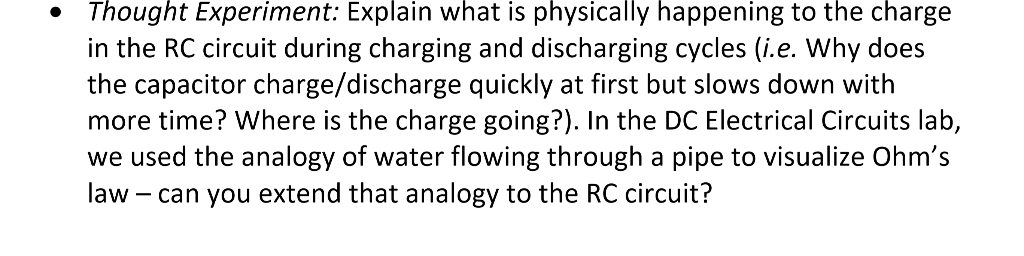 eo Thought Experiment: Explain what is physically happening to the charge
in the RC circuit during charging and discharging cycles (i.e. Why does
the capacitor charge/discharge quickly at first but slows down with
more time? Where is the charge going?). In the DC Electrical Circuits lab,
we used the analogy of water flowing through a pipe to visualize Ohm's
law — can you extend that analogy to the RC circuit?
This is AI generated Response.
Asked by: gvr
Created at: 2025-06-23 21:45:18
Asked by: gvr
Created at: 2025-06-23 21:45:18
Final Answer:
Rendered
Raw Text
Did you like this answer?
Let's break down the question into parts and address each one step by step:
---
### **1. What is physically happening to the charge in the RC circuit during charging and discharging?**
#### **Charging Cycle:**
- **Initially (t = 0):**
The capacitor is uncharged, so the voltage across it is zero. When the circuit is connected to a voltage source, the full voltage appears across the resistor, causing a large initial current.
- **As time passes:**
The capacitor begins to store charge, and the voltage across it rises. As the voltage across the capacitor increases, the voltage across the resistor drops. Thus, the current decreases.
- **Eventually (t → ∞):**
The capacitor becomes fully charged (voltage across it equals the supply voltage). At this point, current stops flowing.
#### **Discharging Cycle:**
- **Initially:**
The capacitor is fully charged. When the circuit is closed (without the voltage source), the capacitor starts to discharge through the resistor, causing a high initial current.
- **As time passes:**
The charge on the capacitor decreases, so the voltage across it drops. The current through the resistor also decreases.
- **Eventually:**
The capacitor is fully discharged, and both the voltage and current drop to zero.
---
### **2. Why does the capacitor charge/discharge quickly at first but slow down over time?**
- **At the start:**
The difference in potential (voltage) between the capacitor and the source (or ground, during discharge) is greatest, so the driving force for current is highest.
- **As charging/discharging progresses:**
The voltage difference decreases, so the current slows down (by Ohm’s law, \( I = \frac{V}{R} \)). This is why the process is fast at first and then slows down.
---
### **3. Where is the charge going?**
- **Charging:**
Electrons are moving onto one plate of the capacitor and leaving the other plate. The charge is stored as an imbalance of electrons on the two plates.
- **Discharging:**
The stored charge flows back through the resistor, returning the plates to electrical neutrality.
---
### **4. Water Analogy for RC Circuit**
#### **Ohm’s Law Analogy:**
- **Voltage:** Pressure difference
- **Current:** Flow of water
- **Resistor:** Narrow section of pipe
#### **Extending to RC Circuit:**
- **Capacitor analogy:**
Imagine a flexible membrane dividing a pipe. At first, if the membrane is flat, water can flow quickly to stretch it, just like charge quickly accumulates on the capacitor (large initial current).
- **As the membrane stretches (capacitor charges):**
It pushes back more and more, making it harder for water to flow (current decreases). Eventually, the membrane is fully stretched (capacitor fully charged), and no more water flows (current stops).
- **Discharging:**
If you remove the pressure, the stretched membrane (charged capacitor) pushes water back through the pipe, but the force (current) gets weaker as the membrane returns to its original state (capacitor discharges).
---
### **Final Summary:**
- In an RC circuit, charging/discharging is rapid at first due to the large initial voltage difference, then slows as the voltage (and thus current) drops.
- The charge moves onto or off the capacitor plates.
- The water analogy: a stretched membrane in a pipe resists water flow more as it stretches, just like a capacitor resists current flow more as it charges.
---
**Final Answer (in short, for your notes):**
The capacitor charges/discharges quickly at first because the voltage difference (and thus current) is greatest at the start, but as the capacitor voltage increases (or decreases, during discharge), the current slows. Charge accumulates on the plates during charging and leaves during discharging. Analogous to water stretching a flexible membrane in a pipe: initially, water flows easily, but as the membrane stretches, it resists further flow, just like a capacitor resists further charging as it fills.
📢 Instructions:
- Ask anything relatd to above question only.
- For new Question goto :