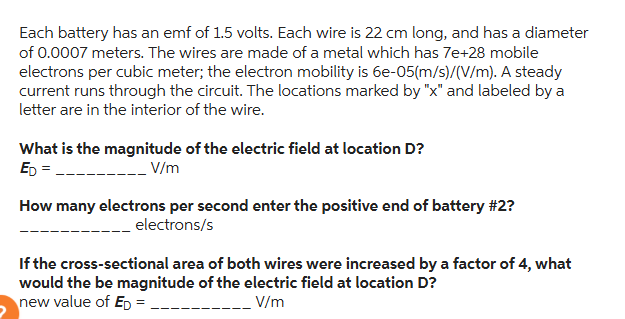
Give step-by-step solution with explanation and final answer:Each battery has an emf of 15 volts. Each wire is 22 cm long, and has a diameter
of 0.0007 meters. The wires are made of a metal which has 7e+28 mobile
electrons per cubic meter; the electron mobility is 6e-05(m/s)/(V/m). A steady
current runs through the circuit. The locations marked by "x" and labeled by a
letter are in the interior of the wire.
What is the magnitude of the electric field at location D?
[oR —)
How many electrons per second enter the positive end of battery #2?
_________electrons/s
If the cross-sectional area of both wires were increased by a factor of 4, what
would the be magnitude of the electric field at location D?
Wnew value of Ep=__________V/m
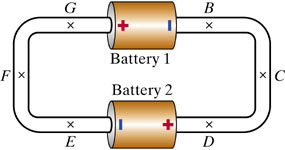
G B
-
Battery |
F le
Battery 2
i
E D
Question:
Give step-by-step solution with explanation and final answer:Each battery has an emf of 15 volts. Each wire is 22 cm long, and has a diameter
of 0.0007 meters. The wires are made of a metal which has 7e+28 mobile
electrons per cubic meter; the electron mobility is 6e-05(m/s)/(V/m). A steady
current runs through the circuit. The locations marked by "x" and labeled by a
letter are in the interior of the wire.
What is the magnitude of the electric field at location D?
[oR —)
How many electrons per second enter the positive end of battery #2?
_________electrons/s
If the cross-sectional area of both wires were increased by a factor of 4, what
would the be magnitude of the electric field at location D?
Wnew value of Ep=__________V/m
G B
-
Battery |
F le
Battery 2
i
E D
This is AI generated Response.
Asked by: gvr
Created at: 2025-06-23 20:26:55
Final Answer:
RenderedRaw Text
Did you like this answer?
Let's solve each part step by step.
---
### 1. **What is the magnitude of the electric field at location D?**
**Given:**
- EMF of each battery, \( \mathcal{E} = 1.5 \) V
- Length of each wire, \( L = 22 \) cm \( = 0.22 \) m
- Diameter of wire, \( d = 0.0007 \) m → radius \( r = 0.00035 \) m
- Electron density, \( n = 7 \times 10^{28} \) electrons/m³
- Electron mobility, \( \mu_e = 6 \times 10^{-5} \) (m/s)/(V/m)
- Two batteries in series, so total voltage \( V = 1.5 + 1.5 = 3.0 \) V
- The circuit has two wires (top and bottom, each 22 cm).
**Assumption:** The total resistance is dominated by the wires, not the battery internal resistance.
#### **Step 1: Calculate the total length of the wire in the loop**
\[
L_\text{total} = 2 \times 0.22\,\text{m} = 0.44\,\text{m}
\]
#### **Step 2: Find the electric field in the wire**
The electric field in the wire (assuming uniform field):
\[
E = \frac{V}{L_\text{total}}
\]
\[
E_D = \frac{3.0\,\text{V}}{0.44\,\text{m}} = 6.82\,\text{V/m}
\]
**Final Answer:**
\[
\boxed{E_D = 6.8\ \text{V/m}}
\]
---
### 2. **How many electrons per second enter the positive end of battery #2?**
#### **Step 1: Calculate the cross-sectional area of the wire**
\[
A = \pi r^2 = \pi (0.00035)^2 = 3.85 \times 10^{-7}\ \text{m}^2
\]
#### **Step 2: Find the drift velocity**
\[
v_d = \mu_e E = (6 \times 10^{-5}) \times 6.82 = 4.09 \times 10^{-4}\ \text{m/s}
\]
#### **Step 3: Find the current**
\[
I = n e A v_d
\]
where \( e = 1.6 \times 10^{-19} \) C
\[
I = (7 \times 10^{28}) \times (1.6 \times 10^{-19}) \times (3.85 \times 10^{-7}) \times (4.09 \times 10^{-4})
\]
Calculate step by step:
1. \( 7 \times 10^{28} \times 1.6 \times 10^{-19} = 1.12 \times 10^{10} \)
2. \( 1.12 \times 10^{10} \times 3.85 \times 10^{-7} = 4.312 \times 10^{3} \)
3. \( 4.312 \times 10^{3} \times 4.09 \times 10^{-4} = 1.76\ \text{A} \)
#### **Step 4: Number of electrons per second**
\[
\text{Electrons/sec} = \frac{I}{e} = \frac{1.76}{1.6 \times 10^{-19}} = 1.1 \times 10^{19}\ \text{electrons/s}
\]
**Final Answer:**
\[
\boxed{1.1 \times 10^{19}\ \text{electrons/s}}
\]
---
### 3. **If the cross-sectional area of both wires were increased by a factor of 4, what would be the magnitude of the electric field at location D?**
- Current must stay the same for the same voltage.
- Resistance: \( R = \frac{\rho L}{A} \)
- For a given voltage, \( I = \frac{V}{R} \)
- If \( A \rightarrow 4A \), then \( R \rightarrow \frac{R}{4} \), so for the same current, \( E \) (which is \( V/L \)) must decrease by 4.
\[
E_\text{new} = \frac{E_D}{4} = \frac{6.8}{4} = 1.7\ \text{V/m}
\]
**Final Answer:**
\[
\boxed{E_D = 1.7\ \text{V/m}}
\]
---
## **Summary of Answers**
1. **Magnitude of electric field at D:** \(\boxed{6.8\ \text{V/m}}\)
2. **Electrons per second entering positive end of battery #2:** \(\boxed{1.1 \times 10^{19}\ \text{electrons/s}}\)
3. **New electric field at D (with area ×4):** \(\boxed{1.7\ \text{V/m}}\)
VIPSolutions focuses on clear, step‑by‑step explanations so you can learn quickly. Whether you need an AI‑generated walkthrough or a short hint to get unstuck, each solution is organized for fast reading and easy review later.
Search similar questions, compare approaches, and bookmark the best answers for revision. Our goal is simple: quick, reliable study help that feels natural—not noisy.
 VIPSolutions
 Each battery has an emf of 15 volts. Each wire is 22 cm long, and has a diameter
of 0.0007 meters. The wires are made of a metal which has 7e+28 mobile
electrons per cubic meter; the electron mobility is 6e-05(m/s)/(V/m). A steady
current runs through the circuit. The locations marked by "x" and labeled by a
letter are in the interior of the wire.
What is the magnitude of the electric field at location D?
[oR —)
How many electrons per second enter the positive end of battery #2?
_________electrons/s
If the cross-sectional area of both wires were increased by a factor of 4, what
would the be magnitude of the electric field at location D?
Wnew value of Ep=__________V/m
G B
-
Battery |
F le
Battery 2
i
E D