 VIPSolutions
Give step-by-step solution with explanation and final answer:3) {oR om region buddy 1, andy 0. Us shot mths id hon ha scld gered when iobed soc ey 5. ! 0 ot ha washr et an ho shl mab rd ho oro he sk at gard hon terion ha sk. cat bound by
Question:
Give step-by-step solution with explanation and final answer: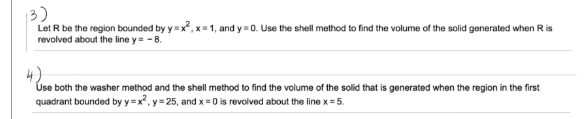 3)
{oR om region buddy 1, andy 0. Us shot mths id hon ha scld gered when
iobed soc ey 5.
!
0 ot ha washr et an ho shl mab rd ho oro he sk at gard hon terion ha sk.
cat bound by
This is AI generated Response.
Asked by: gvr
Created at: 2025-06-23 10:22:00
Asked by: gvr
Created at: 2025-06-23 10:22:00
Final Answer:
Rendered
Raw Text
Did you like this answer?
Let's solve each problem step by step:
---
### **3) Shell Method for Volume**
**Given:**
- Region bounded by \( y = x^2 \), \( x = 1 \), and \( y = 0 \).
- Revolved about the line \( y = -8 \).
#### **Step 1: Visualize the Region**
- The region is above the \( x \)-axis (\( y = 0 \)), below \( y = x^2 \), and to the left of \( x = 1 \).
- Lower bound for \( x \) is 0, upper bound is 1.
#### **Step 2: Setup Shell Method**
- Shells are **vertical**, so integrate with respect to \( x \).
- **Radius** of a typical shell: Distance from \( y = x^2 \) to \( y = -8 \):
\( \text{Radius} = x^2 - (-8) = x^2 + 8 \)
- **Height** of a typical shell: \( x \) runs from 0 to 1, so height is just from \( y = 0 \) to \( y = x^2 \), but since we're using vertical slices, the height is \( x \).
- **Circumference**: \( 2\pi \times \text{radius} \).
- **Height**: \( x^2 \) (from \( y = x^2 \) to \( y = 0 \)).
#### **Step 3: Write the Integral**
\[
V = 2\pi \int_{x=0}^{x=1} (\text{radius}) \cdot (\text{height})\,dx
\]
\[
V = 2\pi \int_{0}^{1} (x^2 + 8) \cdot x \, dx
\]
\[
V = 2\pi \int_{0}^{1} (x^3 + 8x) \, dx
\]
#### **Step 4: Integrate**
\[
\int_{0}^{1} x^3 \, dx = \left. \frac{x^4}{4} \right|_0^1 = \frac{1}{4}
\]
\[
\int_{0}^{1} 8x \, dx = 8 \left. \frac{x^2}{2} \right|_0^1 = 8 \cdot \frac{1}{2} = 4
\]
So,
\[
V = 2\pi \left( \frac{1}{4} + 4 \right) = 2\pi \left( \frac{17}{4} \right) = \frac{17\pi}{2}
\]
#### **Final Answer (3):**
\[
\boxed{V = \frac{17\pi}{2}}
\]
---
### **4) Both Washer and Shell Methods**
**Given:**
- Region in the first quadrant bounded by \( y = x^2 \), \( y = 25 \), and \( x = 0 \).
- Revolved about \( x = 5 \).
#### **Step 1: Bounds**
- \( y = x^2 \implies x = \sqrt{y} \)
- \( y \) ranges from \( 0 \) to \( 25 \)
- \( x \) ranges from \( 0 \) to \( 5 \) (since \( y = 25 \implies x = 5 \))
---
#### **(a) Washer Method (Horizontal Slices)**
- Slices perpendicular to the axis of rotation, so integrate with respect to \( y \).
- At height \( y \), \( x = \sqrt{y} \).
- **Outer radius**: Distance from \( x = 5 \) to \( x = 0 \): \( 5 - 0 = 5 \)
- **Inner radius**: Distance from \( x = 5 \) to \( x = \sqrt{y} \): \( 5 - \sqrt{y} \)
\[
V = \pi \int_{y=0}^{y=25} \left[ (5)^2 - (5 - \sqrt{y})^2 \right] dy
\]
\[
= \pi \int_{0}^{25} \left[ 25 - (25 - 10\sqrt{y} + y) \right] dy
\]
\[
= \pi \int_{0}^{25} (10\sqrt{y} - y) dy
\]
Integrate:
\[
\int_{0}^{25} 10\sqrt{y} \, dy = 10 \int_{0}^{25} y^{1/2} dy = 10 \left. \frac{2}{3} y^{3/2} \right|_0^{25} = 10 \cdot \frac{2}{3} \cdot 125 = \frac{2500}{3}
\]
\[
\int_{0}^{25} y \, dy = \left. \frac{y^2}{2} \right|_0^{25} = \frac{625}{2}
\]
So,
\[
V = \pi \left( \frac{2500}{3} - \frac{625}{2} \right) = \pi \left( \frac{5000 - 1875}{6} \right) = \pi \left( \frac{3125}{6} \right)
\]
#### **Washer Method Answer:**
\[
\boxed{V = \frac{3125\pi}{6}}
\]
---
#### **(b) Shell Method (Vertical Slices)**
- Slices **parallel** to axis of rotation, integrate with respect to \( x \).
- **Radius** (distance from shell at \( x \) to \( x = 5 \)): \( 5 - x \)
- **Height**: From \( y = x^2 \) to \( y = 25 \): \( 25 - x^2 \)
- \( x \) from 0 to 5.
\[
V = 2\pi \int_{x=0}^{x=5} (\text{radius}) \cdot (\text{height}) dx
\]
\[
= 2\pi \int_{0}^{5} (5 - x)(25 - x^2) dx
\]
Expand:
\[
= 2\pi \int_{0}^{5} \left[ 125 - 5x^2 - 25x + x^3 \right] dx
\]
\[
= 2\pi \int_{0}^{5} (125 - 25x - 5x^2 + x^3) dx
\]
Integrate each term:
- \(\int_{0}^{5} 125 dx = 125x|_0^5 = 625\)
- \(\int_{0}^{5} 25x dx = 25 \cdot \frac{x^2}{2}|_0^5 = 25 \cdot \frac{25}{2} = 312.5\)
- \(\int_{0}^{5} 5x^2 dx = 5 \cdot \frac{x^3}{3}|_0^5 = 5 \cdot \frac{125}{3} = \frac{625}{3}\)
- \(\int_{0}^{5} x^3 dx = \frac{x^4}{4}|_0^5 = \frac{625}{4}\)
Sum:
\[
= 2\pi \left[ 625 - 312.5 - \frac{625}{3} + \frac{625}{4} \right]
\]
Convert to common denominator (12):
- \(625 = \frac{7500}{12}\)
- \(312.5 = \frac{3750}{12}\)
- \(\frac{625}{3} = \frac{2500}{12}\)
- \(\frac{625}{4} = \frac{1875}{12}\)
So sum:
\[
625 - 312.5 - \frac{625}{3} + \frac{625}{4} = \frac{7500 - 3750 - 2500 + 1875}{12} = \frac{3125}{12}
\]
Multiply by 2π:
\[
V = 2\pi \cdot \frac{3125}{12} = \frac{3125\pi}{6}
\]
---
#### **Shell Method Answer:**
\[
\boxed{V = \frac{3125\pi}{6}}
\]
---
## **Final Answers**
### **3)**
\[
\boxed{V = \frac{17\pi}{2}}
\]
### **4)**
\[
\boxed{V = \frac{3125\pi}{6}}
\]
(using either method)
📢 Instructions:
- Ask anything relatd to above question only.
- For new Question goto :