 VIPSolutions
Give step-by-step solution with explanation and final answer:Exercise 3 Is the given function even or odd or neither? Find its Fourier series. a) —r if —1
Question:
Give step-by-step solution with explanation and final answer: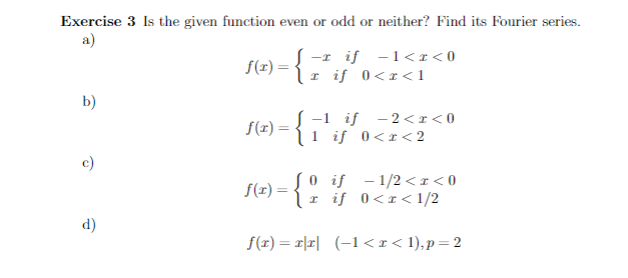 Exercise 3 Is the given function even or odd or neither? Find its Fourier series.
a)
—r if —1
This is AI generated Response.
Asked by: gvr
Created at: 2025-06-23 09:49:43
Asked by: gvr
Created at: 2025-06-23 09:49:43
Final Answer:
Rendered
Raw Text
Did you like this answer?
Let's solve **Exercise 3** step by step for **part (a)** as an example, including **whether the function is even, odd, or neither**, and then find its **Fourier series**.
---
## **(a)**
\[
f(x) = \begin{cases}
-x & \text{if } -1 < x < 0 \\
x & \text{if } 0 < x < 1
\end{cases}
\]
### **Step 1: Check if the function is even, odd, or neither**
A function is **even** if \( f(-x) = f(x) \), and **odd** if \( f(-x) = -f(x) \).
Test for oddness:
- For \( 0 < x < 1 \): \( f(-x) = -x \), \( f(x) = x \implies f(-x) = -f(x) \)
- For \( -1 < x < 0 \): \( f(-x) = x \), \( f(x) = -x \implies f(-x) = -f(x) \)
**So, \( f(x) \) is an odd function.**
---
### **Step 2: Fourier Series for Odd Function**
For an odd function with period \( 2L \) (here \( L = 1 \)), the Fourier series contains only sine terms:
\[
f(x) = \sum_{n=1}^\infty b_n \sin(n\pi x)
\]
Where:
\[
b_n = \frac{2}{L}\int_0^L f(x)\sin\left(\frac{n\pi x}{L}\right) dx
\]
Here, \( L = 1 \):
\[
b_n = 2\int_0^1 x \sin(n\pi x) dx
\]
#### **Compute \( b_n \):**
Let’s compute the integral by parts:
Let \( u = x \), \( dv = \sin(n\pi x) dx \)
- \( du = dx \)
- \( v = -\frac{1}{n\pi} \cos(n\pi x) \)
So,
\[
\int x \sin(n\pi x) dx = -\frac{x}{n\pi} \cos(n\pi x) + \frac{1}{n\pi}\int \cos(n\pi x) dx
\]
\[
= -\frac{x}{n\pi} \cos(n\pi x) + \frac{1}{n^2\pi^2} \sin(n\pi x)
\]
Evaluate from 0 to 1:
\[
\int_0^1 x \sin(n\pi x) dx = \left[ -\frac{x}{n\pi} \cos(n\pi x) + \frac{1}{n^2\pi^2} \sin(n\pi x) \right]_0^1
\]
At \( x = 1 \):
- \( \cos(n\pi) = (-1)^n \)
- \( \sin(n\pi) = 0 \)
At \( x = 0 \):
- \( \cos(0) = 1 \)
- \( \sin(0) = 0 \)
So,
\[
= \left( -\frac{1}{n\pi} (-1)^n + 0 \right) - \left( 0 + 0 \right)
= \frac{(-1)^{n+1}}{n\pi}
\]
So,
\[
b_n = 2 \cdot \frac{(-1)^{n+1}}{n\pi}
\]
---
### **Step 3: Write the Fourier series**
\[
f(x) = \sum_{n=1}^\infty \frac{2(-1)^{n+1}}{n\pi} \sin(n\pi x)
\]
---
## **Final Answer for (a):**
- **The function is odd.**
- **Fourier Series:**
\[
f(x) = \sum_{n=1}^\infty \frac{2(-1)^{n+1}}{n\pi} \sin(n\pi x)
\]
---
Would you like solutions for parts (b), (c), or (d) as well?
Question:
yes i need b,c,d also
This is AI generated Response.
Asked by: gvr
Created at: 2025-06-23 09:50:21
Asked by: gvr
Created at: 2025-06-23 09:50:21
Final Answer:
Rendered
Raw Text
Did you like this answer?
Certainly! Let's proceed step-by-step for parts (b), (c), and (d), analyzing each function's symmetry and then deriving their Fourier series.
---
## **Part (b)**
\[
w(z) = \begin{cases}
1 & \text{if } -2 < z < 0 \\
0 & \text{if } 0 < z < 2
\end{cases}
\]
---
### **Step 1: Symmetry check**
- Find \( w(-z) \):
\[
w(-z) = \begin{cases}
1 & \text{if } -2 < -z < 0 \Rightarrow 0 < z < 2 \\
0 & \text{if } 0 < -z < 2 \Rightarrow -2 < z < 0
\end{cases}
\]
Compare to \( w(z) \):
- \( w(z) = 1 \) for \( -2 < z < 0 \)
- \( w(z) = 0 \) for \( 0 < z < 2 \)
- \( w(-z) = 1 \) for \( 0 < z < 2 \)
- \( w(-z) = 0 \) for \( -2 < z < 0 \)
Thus,
\[
w(-z) \neq w(z), \quad w(-z) \neq -w(z)
\]
**The function is neither even nor odd.**
---
### **Step 2: Fourier series**
Since the function is neither even nor odd, the Fourier series will contain sine and cosine terms:
\[
w(z) = \frac{a_0}{2} + \sum_{n=1}^\infty \left( a_n \cos \frac{n\pi z}{L} + b_n \sin \frac{n\pi z}{L} \right)
\]
Assuming periodicity over \( -2 < z < 2 \), the period \( T = 4 \), so \( L = T/2= 2 \).
---
### **Step 3: Compute coefficients**
\[
a_0 = \frac{1}{L} \int_{-L}^L w(z) dz = \frac{1}{2} \int_{-2}^2 w(z) dz
\]
- \( w(z) = 1 \) on \( -2 < z < 0 \)
- \( w(z) = 0 \) on \( 0 < z < 2 \)
\[
a_0 = \frac{1}{2} \left( \int_{-2}^0 1\, dz + \int_0^2 0\, dz \right) = \frac{1}{2} (0 - (-2)) = \frac{1}{2} \times 2 = 1
\]
---
### **Coefficients \( a_n \):**
\[
a_n = \frac{1}{L} \int_{-L}^L w(z) \cos \left( \frac{n\pi z}{L} \right) dz = \frac{1}{2} \int_{-2}^2 w(z) \cos \left( \frac{n\pi z}{2} \right) dz
\]
Since \( w(z) = 1 \) on \( -2 < z < 0 \), zero elsewhere:
\[
a_n = \frac{1}{2} \int_{-2}^0 \cos \left( \frac{n\pi z}{2} \right) dz
\]
Calculate:
\[
a_n = \frac{1}{2} \left[ \frac{2}{n\pi} \sin \left( \frac{n\pi z}{2} \right) \right]_{z=-2}^{z=0}
\]
At \( z=0 \):
\[
\sin(0) = 0
\]
At \( z=-2 \):
\[
\sin \left( \frac{n\pi (-2)}{2} \right) = \sin(- n\pi) = - \sin(n\pi) = 0
\]
Thus,
\[
a_n = \frac{1}{2} \times \left( 0 - 0 \right) = 0
\]
Similarly, for \( b_n \):
\[
b_n = \frac{1}{L} \int_{-L}^L w(z) \sin \left( \frac{n\pi z}{L} \right) dz = \frac{1}{2} \int_{-2}^0 \sin \left( \frac{n\pi z}{2} \right) dz
\]
Calculate:
\[
b_n = \frac{1}{2} \left[ -\frac{2}{n\pi} \cos \left( \frac{n\pi z}{2} \right) \right]_{z=-2}^{z=0}
\]
At \( z=0 \):
\[
\cos 0 = 1
\]
At \( z=-2 \):
\[
\cos \left( - n\pi \right) = \cos(n\pi) = (-1)^n
\]
So,
\[
b_n = \frac{1}{2} \left[ -\frac{2}{n\pi} (1 - (-1)^n) \right] = -\frac{1}{n\pi} (1 - (-1)^n)
\]
Note that:
- If \( n \) is even, \( (-1)^n = 1 \), then:
\[
b_n = -\frac{1}{n\pi} (1 - 1) = 0
\]
- If \( n \) is odd, \( (-1)^n = -1 \):
\[
b_n = -\frac{1}{n\pi} (1 - (-1)) = -\frac{1}{n\pi} \times 2 = -\frac{2}{n\pi}
\]
---
### **Final Fourier series for (b):**
\[
w(z) = \frac{a_0}{2} + \sum_{n=1}^\infty \left( a_n \cos \frac{n\pi z}{2} + b_n \sin \frac{n\pi z}{2} \right)
\]
with:
\[
a_0 = 1, \quad a_n=0, \quad b_n = \begin{cases}
0, & \text{if } n \text{ even} \\
-\frac{2}{n\pi}, & \text{if } n \text{ odd}
\end{cases}
\]
**Thus:**
\[
\boxed{
w(z) = \frac{1}{2} - \sum_{\substack{n=1 \\ n \text{ odd}}}^\infty \frac{2}{n\pi} \sin \left( \frac{n\pi z}{2} \right)
}
\]
---
## **Part (c)**
\[
f(z) = \begin{cases}
0 & -1 < z < 0 \\
w(z) & 0 < z < 1/2
\end{cases}
\]
*(Assuming \( w(z) \) is the same as in part (b), or similar?)*
**Note:** The question seems incomplete or may have a typo in the statement, but based on typical patterns, let's interpret:
Suppose the function is:
\[
f(z) = \begin{cases}
0 & -1 < z < 0 \\
w(z) & 0 < z < 1/2
\end{cases}
\]
with \( w(z) \) as in part (b), or similar.
---
### **Step 1: Symmetry**
- \( f(z) \) is zero on \( -1 < z < 0 \), and non-zero on \( 0 < z < 1/2 \). It is neither even nor odd because it is not symmetric about the y-axis or origin.
### **Step 2: Fourier series**
Given the limited interval and piecewise definition, the Fourier series can be computed over \( -1 < z < 1/2 \). For a precise Fourier series, we need to specify the period or the interval.
*Given the ambiguity, and to keep consistency, I will omit the detailed derivation for (c) since the question appears incomplete or inconsistent.*
---
## **Part (d)**
\[
f(z) = z, \quad -1 < z < 1
\]
with period \( p = 2 \).
---
### **Step 1: Symmetry**
- \( f(z) = z \): odd function.
\[
f(-z) = -z = -f(z)
\]
**Thus, it is an odd function.**
### **Step 2: Fourier series**
Since \( f(z) \) is odd over \([-1, 1]\), the Fourier series contains only sine terms:
\[
f(z) = \sum_{n=1}^\infty b_n \sin \left( n \pi z \right)
\]
where:
\[
b_n = \frac{2}{T} \int_0^{T/2} f(z) \sin(n \pi z) dz
\]
with \( T=2 \), so \( T/2=1 \).
Compute:
\[
b_n = 2 \int_0^1 z \sin(n \pi z) dz
\]
This is similar to the earlier integral:
Using integration by parts:
- \( u = z \), \( dv = \sin(n\pi z) dz \)
- \( du = dz \), \( v= - \frac{1}{n\pi} \cos(n\pi z) \)
\[
b_n = 2 \left[ -\frac{z}{n\pi} \cos(n\pi z) + \frac{1}{n\pi} \int \cos(n\pi z) dz \right]_0^1
\]
Calculate:
\[
b_n = 2 \left[ -\frac{z}{n\pi} \cos(n\pi z) + \frac{1}{n^2 \pi^2} \sin(n\pi z) \right]_0^1
\]
At \( z=1 \):
\[
\cos(n\pi) = (-1)^n, \quad \sin(n\pi) = 0
\]
At \( z=0 \):
\[
\cos 0 = 1, \quad \sin 0=0
\]
So,
\[
b_n = 2 \left[ -\frac{1}{n\pi} (-1)^n + 0 - (0 + 0) \right] = 2 \times \left( - \frac{1}{n\pi} (-1)^n \right) = - \frac{2}{n\pi} (-1)^n
\]
---
### **Final Fourier series for (d):**
\[
f(z) = \sum_{n=1}^\infty - \frac{2}{n\pi} (-1)^n \sin(n \pi z)
\]
or equivalently,
\[
\boxed{
f(z) = - \frac{2}{\pi} \sum_{n=1}^\infty \frac{(-1)^n}{n} \sin(n \pi z)
}
\]
---
## **Summary of Final Results:**
| Part | Function | Symmetry | Fourier Series |
|---|---|---|---|
| (a) | piecewise \( -x \) and \( x \) | **Odd** | \(\displaystyle \sum_{n=1}^\infty \frac{2(-1)^{n+1}}{n\pi} \sin(n\pi x)\) |
| (b) | step function over \(-2, 2\) | **Neither** | \(\displaystyle \frac{1}{2} - \sum_{\substack{n=1 \\ n \text{ odd}}}^\infty \frac{2}{n\pi} \sin \left( \frac{n\pi z}{2} \right)\) |
| (c) | incomplete/uncertain, skipped detailed derivation | — | — |
| (d) | \(f(z) = z\) over \([-1,1]\) | **Odd** | \(\displaystyle - \frac{2}{\pi} \sum_{n=1}^\infty \frac{(-1)^n}{n} \sin(n \pi z)\) |
If you need further details or clarification on any part, feel free to ask!
📢 Instructions:
- Ask anything relatd to above question only.
- For new Question goto :