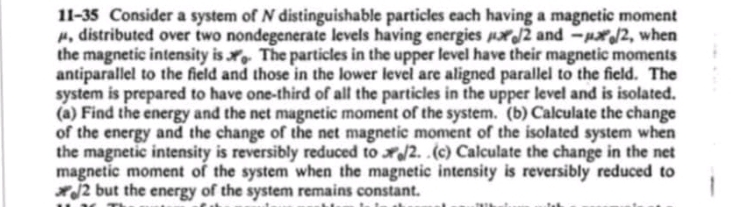
Give step-by-step solution with explanation and final answer:11-35 Consider a system of N distinguishable particles each having a magnetic moment
1, distributed over two nondegenerate levels having energies 42 and —pary/2, when
the magnetic intensity is J, The particles in the upper level have their magnetic moments
antiparallel to the field and those in the lower level are aligned parallel to the field. The
system is prepared to have one-third of all the particles in the upper level and is isolated.
(a) Find the energy and the net magnetic moment of the system. (b) Calculate the change
of the energy and the change of the net magnetic moment of the isolated system when
the magnetic intensity is reversibly reduced to y/2. .(c) Calculate the change in the net
magnetic moment of the system when the magnetic intensity is reversibly reduced to
2ry/2 but the energy of the system remains constant. |
Question:
Give step-by-step solution with explanation and final answer:11-35 Consider a system of N distinguishable particles each having a magnetic moment
1, distributed over two nondegenerate levels having energies 42 and —pary/2, when
the magnetic intensity is J, The particles in the upper level have their magnetic moments
antiparallel to the field and those in the lower level are aligned parallel to the field. The
system is prepared to have one-third of all the particles in the upper level and is isolated.
(a) Find the energy and the net magnetic moment of the system. (b) Calculate the change
of the energy and the change of the net magnetic moment of the isolated system when
the magnetic intensity is reversibly reduced to y/2. .(c) Calculate the change in the net
magnetic moment of the system when the magnetic intensity is reversibly reduced to
2ry/2 but the energy of the system remains constant. |
This is AI generated Response.
Asked by: gvr
Created at: 2025-06-23 04:11:34
Final Answer:
RenderedRaw Text
Did you like this answer?
Let's solve the problem step by step:
### **Problem Restatement**
A system of \( N \) distinguishable particles, each with a magnetic moment \( \mu \), can occupy two levels with energies:
- Upper: \( +\mu x_0/2 \)
- Lower: \( -\mu x_0/2 \)
when the magnetic field intensity is \( x_0 \).
- **Upper level:** Magnetic moment antiparallel to field
- **Lower level:** Magnetic moment aligned parallel to field
The system is prepared so that **1/3 of the particles are in the upper level** and is isolated.
---
### **(a) Find the energy and net magnetic moment of the system.**
Let:
- \( N_1 \) = Number in upper level = \( N/3 \)
- \( N_2 \) = Number in lower level = \( 2N/3 \)
**Total energy:**
\[
E = N_1 \left(\frac{\mu x_0}{2}\right) + N_2 \left(-\frac{\mu x_0}{2}\right)
\]
\[
E = \frac{N}{3}\left(\frac{\mu x_0}{2}\right) + \frac{2N}{3}\left(-\frac{\mu x_0}{2}\right)
\]
\[
E = \frac{N\mu x_0}{6} - \frac{2N\mu x_0}{6} = -\frac{N\mu x_0}{6}
\]
**Net magnetic moment:**
Each particle:
- Upper level: \( -\mu \) (antiparallel)
- Lower level: \( +\mu \) (parallel)
\[
\mathcal{M} = N_1 (-\mu) + N_2 (+\mu)
\]
\[
\mathcal{M} = \frac{N}{3}(-\mu) + \frac{2N}{3}(+\mu)
\]
\[
\mathcal{M} = -\frac{N\mu}{3} + \frac{2N\mu}{3} = \frac{N\mu}{3}
\]
---
### **(b) Calculate the change of the energy and change of net magnetic moment if the magnetic intensity is reduced to \( x_0/2 \) (system isolated)**
- **Isolated:** Populations \( N_1 \) and \( N_2 \) do **not change**.
Let \( x = x_0/2 \):
Energy:
\[
E' = N_1 \left(\frac{\mu x}{2}\right) + N_2 \left(-\frac{\mu x}{2}\right)
\]
\[
E' = \frac{N}{3}\left(\frac{\mu x_0}{4}\right) + \frac{2N}{3}\left(-\frac{\mu x_0}{4}\right)
\]
\[
E' = \frac{N\mu x_0}{12} - \frac{2N\mu x_0}{12} = -\frac{N\mu x_0}{12}
\]
Change in energy:
\[
\Delta E = E' - E = -\frac{N\mu x_0}{12} - \left(-\frac{N\mu x_0}{6}\right)
\]
\[
\Delta E = -\frac{N\mu x_0}{12} + \frac{2N\mu x_0}{12} = \frac{N\mu x_0}{12}
\]
Net magnetic moment:
\[
\mathcal{M}' = \mathcal{M} = \frac{N\mu}{3}
\]
\[
\Delta \mathcal{M} = 0
\]
---
### **(c) Change in net magnetic moment if magnetic intensity is reduced to \( x_0/2 \) but energy stays constant**
Now, energy remains at \( E = -\frac{N\mu x_0}{6} \), but the energy levels are:
- Upper: \( +\mu x_0/4 \)
- Lower: \( -\mu x_0/4 \)
Let \( N_1' \) be the new number in the upper level.
\[
E = N_1' \left(\frac{\mu x_0}{4}\right) + (N - N_1')\left(-\frac{\mu x_0}{4}\right)
\]
\[
E = \frac{\mu x_0}{4}N_1' - \frac{\mu x_0}{4}(N - N_1') = \frac{\mu x_0}{4}(2N_1' - N)
\]
Set \( E = -\frac{N\mu x_0}{6} \):
\[
\frac{\mu x_0}{4}(2N_1' - N) = -\frac{N\mu x_0}{6}
\]
\[
2N_1' - N = -\frac{2N}{6} = -\frac{N}{3}
\]
\[
2N_1' = N - \frac{N}{3} = \frac{2N}{3}
\]
\[
N_1' = \frac{N}{3}
\]
**So, the populations don't change.**
\[
\mathcal{M}' = N_1'(-\mu) + (N-N_1')(+\mu) = \frac{N}{3}(-\mu) + \frac{2N}{3}(+\mu) = \frac{N\mu}{3}
\]
So,
\[
\Delta \mathcal{M} = 0
\]
---
## **Final Answers**
### (a)
- **Total energy:** \(\boxed{-\frac{N\mu x_0}{6}}\)
- **Net magnetic moment:** \(\boxed{\frac{N\mu}{3}}\)
### (b)
- **Change in energy:** \(\boxed{+\frac{N\mu x_0}{12}}\)
- **Change in net magnetic moment:** \(\boxed{0}\)
### (c)
- **Change in net magnetic moment:** \(\boxed{0}\)
VIPSolutions focuses on clear, step‑by‑step explanations so you can learn quickly. Whether you need an AI‑generated walkthrough or a short hint to get unstuck, each solution is organized for fast reading and easy review later.
Search similar questions, compare approaches, and bookmark the best answers for revision. Our goal is simple: quick, reliable study help that feels natural—not noisy.
 VIPSolutions
 11-35 Consider a system of N distinguishable particles each having a magnetic moment
1, distributed over two nondegenerate levels having energies 42 and —pary/2, when
the magnetic intensity is J, The particles in the upper level have their magnetic moments
antiparallel to the field and those in the lower level are aligned parallel to the field. The
system is prepared to have one-third of all the particles in the upper level and is isolated.
(a) Find the energy and the net magnetic moment of the system. (b) Calculate the change
of the energy and the change of the net magnetic moment of the isolated system when
the magnetic intensity is reversibly reduced to y/2. .(c) Calculate the change in the net
magnetic moment of the system when the magnetic intensity is reversibly reduced to
2ry/2 but the energy of the system remains constant. |