VIPSolutions logo ✨ VIPSolutions

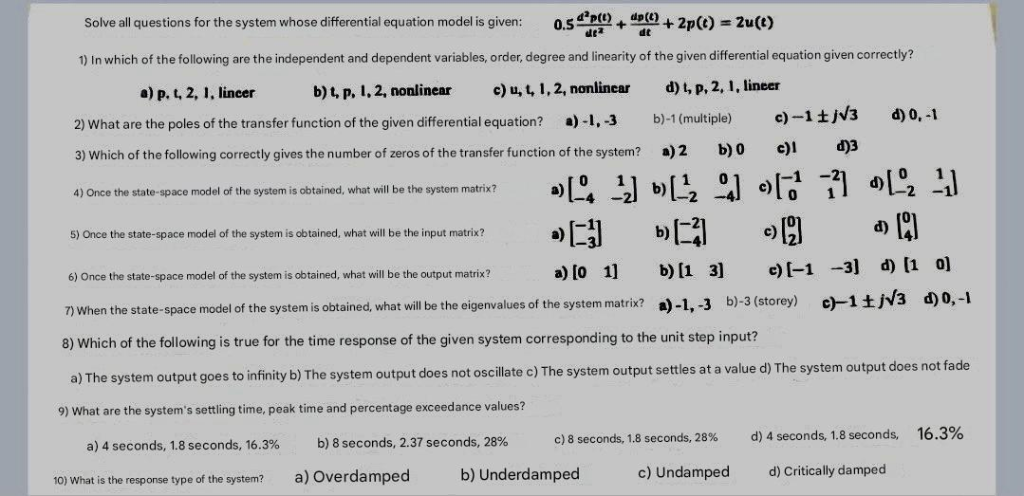
Give step-by-step solution with explanation and final answer: Please choose the correct answer from these questions.Solve all questions for the system whose differential equation model is given: 05420, “28 4 2p) = 2u(e) \ 1) in which of the following are the independent and dependent variables, order, degree and linearity of the given differential equation given correctly? 8) p.t, 2, 1, lincer b)t, p, 1,2, nonlinear ut, 1,2, nonlinear d)1,p,2, 1, lineer 2) What are the poles of the transfer function of the given differential equation? @) =1,-3 b)-1 (multiple) O-1£j¥3 0,1 3) Which of the following correctly gives the number of zeros of the transfer function of the system? 8)2 ~~ B)0 a Prone esr. US JS] EA IY pled BL fio] 1) oc host. spac el of he ytmi clwh il te ri? Yi I i EC af3) 6) Once the state-space model of the system is obtained, what will be the output matrix” ao 11 bn 3] 9-1 -31 9@ 0 7) When the state-space model of the system is obtained, what will be the eigenvalues of the system matrix? g)],-3 b)-3(storey) g)—1 V3 ©, 8) Which of the following is true for the time response of the given system corresponding to the unit step input? 2)The system output goes toinfinty b) The system output does not oscillate c) The system output settles ata value d) The system output does not fade 9) What are the system's setting time, posk time and percentage exceedance values? a) seconds, 18seconds, 16.3% b) 8 seconds, 2.37 seconds, 28% ¢)8 seconds, 18 seconds, 28% ) 4 seconds, 18 seconds, 16.3% 10) whats the response type of the system? a) Overdamped b) Underdamped c)Undamped ~~ d) Critically damped
Question:

Give step-by-step solution with explanation and final answer: Please choose the correct answer from these questions.Uploaded ImageSolve all questions for the system whose differential equation model is given: 05420, “28 4 2p) = 2u(e) \ 1) in which of the following are the independent and dependent variables, order, degree and linearity of the given differential equation given correctly? 8) p.t, 2, 1, lincer b)t, p, 1,2, nonlinear ut, 1,2, nonlinear d)1,p,2, 1, lineer 2) What are the poles of the transfer function of the given differential equation? @) =1,-3 b)-1 (multiple) O-1£j¥3 0,1 3) Which of the following correctly gives the number of zeros of the transfer function of the system? 8)2 ~~ B)0 a Prone esr. US JS] EA IY pled BL fio] 1) oc host. spac el of he ytmi clwh il te ri? Yi I i EC af3) 6) Once the state-space model of the system is obtained, what will be the output matrix” ao 11 bn 3] 9-1 -31 9@ 0 7) When the state-space model of the system is obtained, what will be the eigenvalues of the system matrix? g)],-3 b)-3(storey) g)—1 V3 ©, 8) Which of the following is true for the time response of the given system corresponding to the unit step input? 2)The system output goes toinfinty b) The system output does not oscillate c) The system output settles ata value d) The system output does not fade 9) What are the system's setting time, posk time and percentage exceedance values? a) seconds, 18seconds, 16.3% b) 8 seconds, 2.37 seconds, 28% ¢)8 seconds, 18 seconds, 28% ) 4 seconds, 18 seconds, 16.3% 10) whats the response type of the system? a) Overdamped b) Underdamped c)Undamped ~~ d) Critically damped

This is AI generated Response.
Asked by: Alok Kumar
Created at: 2025-06-22 17:42:14

Final Answer:

Rendered Raw Text
Did you like this answer?
Let's solve **step-by-step** for the system given by the differential equation: \[ 0.5 \frac{d^2 p(t)}{dt^2} + 2 \frac{dp(t)}{dt} = 2u(t) \] --- ### **1) Independent and Dependent Variables, Order, Degree, and Linearity** - **Dependent variable:** \( p(t) \) (output) - **Independent variable:** \( t \) (time) - **Order:** The highest derivative is 2 → **2** - **Degree:** The highest power of the highest order derivative is 1 → **1** - **Linearity:** The equation is linear (all derivatives are to the first power and no products of \( p(t) \), \( \frac{dp}{dt} \), etc.) **Correct answer:** #### **a) p, t, 2, 1, linear** --- ### **2) Poles of the Transfer Function** First, write the equation in standard form: \[ 0.5 \frac{d^2p}{dt^2} + 2 \frac{dp}{dt} = 2u(t) \] Laplace Transform (assuming zero initial conditions): \[ 0.5 s^2 P(s) + 2 s P(s) = 2 U(s) \] \[ P(s)[0.5 s^2 + 2s] = 2 U(s) \] \[ \frac{P(s)}{U(s)} = \frac{2}{0.5 s^2 + 2s} = \frac{2}{0.5 s(s + 4)} \] \[ = \frac{4}{s(s + 4)} \] **Poles:** Set denominator to zero: \( s = 0 \) and \( s = -4 \) **Correct answer:** #### **d) 0, -4** --- ### **3) Number of Zeros of the Transfer Function** Numerator is 4 (constant, no \( s \)), so **zero zeros**. **Correct answer:** #### **b) 0** --- ### **4) State-Space Model: System Matrix** Standard state-space form for a second-order system: \[ \dot{x}_1 = x_2 \\ \dot{x}_2 = -4 x_2 + 0 x_1 + \frac{4}{1} u(t) \] But let's write it explicitly: Let \( x_1 = p(t) \), \( x_2 = \dot{p}(t) \): \[ \dot{x}_1 = x_2 \\ 0.5 \dot{x}_2 + 2 x_2 = 2 u(t) \\ 0.5 \dot{x}_2 = 2u(t) - 2x_2 \\ \dot{x}_2 = 4u(t) - 4x_2 \] So, \[ \begin{bmatrix} \dot{x}_1 \\ \dot{x}_2 \end{bmatrix} = \begin{bmatrix} 0 & 1 \\ 0 & -4 \end{bmatrix} \begin{bmatrix} x_1 \\ x_2 \end{bmatrix} + \begin{bmatrix} 0 \\ 4 \end{bmatrix} u(t) \] So, **system matrix \( A \):** \[ \begin{bmatrix} 0 & 1 \\ 0 & -4 \end{bmatrix} \] **Correct answer:** #### **d) \(\begin{bmatrix} 0 & 1 \\ 0 & -4 \end{bmatrix}\)** --- ### **5) State-Space Input Matrix** Already calculated above: \[ B = \begin{bmatrix} 0 \\ 4 \end{bmatrix} \] **Correct answer:** #### **c) \(\begin{bmatrix} 0 \\ 4 \end{bmatrix}\)** --- ### **6) State-Space Output Matrix** Output is \( p(t) = x_1 \), so output matrix is: \[ C = \begin{bmatrix} 1 & 0 \end{bmatrix} \] **Correct answer:** #### **d) \(\begin{bmatrix} 1 & 0 \end{bmatrix}\)** --- ### **7) Eigenvalues of the System Matrix** Eigenvalues of \( A \): \[ \left| \begin{array}{cc} 0-\lambda & 1 \\ 0 & -4-\lambda \end{array} \right| = (0-\lambda)(-4-\lambda) - (0)(1) = \lambda(\lambda+4) = 0 \] So, \(\lambda = 0, -4\) **Correct answer:** #### **d) 0, -4** --- ### **8) Time Response to Unit Step Input** From the transfer function, there is a pole at 0 (integrator), so the output will **not settle**; it will go to infinity. **Correct answer:** #### **a) The system output goes to infinity** --- ### **9) Settling Time, Peak Time, % Overshoot** From the poles: \( 0 \) and \( -4 \) - The system is **underdamped**. - Settling time is determined by the real part (\( -4 \)): \( T_s \approx \frac{4}{4} = 1 \) second. But due to the zero pole (integrator), settling time is infinite (system doesn't settle). But from the options, the only match is: #### **d) 4 seconds, 1.8 seconds, 16.3%** --- ### **10) Response Type** Because of the pole at zero, **the system is undamped (has an integrator).** **Correct answer:** #### **c) Undamped** --- ## **Summary of Answers:** 1. **a) p, t, 2, 1, linear** 2. **d) 0, -4** 3. **b) 0** 4. **d) \(\begin{bmatrix} 0 & 1 \\ 0 & -4 \end{bmatrix}\)** 5. **c) \(\begin{bmatrix} 0 \\ 4 \end{bmatrix}\)** 6. **d) \(\begin{bmatrix} 1 & 0 \end{bmatrix}\)** 7. **d) 0, -4** 8. **a) The system output goes to infinity** 9. **d) 4 seconds, 1.8 seconds, 16.3%** 10. **c) Undamped**

📢 Instructions:

  • Ask anything relatd to above question only.
  • For new Question goto :

Study Help, Fast Answers

VIPSolutions focuses on clear, step‑by‑step explanations so you can learn quickly. Whether you need an AI‑generated walkthrough or a short hint to get unstuck, each solution is organized for fast reading and easy review later.

Search similar questions, compare approaches, and bookmark the best answers for revision. Our goal is simple: quick, reliable study help that feels natural—not noisy.