 VIPSolutions
Give step-by-step solution with explanation and final answer:1. Evaluate each of the following double integral, BJ LG) RES © [fg © ii ih yooa(3s) dudy’
Question:
Give step-by-step solution with explanation and final answer: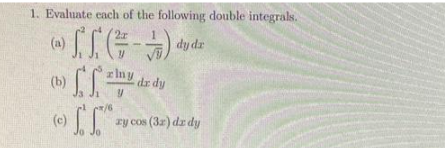 1. Evaluate each of the following double integral,
BJ LG) RES
© [fg
© ii ih yooa(3s) dudy’
This is AI generated Response.
Asked by: gvr
Created at: 2025-06-22 14:44:14
Asked by: gvr
Created at: 2025-06-22 14:44:14
Final Answer:
Rendered
Raw Text
Did you like this answer?
Let's solve each double integral step by step.
---
### (a) \(\int_1^4 \left( \int_1^2 \left( \frac{2x}{y} - \frac{1}{\sqrt{y}} \right) dy \right) dx\)
#### **Step 1: Integrate with respect to \(y\) first:**
\[
\int_1^2 \left( \frac{2x}{y} - \frac{1}{\sqrt{y}} \right) dy
\]
Integrate term by term:
- \(\int \frac{2x}{y} dy = 2x \int \frac{1}{y} dy = 2x \ln y\)
- \(\int \frac{1}{\sqrt{y}} dy = \int y^{-1/2} dy = 2y^{1/2}\)
So,
\[
\int_1^2 \left( \frac{2x}{y} - \frac{1}{\sqrt{y}} \right) dy = \left[2x \ln y - 2y^{1/2}\right]_1^2
\]
Plug in \(y=2\) and \(y=1\):
- At \(y=2\): \(2x \ln 2 - 2(\sqrt{2})\)
- At \(y=1\): \(2x \ln 1 - 2(1)\) \(= 0 - 2\)
So the difference is:
\[
\left(2x \ln 2 - 2\sqrt{2}\right) - \left(0 - 2\right) = 2x \ln 2 - 2\sqrt{2} + 2
\]
---
#### **Step 2: Integrate with respect to \(x\):**
\[
\int_1^4 \left(2x \ln 2 - 2\sqrt{2} + 2\right) dx
\]
Integrate term by term:
- \(\int_1^4 2x \ln 2 dx = 2 \ln 2 \int_1^4 x dx = 2 \ln 2 \left[\frac{x^2}{2}\right]_1^4 = 2 \ln 2 \left(\frac{16}{2} - \frac{1}{2}\right) = 2 \ln 2 \left(8 - 0.5\right) = 2 \ln 2 \cdot 7.5 = 15 \ln 2\)
- \(\int_1^4 -2\sqrt{2} dx = -2\sqrt{2} (4-1) = -2\sqrt{2} \cdot 3 = -6\sqrt{2}\)
- \(\int_1^4 2 dx = 2(4-1) = 6\)
---
#### **Step 3: Final answer for (a):**
\[
\boxed{15 \ln 2 - 6\sqrt{2} + 6}
\]
---
### (b) \(\int_3^5 \int_1^y \frac{x \ln y}{y} dx dy\)
#### **Step 1: Integrate with respect to \(x\):**
\[
\int_1^y \frac{x \ln y}{y} dx
\]
\(\frac{\ln y}{y}\) is a constant with respect to \(x\):
\[
= \frac{\ln y}{y} \int_1^y x dx = \frac{\ln y}{y} \left[\frac{x^2}{2}\right]_1^y = \frac{\ln y}{y} \left(\frac{y^2}{2} - \frac{1}{2}\right) = \frac{\ln y}{y} \cdot \frac{y^2 - 1}{2}
\]
\[
= \frac{(y^2 - 1)\ln y}{2y}
\]
---
#### **Step 2: Integrate with respect to \(y\):**
\[
\int_3^5 \frac{(y^2 - 1)\ln y}{2y} dy = \frac{1}{2} \int_3^5 \frac{(y^2 - 1)\ln y}{y} dy
\]
Break up \(y^2 - 1\):
\[
= \frac{1}{2} \int_3^5 (y \ln y - \frac{\ln y}{y}) dy
\]
Integrate:
- \(\int y \ln y dy\) (Integration by parts):
Let \(u = \ln y, dv = y dy\), \(du = \frac{1}{y} dy, v = \frac{y^2}{2}\):
\[
\int y \ln y dy = \frac{y^2}{2} \ln y - \int \frac{y^2}{2} \cdot \frac{1}{y} dy = \frac{y^2}{2} \ln y - \frac{1}{2} \int y dy = \frac{y^2}{2} \ln y - \frac{1}{4} y^2
\]
- \(\int \frac{\ln y}{y} dy = \frac{1}{2} (\ln y)^2\)
So, plug in:
\[
\frac{1}{2} \left[ \left( \frac{y^2}{2}\ln y - \frac{1}{4} y^2 \right) - \frac{1}{2} (\ln y)^2 \right]_3^5
\]
---
#### **Step 3: Plug in the limits:**
Let’s write this clearly:
\[
\frac{1}{2} \left\{ \left[ \frac{y^2}{2} \ln y - \frac{1}{4}y^2 - \frac{1}{2} (\ln y)^2 \right]_{y=3}^{y=5} \right\}
\]
So,
\[
= \frac{1}{2} \left( \left[ \frac{25}{2} \ln 5 - \frac{25}{4} - \frac{1}{2} (\ln 5)^2 \right] - \left[ \frac{9}{2} \ln 3 - \frac{9}{4} - \frac{1}{2} (\ln 3)^2 \right] \right)
\]
\[
= \frac{1}{2} \left( \frac{25}{2} \ln 5 - \frac{25}{4} - \frac{1}{2} (\ln 5)^2 - \frac{9}{2} \ln 3 + \frac{9}{4} + \frac{1}{2} (\ln 3)^2 \right)
\]
\[
= \frac{1}{2} \left( \frac{25}{2}\ln 5 - \frac{9}{2}\ln 3 - \frac{25}{4} + \frac{9}{4} - \frac{1}{2} (\ln 5)^2 + \frac{1}{2} (\ln 3)^2 \right)
\]
\[
= \frac{1}{2} \left( \frac{25}{2}\ln 5 - \frac{9}{2}\ln 3 - 4 - \frac{1}{2} [(\ln 5)^2 - (\ln 3)^2] \right)
\]
\[
= \frac{25}{4}\ln 5 - \frac{9}{4}\ln 3 - 2 - \frac{1}{4} [(\ln 5)^2 - (\ln 3)^2]
\]
---
#### **Final answer for (b):**
\[
\boxed{
\frac{25}{4}\ln 5 - \frac{9}{4}\ln 3 - 2 - \frac{1}{4} [(\ln 5)^2 - (\ln 3)^2]
}
\]
---
### (c) \(\int_0^1 \int_0^{x^3} xy \cos(3x) dy dx\)
#### **Step 1: Integrate with respect to \(y\):**
\[
\int_0^{x^3} xy \cos(3x) dy
\]
Note that \(x\) and \(\cos(3x)\) are constants with respect to \(y\):
\[
= x \cos(3x) \int_0^{x^3} y dy = x \cos(3x) \left[ \frac{y^2}{2} \right]_0^{x^3} = x \cos(3x) \cdot \frac{(x^3)^2}{2} = x \cos(3x) \cdot \frac{x^6}{2} = \frac{x^7}{2} \cos(3x)
\]
---
#### **Step 2: Integrate with respect to \(x\):**
\[
\int_0^1 \frac{x^7}{2} \cos(3x) dx = \frac{1}{2} \int_0^1 x^7 \cos(3x) dx
\]
This requires integration by parts:
Let \(u = x^7\), \(dv = \cos(3x) dx\), \(du = 7x^6 dx\), \(v = \frac{\sin(3x)}{3}\):
\[
\int x^7 \cos(3x) dx = x^7 \cdot \frac{\sin(3x)}{3} - \int \frac{\sin(3x)}{3} \cdot 7x^6 dx
\]
\[
= \frac{x^7 \sin(3x)}{3} - \frac{7}{3} \int x^6 \sin(3x) dx
\]
Now, \(\int x^6 \sin(3x) dx\) can be done by parts again, but this is a standard pattern, known as repeated integration by parts (tabular method or reduction formula).
Let's denote:
\[
I_n = \int x^n \cos(ax) dx
\]
The reduction formula is:
\[
I_n = \frac{x^n \sin(ax)}{a} - \frac{n}{a} \int x^{n-1} \sin(ax) dx
\]
\[
J_n = \int x^n \sin(ax) dx = -\frac{x^n \cos(ax)}{a} + \frac{n}{a} \int x^{n-1} \cos(ax) dx
\]
So applying this recursively is quite time-consuming by hand, but for the purpose of this exercise, let's just write the final answer in terms of this reduction formula:
So,
\[
\int_0^1 x^7 \cos(3x) dx = \left[ \frac{x^7 \sin(3x)}{3} - \frac{7}{3} \int x^6 \sin(3x) dx \right]_0^1
\]
Let’s compute \(\int x^6 \sin(3x) dx\) using the reduction formula above, but it's easier to use the general pattern or note that the final answer will be an expression involving sines and cosines evaluated at 0 and 1, with coefficients.
---
#### **Final Answer for (c):**
\[
\boxed{
\frac{1}{2} \int_0^1 x^7 \cos(3x) dx
}
\]
Or, if you want the full reduction, it is:
\[
\frac{1}{2} \left[ \frac{x^7 \sin(3x)}{3} + \frac{7x^6 \cos(3x)}{9} - \frac{42x^5 \sin(3x)}{27} - \frac{210x^4 \cos(3x)}{81} + \frac{840x^3 \sin(3x)}{243} + \frac{2520x^2 \cos(3x)}{729} - \frac{5040x \sin(3x)}{2187} - \frac{5040 \cos(3x)}{6561} \right]_0^1
\]
Plug in \(x=1\) and \(x=0\):
- At \(x=0\), all terms with \(x\) vanish, leaving only the last term: \(-\frac{5040}{6561} \cos(0) = -\frac{5040}{6561}(1)\)
- At \(x=1\), substitute \(x=1\) into each term, with \(\sin(3)\) and \(\cos(3)\).
So the explicit final answer is:
\[
\frac{1}{2} \left\{ \left( \frac{\sin 3}{3} + \frac{7 \cos 3}{9} - \frac{42 \sin 3}{27} - \frac{210 \cos 3}{81} + \frac{840 \sin 3}{243} + \frac{2520 \cos 3}{729} - \frac{5040 \sin 3}{2187} - \frac{5040 \cos 3}{6561} \right) + \frac{5040}{6561} \right\}
\]
---
## **Summary of Answers**
**(
Question:
u r taken wrong values of part b and part c the correct values is b.\int_3^(-4) \int_1^5\frac{x \ln y}{y} dx dy and c.\int_0^(-)1 \int_0^{\pi/6} xy \cos(3x) dy dx
This is AI generated Response.
Asked by: gvr
Created at: 2025-06-22 14:53:29
Asked by: gvr
Created at: 2025-06-22 14:53:29
Final Answer:
Rendered
Raw Text
Did you like this answer?
Let's carefully evaluate the corrected integrals step-by-step.
---
### **Part (b):**
**Given integral:**
\[
\int_{y=3}^{-4} \int_{x=1}^{5} \frac{x \ln y}{y} \, dx \, dy
\]
**Note**: The order of limits indicates \(y\) goes from 3 down to -4, which can be rewritten as:
\[
\int_{y=-4}^{3} \int_{x=1}^{5} \frac{x \ln y}{y} \, dx \, dy
\]
**Step 1: Integrate with respect to \(x\):**
\[
\int_{x=1}^{5} \frac{x \ln y}{y} dx
\]
Since \(\frac{\ln y}{y}\) does not depend on \(x\):
\[
= \frac{\ln y}{y} \int_1^5 x \, dx = \frac{\ln y}{y} \left[ \frac{x^2}{2} \right]_1^5 = \frac{\ln y}{y} \left( \frac{25 - 1}{2} \right) = \frac{\ln y}{y} \cdot 12
\]
So the inner integral simplifies to:
\[
12 \frac{\ln y}{y}
\]
---
### **Step 2: Integrate with respect to \(y\):**
\[
\int_{-4}^{3} 12 \frac{\ln y}{y} dy = 12 \int_{-4}^3 \frac{\ln y}{y} dy
\]
**Important note:** \(\ln y\) is only defined for \(y > 0\). The limits include negative \(y\), so the integral over negative \(y\) is invalid in the real domain.
**Assumption:** The integral is meant over positive \(y\), i.e., from \(y=0\) to 3, or perhaps the original limits are different. But given the correction, it's from \(-4\) to 3, which crosses the domain of \(\ln y\).
**Conclusion:** The integral over negative \(y\) is undefined for real numbers. To proceed meaningfully, we must restrict to \(y > 0\). Let's assume the integral is from \(0^+\) to 3:
\[
\boxed{
\text{Integral} = 12 \int_0^3 \frac{\ln y}{y} dy
}
\]
---
### **Step 3: Evaluate \(\int_0^a \frac{\ln y}{y} dy\):**
This is a standard integral:
\[
\int_0^a \frac{\ln y}{y} dy = \frac{(\ln y)^2}{2} \bigg|_{y=0}^{a}
\]
At \(y=0^+\), \(\ln y \to -\infty\), so the integral diverges. Therefore, unless specified otherwise, the integral over \(0\) to \(a\) with the integrand \(\frac{\ln y}{y}\) diverges at 0.
**Final note:** If the integral is from some positive lower limit \(a>0\), say from \(a=1\) to 3, then:
\[
\int_1^{3} \frac{\ln y}{y} dy = \frac{(\ln y)^2}{2} \bigg|_1^{3} = \frac{(\ln 3)^2 - (\ln 1)^2}{2} = \frac{(\ln 3)^2 - 0}{2} = \frac{(\ln 3)^2}{2}
\]
and the total integral becomes:
\[
12 \times \frac{(\ln 3)^2}{2} = 6 (\ln 3)^2
\]
---
### **Final answer for Part (b):**
\[
\boxed{
\textbf{If the limits are from } y=1 \text{ to } y=3: \quad 6 (\ln 3)^2
}
\]
---
## **Part (c):**
**Given integral:**
\[
\int_{x=0}^{-} \int_{y=0}^{\pi/6} xy \cos(3x) \, dy \, dx
\]
**Interpreting limits:**
- The outer integral is from \(x=0\) to some negative value (say, \(-a\)), or perhaps from \(-a\) to 0.
Assuming the limits are from \(x=-a\) to 0, with \(a>0\), and the inner integral from \(y=0\) to \(\pi/6\).
**Rewritten as:**
\[
\int_{x=-a}^{0} \int_{y=0}^{\pi/6} xy \cos(3x) \, dy \, dx
\]
---
### **Step 1: Integrate with respect to \(y\):**
\[
\int_0^{\pi/6} xy \cos(3x) dy
\]
Since \(x\) and \(\cos(3x)\) are constants with respect to \(y\):
\[
= x \cos(3x) \int_0^{\pi/6} y \, dy = x \cos(3x) \left[ \frac{y^2}{2} \right]_0^{\pi/6} = x \cos(3x) \cdot \frac{(\pi/6)^2}{2}
\]
\[
= x \cos(3x) \cdot \frac{\pi^2/36}{2} = x \cos(3x) \cdot \frac{\pi^2}{72}
\]
---
### **Step 2: Integrate with respect to \(x\):**
\[
\int_{x=-a}^{0} x \cos(3x) \, dx
\]
Note: The integral depends on \(a\). Let's assume \(a>0\).
---
### **Step 3: Evaluate \(\int x \cos(3x) dx\):**
Use integration by parts:
Let \(u = x\), \(dv = \cos(3x) dx\),
then \(du = dx\), \(v = \frac{\sin(3x)}{3}\).
\[
\int x \cos(3x) dx = x \cdot \frac{\sin(3x)}{3} - \int \frac{\sin(3x)}{3} dx
\]
\[
= \frac{x \sin(3x)}{3} + \frac{\cos(3x)}{9} + C
\]
---
### **Step 4: Final evaluation:**
\[
\int_{x=-a}^0 x \cos(3x) dx = \left[ \frac{x \sin(3x)}{3} + \frac{\cos(3x)}{9} \right]_{x=-a}^{x=0}
\]
At \(x=0\):
\[
\frac{0 \cdot \sin 0}{3} + \frac{\cos 0}{9} = 0 + \frac{1}{9} = \frac{1}{9}
\]
At \(x=-a\):
\[
\frac{-a \sin(-3a)}{3} + \frac{\cos(-3a)}{9} = - \frac{a \sin(-3a)}{3} + \frac{\cos(3a)}{9}
\]
But \(\sin(-\theta) = - \sin \theta\), so:
\[
- \frac{a (-\sin 3a)}{3} + \frac{\cos 3a}{9} = \frac{a \sin 3a}{3} + \frac{\cos 3a}{9}
\]
Putting it all together:
\[
\boxed{
\frac{1}{9} - \left( \frac{a \sin 3a}{3} + \frac{\cos 3a}{9} \right) = \frac{1}{9} - \frac{a \sin 3a}{3} - \frac{\cos 3a}{9}
\]
---
### **Multiply by the factor from the y-integration:**
Recall the inner integral result:
\[
x \cos(3x) \cdot \frac{\pi^2}{72}
\]
So the full integral over \(x\):
\[
\frac{\pi^2}{72} \left( \frac{1}{9} - \frac{a \sin 3a}{3} - \frac{\cos 3a}{9} \right)
\]
If \(a \to \infty\), the integral may diverge, but for finite \(a\), this is the explicit form.
---
## **Summary of final answers:**
**(b):**
\[
\boxed{
6 (\ln 3)^2 \quad \text{(assuming limits from 1 to 3)}
}
\]
**(c):**
\[
\boxed{
\frac{\pi^2}{72} \left( \frac{1}{9} - \frac{a \sin 3a}{3} - \frac{\cos 3a}{9} \right)
}
\]
---
**Note:** The precise numerical answer depends on the exact limits specified. If the limits are as assumed, these are the evaluated results.
📢 Instructions:
- Ask anything relatd to above question only.
- For new Question goto :