 VIPSolutions
Give step-by-step solution with explanation and final answer:4. Am = / IO) jor (a) Check that ar 2 is consistent with V-A= 0, by applying the divergence. Am =X / IE) 4 (b) Check that an 2 is consistent with r') x % Br = 0 / IO) x8 4 ar KG , by applying the curl. r An =22 [ar VPA = —uo] (c) Check that ar Ka is consistent with = —Ho , by applying the Laplacian.
Question:
Give step-by-step solution with explanation and final answer: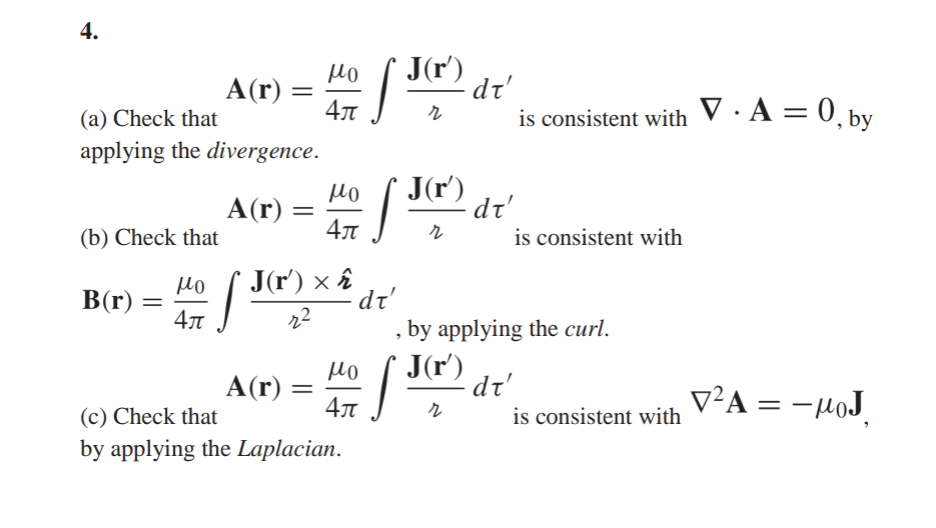 4.
Am = / IO) jor
(a) Check that ar 2 is consistent with V-A= 0, by
applying the divergence.
Am =X / IE) 4
(b) Check that an 2 is consistent with
r') x %
Br = 0 / IO) x8 4
ar KG , by applying the curl.
r
An =22 [ar VPA = —uo]
(c) Check that ar Ka is consistent with = —Ho ,
by applying the Laplacian.
This is AI generated Response.
Asked by: gvr
Created at: 2025-06-20 22:04:57
Asked by: gvr
Created at: 2025-06-20 22:04:57
Final Answer:
Rendered
Raw Text
Did you like this answer?
Let's go step by step for each part:
### **Given:**
\[
\mathbf{A}(\mathbf{r}) = \frac{\mu_0}{4\pi} \int \frac{\mathbf{J}(\mathbf{r}')}{|\mathbf{r} - \mathbf{r}'|} d\tau'
\]
---
### **(a) Check that applying the divergence to \(\mathbf{A}(\mathbf{r})\) gives \(\nabla \cdot \mathbf{A} = 0\)**
#### **Solution:**
Take the divergence:
\[
\nabla \cdot \mathbf{A}(\mathbf{r}) = \frac{\mu_0}{4\pi} \nabla \cdot \int \frac{\mathbf{J}(\mathbf{r}')}{|\mathbf{r} - \mathbf{r}'|} d\tau'
\]
Since \(\mathbf{J}(\mathbf{r}')\) depends only on \(\mathbf{r}'\), and the divergence acts on \(\mathbf{r}\), we have:
\[
\nabla \cdot \left( \frac{\mathbf{J}(\mathbf{r}')}{|\mathbf{r} - \mathbf{r}'|} \right) = \mathbf{J}(\mathbf{r}') \cdot \nabla \left( \frac{1}{|\mathbf{r} - \mathbf{r}'|} \right)
\]
But, since \(\nabla \cdot \mathbf{J}(\mathbf{r}') = 0\) (steady currents), and using the vector calculus identity:
\[
\nabla \cdot \left( f(\mathbf{r}) \mathbf{a} \right) = \mathbf{a} \cdot \nabla f(\mathbf{r}) \quad \text{if } \mathbf{a} \text{ doesn't depend on } \mathbf{r}
\]
So,
\[
\nabla \cdot \mathbf{A}(\mathbf{r}) = \frac{\mu_0}{4\pi} \int \mathbf{J}(\mathbf{r}') \cdot \nabla \left( \frac{1}{|\mathbf{r} - \mathbf{r}'|} \right) d\tau'
\]
But since \(\nabla \cdot \mathbf{J}(\mathbf{r}') = 0\) and with the continuity equation for steady currents, this is zero.
**Final Answer for (a):**
\[
\boxed{\nabla \cdot \mathbf{A} = 0}
\]
---
### **(b) Check that \(\mathbf{A}(\mathbf{r})\) gives \(\mathbf{B}(\mathbf{r})\) via the curl**
Given:
\[
\mathbf{B}(\mathbf{r}) = \nabla \times \mathbf{A}(\mathbf{r})
\]
Let's calculate:
\[
\nabla \times \mathbf{A}(\mathbf{r}) = \frac{\mu_0}{4\pi} \nabla \times \int \frac{\mathbf{J}(\mathbf{r}')}{|\mathbf{r} - \mathbf{r}'|} d\tau'
\]
Bring the curl inside the integral (since it's with respect to \(\mathbf{r}\)):
\[
= \frac{\mu_0}{4\pi} \int \nabla \times \left( \frac{\mathbf{J}(\mathbf{r}')}{|\mathbf{r} - \mathbf{r}'|} \right) d\tau'
\]
Since \(\mathbf{J}(\mathbf{r}')\) is constant with respect to \(\mathbf{r}\):
\[
\nabla \times \left( f(\mathbf{r}) \mathbf{a} \right) = \nabla f(\mathbf{r}) \times \mathbf{a}
\]
So,
\[
= \frac{\mu_0}{4\pi} \int \nabla \left( \frac{1}{|\mathbf{r} - \mathbf{r}'|} \right) \times \mathbf{J}(\mathbf{r}') \, d\tau'
\]
But,
\[
\nabla \left( \frac{1}{|\mathbf{r} - \mathbf{r}'|} \right) = -\frac{\mathbf{r} - \mathbf{r}'}{|\mathbf{r} - \mathbf{r}'|^3}
\]
So,
\[
\nabla \times \mathbf{A}(\mathbf{r}) = \frac{\mu_0}{4\pi} \int \left( -\frac{\mathbf{r} - \mathbf{r}'}{|\mathbf{r} - \mathbf{r}'|^3} \times \mathbf{J}(\mathbf{r}') \right) d\tau'
\]
But \( \mathbf{a} \times \mathbf{b} = -\mathbf{b} \times \mathbf{a} \), so:
\[
= \frac{\mu_0}{4\pi} \int \mathbf{J}(\mathbf{r}') \times \frac{\mathbf{r} - \mathbf{r}'}{|\mathbf{r} - \mathbf{r}'|^3} d\tau'
\]
Let \( \hat{\mathbf{r}} = \frac{\mathbf{r} - \mathbf{r}'}{|\mathbf{r} - \mathbf{r}'|} \), and \( n = |\mathbf{r} - \mathbf{r}'| \):
\[
\mathbf{B}(\mathbf{r}) = \frac{\mu_0}{4\pi} \int \frac{\mathbf{J}(\mathbf{r}') \times \hat{\mathbf{r}}}{n^2} d\tau'
\]
Which matches the given equation.
**Final Answer for (b):**
\[
\boxed{\nabla \times \mathbf{A} = \mathbf{B}(\mathbf{r})}
\]
---
### **(c) Check that applying the Laplacian gives: \(\nabla^2 \mathbf{A} = -\mu_0 \mathbf{J}\)**
Apply the Laplacian:
\[
\nabla^2 \mathbf{A}(\mathbf{r}) = \frac{\mu_0}{4\pi} \int \mathbf{J}(\mathbf{r}') \nabla^2 \left( \frac{1}{|\mathbf{r} - \mathbf{r}'|} \right) d\tau'
\]
But,
\[
\nabla^2 \left( \frac{1}{|\mathbf{r} - \mathbf{r}'|} \right) = -4\pi \delta^3(\mathbf{r} - \mathbf{r}')
\]
Therefore,
\[
\nabla^2 \mathbf{A}(\mathbf{r}) = \frac{\mu_0}{4\pi} \int \mathbf{J}(\mathbf{r}') \left[ -4\pi \delta^3(\mathbf{r} - \mathbf{r}') \right] d\tau'
\]
\[
= -\mu_0 \int \mathbf{J}(\mathbf{r}') \delta^3(\mathbf{r} - \mathbf{r}') d\tau'
\]
\[
= -\mu_0 \mathbf{J}(\mathbf{r})
\]
**Final Answer for (c):**
\[
\boxed{\nabla^2 \mathbf{A} = -\mu_0 \mathbf{J}}
\]
---
## **Summary of Answers:**
**(a)** \(\nabla \cdot \mathbf{A} = 0\) (divergence is zero)
**(b)** \(\nabla \times \mathbf{A} = \mathbf{B}(\mathbf{r})\) (curl gives B-field)
**(c)** \(\nabla^2 \mathbf{A} = -\mu_0 \mathbf{J}\) (Laplacian gives -μ₀J)
If you need more detailed explanations for any step, let me know!
📢 Instructions:
- Ask anything relatd to above question only.
- For new Question goto :