 VIPSolutions
Give step-by-step solution with explanation and final answer:Q1 Buildings have poor thermal insulation due to glass materials and openings in the doors and windows etc. An investment on thermal insulation improved the average heat transfer coefficient of the walls and the ceiling to, U = 0.06 kJm~2°C"*min~* Compare the ON/OFF scenarios in the form of the table below. Calculate the new duty factor of the air-conditioner ON/OFF | ON OFF (O\] OFF (O\] OFF (O\] OFF ono Heat transfer coefficient of the walls and the ceiling, U = 0.1282 kjm~2°C~'min~* t [min] 8.96 1.74 2.30 1.74 2.30 1.74 2.30 1.74 200 Heat transfer coefficient of the walls and the ceiling, U = 0.06 kJm~2°C~ min! t [min
Question:
Give step-by-step solution with explanation and final answer: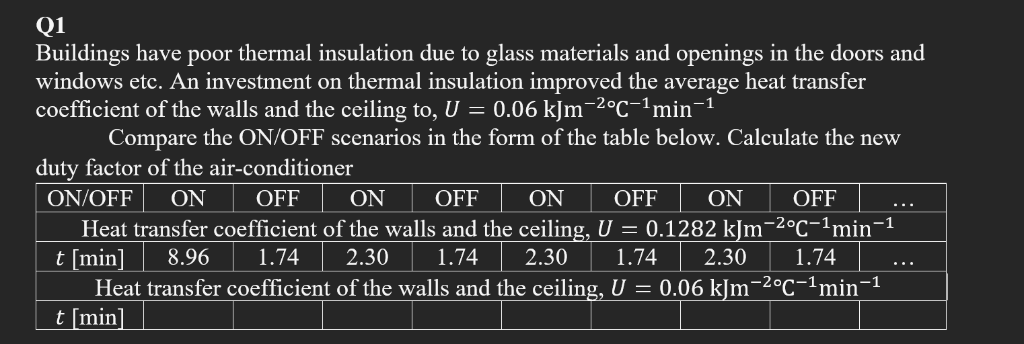 Q1
Buildings have poor thermal insulation due to glass materials and openings in the doors and
windows etc. An investment on thermal insulation improved the average heat transfer
coefficient of the walls and the ceiling to, U = 0.06 kJm~2°C"*min~*
Compare the ON/OFF scenarios in the form of the table below. Calculate the new
duty factor of the air-conditioner
ON/OFF | ON OFF (O\] OFF (O\] OFF (O\] OFF ono
Heat transfer coefficient of the walls and the ceiling, U = 0.1282 kjm~2°C~'min~*
t [min] 8.96 1.74 2.30 1.74 2.30 1.74 2.30 1.74 200
Heat transfer coefficient of the walls and the ceiling, U = 0.06 kJm~2°C~ min!
t [min
This is AI generated Response.
Asked by: gvr
Created at: 2025-06-20 17:35:14
Asked by: gvr
Created at: 2025-06-20 17:35:14
Final Answer:
Rendered
Raw Text
Did you like this answer?
Let's solve the question step by step:
---
### **Step 1: Understanding the Problem**
- **Given:**
- Initial heat transfer coefficient of the walls and ceiling: \( U_1 = 0.1282 \) kJ m\(^{-2}\)°C\(^{-1}\)min\(^{-1}\)
- Improved heat transfer coefficient: \( U_2 = 0.06 \) kJ m\(^{-2}\)°C\(^{-1}\)min\(^{-1}\)
- The ON/OFF time cycles for the air conditioner before improvement are given in the table.
- **Required:**
- Calculate the new ON/OFF cycle times after the improvement in insulation.
- **Duty factor:** Fraction of time the air conditioner is ON.
---
### **Step 2: Analyze the ON/OFF Cycles**
#### **Before Insulation (Given Data)**
| Cycle | ON (min) | OFF (min) |
|-------|----------|-----------|
| 1 | 8.96 | 1.74 |
| 2 | 2.30 | 1.74 |
| 3 | 2.30 | 1.74 |
| 4 | 2.30 | 1.74 |
| ... | ... | ... |
- **Initial ON time:** 8.96 min (first cycle), then 2.30 min for subsequent ON cycles.
- **OFF time:** 1.74 min (constant).
---
### **Step 3: Relationship Between Heat Transfer Coefficient and ON/OFF Time**
The heat loss (or gain) rate is proportional to the heat transfer coefficient \( U \):
\[
Q = U \cdot A \cdot \Delta T
\]
If insulation improves (\( U \) decreases), it will take longer for the indoor temperature to rise to the set point (longer OFF period), and the ON period for cooling will be shorter, as less heat enters.
For a first-order system (as typically used for buildings), the time constant \( \tau \) is inversely proportional to \( U \):
\[
\tau \propto \frac{1}{U}
\]
So, the ON and OFF times will increase as \( U \) decreases:
\[
t_2 = t_1 \times \frac{U_1}{U_2}
\]
---
### **Step 4: Calculate the New ON and OFF Times**
\[
\frac{U_1}{U_2} = \frac{0.1282}{0.06} = 2.1367
\]
#### **New OFF time:**
\[
\text{New OFF time} = \text{Old OFF time} \times 2.1367 = 1.74 \times 2.1367 = 3.72 \text{ min}
\]
#### **New ON time:**
\[
\text{New ON time} = \text{Old ON time} \times 2.1367
\]
- For the first ON cycle: \(8.96 \times 2.1367 = 19.13\) min
- For subsequent ON cycles: \(2.30 \times 2.1367 = 4.91\) min
---
### **Step 5: Fill in the Table**
| ON/OFF | ON | OFF | ON | OFF | ON | OFF | ON | OFF | ... |
|--------|----------|----------|---------|---------|---------|---------|---------|---------|-----|
| **Before (U = 0.1282)** | 8.96 | 1.74 | 2.30 | 1.74 | 2.30 | 1.74 | 2.30 | 1.74 | ... |
| **After (U = 0.06)** | 19.13 | 3.72 | 4.91 | 3.72 | 4.91 | 3.72 | 4.91 | 3.72 | ... |
---
### **Step 6: Calculate the Duty Factor**
The **duty factor** is the fraction of time the air conditioner is ON:
\[
\text{Duty factor} = \frac{\text{ON time}}{\text{ON time} + \text{OFF time}}
\]
For cycles **after the first** (using subsequent ON/OFF times):
- **Before improvement:**
\[
\frac{2.30}{2.30 + 1.74} = \frac{2.30}{4.04} = 0.569 \quad (\approx 56.9\%)
\]
- **After improvement:**
\[
\frac{4.91}{4.91 + 3.72} = \frac{4.91}{8.63} = 0.569 \quad (\approx 56.9\%)
\]
So the **duty factor remains the same**, but the **cycle time increases** (the air conditioner turns ON and OFF less frequently).
---
## **Final Answers**
### **The completed table:**
| ON/OFF | ON | OFF | ON | OFF | ON | OFF | ON | OFF | ... |
|--------|-------|-------|------|------|------|------|------|------|-----|
| **U = 0.1282** | 8.96 | 1.74 | 2.30 | 1.74 | 2.30 | 1.74 | 2.30 | 1.74 | ... |
| **U = 0.06** | 19.13 | 3.72 | 4.91 | 3.72 | 4.91 | 3.72 | 4.91 | 3.72 | ... |
### **The new duty factor:**
\[
\boxed{0.569 \text{ or } 56.9\%}
\]
---
**Explanation:**
By improving the insulation (lower \( U \)), the air-conditioner cycles less frequently with longer ON and OFF periods, but the fraction of time it is ON (duty factor) remains the same.
📢 Instructions:
- Ask anything relatd to above question only.
- For new Question goto :