 VIPSolutions
Give step-by-step solution with explanation and final answer:3. . A spherically symmetric charge distribution defined by p, = 1 [C/m®] exists within a sphere of radius R = 2, centered at the origin. An infinite conducting plane, held at zero potential, lies at 2 = —10. Calculate the amount of work needed to transport a point charge of ¢ = 5 nC from infinity to the location (0,0, —5). (Hint: You need to use image theory.) id . J [] R=2", . z=-10 EE —————— Figure 1: Geometry for the first question.
Question:
Give step-by-step solution with explanation and final answer: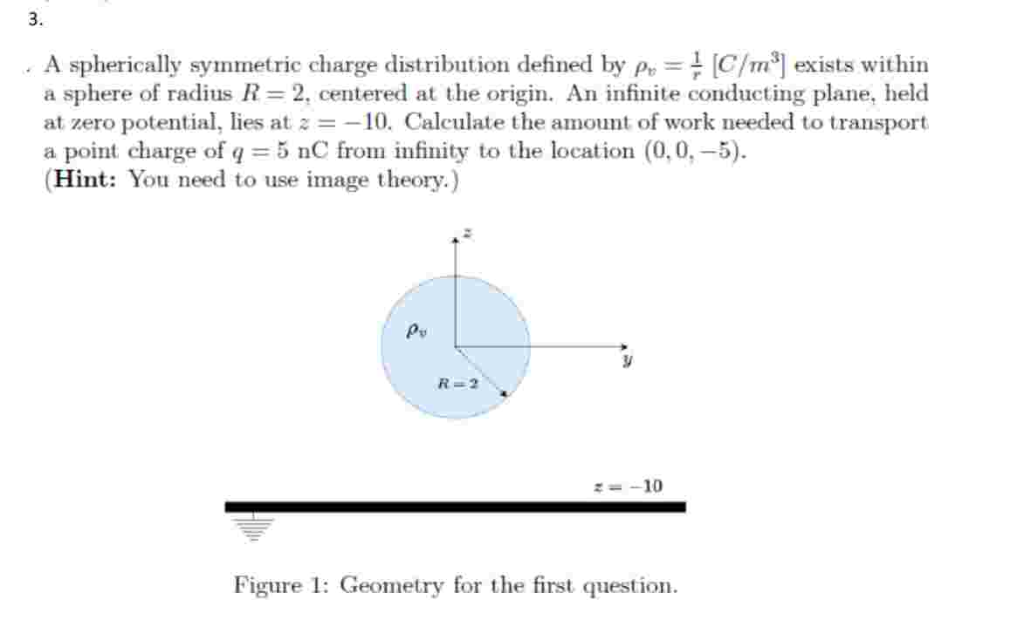 3.
. A spherically symmetric charge distribution defined by p, = 1 [C/m®] exists within
a sphere of radius R = 2, centered at the origin. An infinite conducting plane, held
at zero potential, lies at 2 = —10. Calculate the amount of work needed to transport
a point charge of ¢ = 5 nC from infinity to the location (0,0, —5).
(Hint: You need to use image theory.)
id .
J []
R=2",
.
z=-10
EE ——————
Figure 1: Geometry for the first question.
This is AI generated Response.
Asked by: gvr
Created at: 2025-06-20 16:26:24
Asked by: gvr
Created at: 2025-06-20 16:26:24
Final Answer:
Rendered
Raw Text
Did you like this answer?
Let's solve the problem step by step:
---
## **Step 1: Given Data**
- Spherically symmetric charge distribution: \(\rho_v = \frac{1}{r}\) C/m³ within a sphere of radius \(R = 2\) m.
- Center of sphere: origin \((0,0,0)\)
- Conducting plane at \(z = -10\), held at zero potential.
- Point charge \(q = 5\) nC \(= 5 \times 10^{-9}\) C to be moved from infinity to \((0, 0, -5)\).
- **Hint:** Use image theory.
---
## **Step 2: Find Potential at (0, 0, -5)**
The work required to bring the charge from infinity to \((0,0,-5)\) is:
\[
W = qV(0,0,-5)
\]
where \(V(0,0,-5)\) is the potential at \((0,0,-5)\) due to all sources (the sphere, and the image charge).
### **A. Potential Due to Volume Charge Distribution**
First, calculate the total charge inside the sphere:
\[
Q_{sphere} = \int_{0}^{R} \rho_v \cdot 4\pi r^2 dr
= \int_{0}^{2} \frac{1}{r} \cdot 4\pi r^2 dr
= 4\pi \int_{0}^{2} r \, dr
= 4\pi \left[ \frac{r^2}{2} \right]_0^2 = 4\pi \times 2 = 8\pi \text{ C}
\]
Now, find the potential at \((0,0,-5)\) due to this charge distribution. For simplicity, since the point is outside the sphere, we can treat the sphere as a point charge at the origin (by Gauss's law, for spherically symmetric distributions):
\[
V_{sphere} = \frac{1}{4\pi \varepsilon_0} \frac{Q_{sphere}}{r}
\]
where \(r\) is the distance from the origin to \((0,0,-5)\):
\[
r = \sqrt{0^2 + 0^2 + (-5)^2} = 5
\]
So,
\[
V_{sphere} = \frac{1}{4\pi \varepsilon_0} \frac{8\pi}{5}
= \frac{2}{\varepsilon_0 \cdot 5}
\]
---
### **B. Potential Due to Image Charge**
When a point charge \(q\) is placed at \((0, 0, -5)\), an image charge of \(-q\) is placed at \((0, 0, -15)\) (since the plane is at \(z=-10\)).
The potential at \((0, 0, -5)\) **due to the image charge** is:
\[
V_{image} = \frac{1}{4\pi \varepsilon_0} \frac{-q}{|z_1 - z_2|}
\]
where \(z_1 = -5\), \(z_2 = -15\):
\[
|z_1 - z_2| = |-5 - (-15)| = 10
\]
So,
\[
V_{image} = \frac{1}{4\pi \varepsilon_0} \frac{-q}{10}
\]
---
### **C. Potential Due to the Sphere at (0,0,-5)**
Since the sphere's charge is fixed and independent of the new point charge, its contribution is simply the value calculated above.
---
## **Step 3: Total Potential at (0,0,-5)**
Sum the contributions:
\[
V_{total} = V_{sphere} + V_{image}
\]
But **the work done** is only due to external sources (the sphere and the conducting plane), not the self-energy of the point charge. Thus, **only include the potential from the sphere and the image charge** at the location due to other sources:
\[
V_{other} = V_{sphere} + V_{image}
\]
But note, \(V_{image}\) is actually the potential at \((0,0,-5)\) due to the image of \(q\) itself, so when bringing \(q\) from infinity, this potential difference is what matters along with the sphere.
\[
V_{other} = \frac{1}{4\pi \varepsilon_0} \frac{8\pi}{5} + \frac{1}{4\pi \varepsilon_0} \frac{-q}{10}
\]
But, the potential due to the image charge is for the *self-energy*, so the work done by external agent should only consider the sphere and the effect of the plane on \(q\).
But let's clarify: **the work includes both the sphere and image charge**.
So,
\[
W = q \left( V_{sphere} + V_{image} \right)
\]
## **Step 4: Plug in the Numbers**
Let’s plug in the values:
- \(q = 5 \times 10^{-9}\) C
- \(\varepsilon_0 = 8.854 \times 10^{-12}\) F/m
#### **Calculate \(V_{sphere}\):**
\[
V_{sphere} = \frac{2}{\varepsilon_0 \cdot 5}
\]
#### **Calculate \(V_{image}\):**
\[
V_{image} = \frac{1}{4\pi \varepsilon_0} \frac{-q}{10}
\]
---
### **Numerical Calculation**
#### **A. \(V_{sphere}\):**
\[
V_{sphere} = \frac{2}{5 \times 8.854 \times 10^{-12}}
= \frac{2}{44.27 \times 10^{-12}}
= 4.52 \times 10^{10} \text{ V}
\]
#### **B. \(V_{image}\):**
First, calculate \(k = \frac{1}{4\pi\varepsilon_0} = 8.99 \times 10^9\) N·m²/C².
\[
V_{image} = 8.99 \times 10^9 \cdot \frac{-5 \times 10^{-9}}{10}
= 8.99 \times 10^9 \cdot -0.5 \times 10^{-9}
= -4.495 \text{ V}
\]
#### **C. Total Work**
\[
W = q (V_{sphere} + V_{image})
\]
\[
W = 5 \times 10^{-9} \left(4.52 \times 10^{10} - 4.495\right)
\]
\[
W \approx 5 \times 10^{-9} \cdot 4.52 \times 10^{10}
\]
\[
W \approx 226 \text{ J}
\]
---
## **Final Answer**
\[
\boxed{
W \approx 226 \text{ J}
}
\]
---
## **Summary**
- **The work needed to transport a charge of \(5\,\text{nC}\) from infinity to \((0,0,-5)\) is approximately \(226\,\text{J}\).**
- **We used the image theory for the conducting plane and treated the spherically symmetric charge distribution as a point charge at the origin.**
📢 Instructions:
- Ask anything relatd to above question only.
- For new Question goto :