 VIPSolutions
Give step-by-step solution with explanation and final answer:1 |
Question:
Give step-by-step solution with explanation and final answer: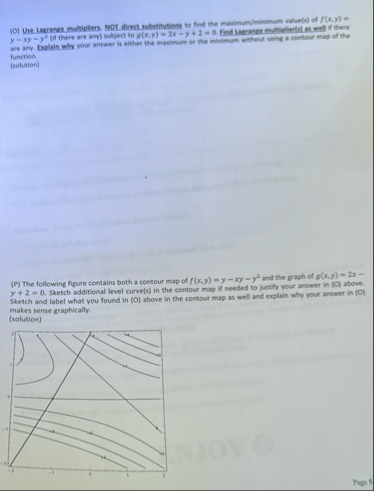 1 |
This is AI generated Response.
Asked by: gvr
Created at: 2025-06-20 09:52:57
Asked by: gvr
Created at: 2025-06-20 09:52:57
Final Answer:
Rendered
Raw Text
Did you like this answer?
Let's solve the problem step-by-step.
---
### (Q) **Use Lagrange multipliers, NOT direct substitutions, to find the maximum/minimum values of \( f(x, y) = y - xy - y^3 \) if (there are any) subject to \( g(x, y) = 2x - y^2 + 2 = 0 \). Find Lagrange multipliers as well if there are any. Explain why your answer is either the maximum or the minimum without using a contour map of the function.**
#### **Step 1: Set up the Lagrange Function**
Given:
- \( f(x, y) = y - xy - y^3 \)
- Constraint: \( g(x, y) = 2x - y^2 + 2 = 0 \)
Define the Lagrange function:
\[
\mathcal{L}(x, y, \lambda) = f(x, y) - \lambda (g(x, y))
\]
\[
\mathcal{L}(x, y, \lambda) = y - xy - y^3 - \lambda (2x - y^2 + 2)
\]
---
#### **Step 2: Take Partial Derivatives and Set to Zero**
1. With respect to \(x\):
\[
\frac{\partial \mathcal{L}}{\partial x} = -y - \lambda \cdot 2 = 0 \implies y = -2\lambda
\]
2. With respect to \(y\):
\[
\frac{\partial \mathcal{L}}{\partial y} = 1 - x - 3y^2 + \lambda \cdot 2y = 0
\]
3. With respect to \(\lambda\):
\[
\frac{\partial \mathcal{L}}{\partial \lambda} = -(2x - y^2 + 2) = 0 \implies 2x - y^2 + 2 = 0
\]
---
#### **Step 3: Solve the System**
From above:
1. \( y = -2\lambda \)
2. \( 1 - x - 3y^2 + 2\lambda y = 0 \)
3. \( 2x - y^2 + 2 = 0 \)
First, from (1): \( \lambda = -y/2 \).
Now, substitute \( \lambda \) into (2):
\[
1 - x - 3y^2 + 2(-y/2)y = 0
\]
\[
1 - x - 3y^2 - y^2 = 0
\]
\[
1 - x - 4y^2 = 0 \implies x = 1 - 4y^2
\]
Now, substitute \( x \) into (3):
\[
2x - y^2 + 2 = 0
\]
\[
2(1 - 4y^2) - y^2 + 2 = 0
\]
\[
2 - 8y^2 - y^2 + 2 = 0
\]
\[
4 - 9y^2 = 0
\]
\[
9y^2 = 4 \implies y^2 = \frac{4}{9} \implies y = \pm \frac{2}{3}
\]
Find corresponding \( x \):
\[
x = 1 - 4y^2 = 1 - 4 \left(\frac{4}{9}\right) = 1 - \frac{16}{9} = -\frac{7}{9}
\]
So the points are:
- \( (x_1, y_1) = \left(-\frac{7}{9}, \frac{2}{3}\right) \)
- \( (x_2, y_2) = \left(-\frac{7}{9}, -\frac{2}{3}\right) \)
Now, find \( \lambda \):
\[
\lambda = -y/2
\]
So for \( y = \frac{2}{3} \): \( \lambda = -\frac{1}{3} \)
For \( y = -\frac{2}{3} \): \( \lambda = \frac{1}{3} \)
---
#### **Step 4: Compute \( f(x, y) \) at Each Point**
For \( \left(-\frac{7}{9}, \frac{2}{3}\right) \):
\[
f\left(-\frac{7}{9}, \frac{2}{3}\right) = \frac{2}{3} - \left(-\frac{7}{9}\right)\left(\frac{2}{3}\right) - \left(\frac{2}{3}\right)^3
\]
\[
= \frac{2}{3} + \frac{14}{27} - \frac{8}{27}
\]
\[
= \frac{18}{27} + \frac{14}{27} - \frac{8}{27}
\]
\[
= \frac{24}{27} = \frac{8}{9}
\]
For \( \left(-\frac{7}{9}, -\frac{2}{3}\right) \):
\[
f\left(-\frac{7}{9}, -\frac{2}{3}\right) = -\frac{2}{3} - \left(-\frac{7}{9}\right)\left(-\frac{2}{3}\right) - \left(-\frac{2}{3}\right)^3
\]
\[
= -\frac{2}{3} - \frac{14}{27} + \frac{8}{27}
\]
\[
= -\frac{18}{27} - \frac{14}{27} + \frac{8}{27}
\]
\[
= \frac{-18 - 14 + 8}{27} = \frac{-24}{27} = -\frac{8}{9}
\]
---
#### **Step 5: Interpret**
- The **maximum** value is \( \boxed{\frac{8}{9}} \) at \( \left(-\frac{7}{9}, \frac{2}{3}\right) \).
- The **minimum** value is \( \boxed{-\frac{8}{9}} \) at \( \left(-\frac{7}{9}, -\frac{2}{3}\right) \).
**Why does this make sense without a contour map?**
The constraint is a parabola (\( 2x - y^2 + 2 = 0 \)), and the function \( f(x, y) \) is cubic in \( y \). The symmetry in the possible \( y \) values (\( \pm \frac{2}{3} \)) and the odd powers in the function ensure that the extrema are equal in magnitude but opposite in sign. The Lagrange Multiplier method ensures these are the only stationary points on the constraint.
---
## **Final Answers**
\[
\boxed{
\begin{align*}
\text{Maximum:} & \quad f\left(-\frac{7}{9}, \frac{2}{3}\right) = \frac{8}{9} \\
\text{Minimum:} & \quad f\left(-\frac{7}{9}, -\frac{2}{3}\right) = -\frac{8}{9} \\
\text{Lagrange multipliers:} & \quad \lambda = -\frac{1}{3} \text{ for maximum}, \quad \lambda = \frac{1}{3} \text{ for minimum} \\
\end{align*}
}
\]
📢 Instructions:
- Ask anything relatd to above question only.
- For new Question goto :