 VIPSolutions
Give step-by-step solution with explanation and final answer:‘position function” hy b. When the velocity is negative, what do you notice about hy
Question:
Give step-by-step solution with explanation and final answer: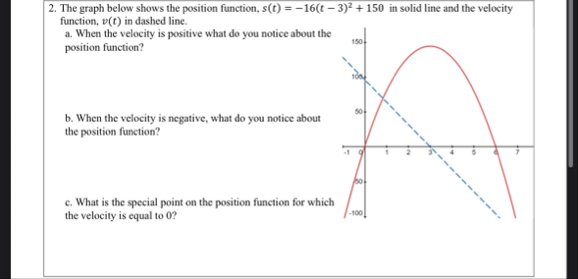 ‘position function” hy
b. When the velocity is negative, what do you notice about hy
This is AI generated Response.
Asked by: gvr
Created at: 2025-06-19 23:32:39
Asked by: gvr
Created at: 2025-06-19 23:32:39
Final Answer:
Rendered
Raw Text
Did you like this answer?
Let's break down each part of the problem step by step, referencing the graph and the given functions:
Given:
- **Position function:** \( s(t) = -16(t-3)^2 + 150 \) (solid line)
- **Velocity function:** \( v(t) \) (dashed line)
### **a. When the velocity is positive, what do you notice about the position function?**
#### **Step-by-Step Solution:**
1. **Velocity and Position Relationship:**
Velocity is the derivative of the position function. If velocity is **positive**, the position function is **increasing** (moving upward).
2. **Graph Observation:**
On the graph, when the dashed velocity line is **above the t-axis** (positive values), the solid position curve is **rising**.
#### **Final Answer:**
**When the velocity is positive, the position function is increasing.**
---
### **b. When the velocity is negative, what do you notice about the position function?**
#### **Step-by-Step Solution:**
1. **Velocity and Position Relationship:**
If velocity is **negative**, the position function is **decreasing** (moving downward).
2. **Graph Observation:**
When the dashed velocity line is **below the t-axis** (negative values), the solid position curve is **falling**.
#### **Final Answer:**
**When the velocity is negative, the position function is decreasing.**
---
### **c. What is the special point on the position function for which the velocity is equal to 0?**
#### **Step-by-Step Solution:**
1. **Find Velocity Function:**
The velocity is the derivative of the position function:
\[
s(t) = -16(t-3)^2 + 150
\]
\[
v(t) = s'(t) = -16 \cdot 2(t-3) = -32(t-3)
\]
2. **Set velocity to zero to find the special point:**
\[
v(t) = 0 \implies -32(t-3) = 0 \implies t = 3
\]
3. **Find the corresponding position:**
\[
s(3) = -16(3-3)^2 + 150 = 150
\]
4. **Interpretation:**
At \( t = 3 \), the velocity is zero. On the graph, this is the **vertex** (maximum point) of the position curve.
#### **Final Answer:**
**The special point is the vertex (maximum point) of the position function at \( t = 3 \), \( s(3) = 150 \), where the velocity is zero.**
---
## **Summary Table**
| Part | Explanation | Final Answer |
|------|-------------|--------------|
| (a) | Velocity positive ⟹ position increasing | Position function is increasing |
| (b) | Velocity negative ⟹ position decreasing | Position function is decreasing |
| (c) | Velocity zero ⟹ vertex of position function | \( t = 3, s(3) = 150 \); maximum point |
📢 Instructions:
- Ask anything relatd to above question only.
- For new Question goto :