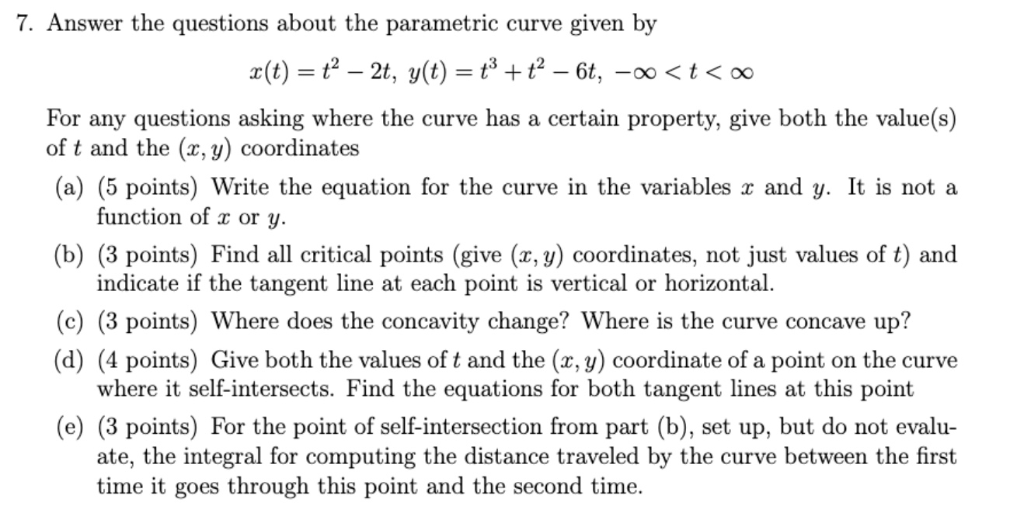
Give step-by-step solution with explanation and final answer:7. Answer the questions about the parametric curve given by
z(t) = —2t, y(t) =t* +> —6t, —c0 < t < 00
For any questions asking where the curve has a certain property, give both the value(s)
of t and the (z,y) coordinates
(a) (5 points) Write the equation for the curve in the variables z and y. It is not a
function of z or y.
(b) (3 points) Find all critical points (give (z,y) coordinates, not just values of t) and
indicate if the tangent line at each point is vertical or horizontal.
(c) (3 points) Where does the concavity change? Where is the curve concave up?
(d) (4 points) Give both the values of ¢ and the (z, y) coordinate of a point on the curve
where it self-intersects. Find the equations for both tangent lines at this point
(e) (3 points) For the point of self-intersection from part (b), set up, but do not evalu-
ate, the integral for computing the distance traveled by the curve between the first
time it goes through this point and the second time.
Question:
Give step-by-step solution with explanation and final answer:7. Answer the questions about the parametric curve given by
z(t) = —2t, y(t) =t* +> —6t, —c0 < t < 00
For any questions asking where the curve has a certain property, give both the value(s)
of t and the (z,y) coordinates
(a) (5 points) Write the equation for the curve in the variables z and y. It is not a
function of z or y.
(b) (3 points) Find all critical points (give (z,y) coordinates, not just values of t) and
indicate if the tangent line at each point is vertical or horizontal.
(c) (3 points) Where does the concavity change? Where is the curve concave up?
(d) (4 points) Give both the values of ¢ and the (z, y) coordinate of a point on the curve
where it self-intersects. Find the equations for both tangent lines at this point
(e) (3 points) For the point of self-intersection from part (b), set up, but do not evalu-
ate, the integral for computing the distance traveled by the curve between the first
time it goes through this point and the second time.
This is AI generated Response.
Asked by: gvr
Created at: 2025-06-19 22:52:10
Final Answer:
RenderedRaw Text
Did you like this answer?
Let's solve each part step by step for the parametric curve:
\[
x(t) = t^2 - 2t, \quad y(t) = t^3 + t^2 - 6t, \quad -\infty < t < \infty
\]
---
### **(a) Write the equation for the curve in \(x\) and \(y\) (eliminate \(t\))**
Given:
\[
x = t^2 - 2t \implies t^2 - 2t - x = 0
\]
This is a quadratic in \(t\):
\[
t = 1 \pm \sqrt{1 + x}
\]
Now, plug \(t\) into \(y\):
Let’s use \(y = t^3 + t^2 - 6t\).
Substitute \(t = 1 \pm \sqrt{1 + x}\):
\[
y = (t)^3 + (t)^2 - 6(t)
\]
So, the equation in \(x\) and \(y\) is:
\[
y = (t^3 + t^2 - 6t) \quad \text{where} \quad t = 1 \pm \sqrt{1 + x}
\]
Or more explicitly:
\[
y = (1 \pm \sqrt{1 + x})^3 + (1 \pm \sqrt{1 + x})^2 - 6(1 \pm \sqrt{1 + x})
\]
---
### **(b) Find all critical points and indicate if the tangent is vertical or horizontal**
Critical points occur when either \( \frac{dx}{dt} = 0 \) (vertical tangent) or \( \frac{dy}{dt} = 0 \) (horizontal tangent).
#### **Step 1: Compute derivatives**
\[
\frac{dx}{dt} = 2t - 2
\]
\[
\frac{dy}{dt} = 3t^2 + 2t - 6
\]
#### **Step 2: Horizontal Tangent (\(dy/dt = 0\))**
Set \(3t^2 + 2t - 6 = 0\):
\[
3t^2 + 2t - 6 = 0
\]
Use quadratic formula:
\[
t = \frac{-2 \pm \sqrt{4 + 72}}{6} = \frac{-2 \pm \sqrt{76}}{6} = \frac{-2 \pm 2\sqrt{19}}{6} = \frac{-1 \pm \sqrt{19}}{3}
\]
So, two values:
\[
t_1 = \frac{-1 + \sqrt{19}}{3}, \quad t_2 = \frac{-1 - \sqrt{19}}{3}
\]
Plug into \(x(t)\) and \(y(t)\) for coordinates.
#### **Step 3: Vertical Tangent (\(dx/dt = 0\))**
Set \(2t - 2 = 0 \implies t = 1\)
Find point:
\[
x(1) = 1^2 - 2\times1 = 1 - 2 = -1
\]
\[
y(1) = 1^3 + 1^2 - 6\times1 = 1 + 1 - 6 = -4
\]
So, the critical point for vertical tangent is \((1, (-1, -4))\).
#### **Summary of critical points:**
- Horizontal: \(t_1, t_2\) as above, coordinates \( (x(t_1), y(t_1)) \), \( (x(t_2), y(t_2)) \).
- Vertical: \(t = 1\), coordinate \((-1,-4)\).
---
### **(c) Where does the concavity change? Where is the curve concave up?**
We need to consider the second derivative of \(y\) with respect to \(x\):
\[
\frac{d^2y}{dx^2} = \frac{d}{dt}\left(\frac{dy}{dx}\right)\Big/\frac{dx}{dt}
\]
First,
\[
\frac{dy}{dx} = \frac{dy/dt}{dx/dt} = \frac{3t^2 + 2t - 6}{2t - 2}
\]
Now,
\[
\frac{d}{dt}\left(\frac{dy}{dx}\right) = \frac{(6t + 2)(2t - 2) - (3t^2 + 2t - 6) \cdot 2}{(2t - 2)^2}
\]
Set numerator to zero to find inflection points:
\[
(6t + 2)(2t - 2) - 2(3t^2 + 2t - 6) = 0
\]
\[
(12t^2 - 12t + 4t - 4) - (6t^2 + 4t - 12) = 0
\]
\[
(12t^2 - 8t - 4) - (6t^2 + 4t - 12) = 0
\]
\[
12t^2 - 8t - 4 - 6t^2 - 4t + 12 = 0
\]
\[
(12t^2 - 6t^2) + (-8t - 4t) + (-4 + 12) = 0
\]
\[
6t^2 - 12t + 8 = 0
\]
\[
3t^2 - 6t + 4 = 0
\]
\[
t = \frac{6 \pm \sqrt{36 - 48}}{6} = \frac{6 \pm \sqrt{-12}}{6}
\]
\[
t = \frac{6 \pm 2i\sqrt{3}}{6} = 1 \pm \frac{i\sqrt{3}}{3}
\]
No **real** solutions, so the curve never changes concavity; the sign of the second derivative is always the same.
Check concavity at a test value (say, \(t = 0\)):
Plug \(t = 0\) into numerator:
\[
(6(0) + 2)(2(0) - 2) - 2(3(0)^2 + 2(0) - 6) = (2)(-2) - 2(-6) = -4 + 12 = 8
\]
Since denominator \((2t-2)^2 > 0\) always, and numerator is positive, the curve is always **concave up**.
---
### **(d) Self-intersection: find \(t\), \((x, y)\), and tangent lines**
Self-intersection: \((x(t_1), y(t_1)) = (x(t_2), y(t_2)), t_1 \neq t_2\).
Set \(x(t_1) = x(t_2)\):
\[
t_1^2 - 2t_1 = t_2^2 - 2t_2
\]
\[
t_1^2 - t_2^2 - 2t_1 + 2t_2 = 0
\]
\[
(t_1 - t_2)(t_1 + t_2) - 2(t_1 - t_2) = 0
\]
\[
(t_1 - t_2)[(t_1 + t_2) - 2] = 0
\]
Since \(t_1 \neq t_2\), \(t_1 + t_2 = 2\).
Now, set \(y(t_1) = y(t_2)\):
\[
t_1^3 + t_1^2 - 6t_1 = t_2^3 + t_2^2 - 6t_2
\]
\[
(t_1^3 - t_2^3) + (t_1^2 - t_2^2) - 6(t_1 - t_2) = 0
\]
\[
(t_1 - t_2)[t_1^2 + t_1 t_2 + t_2^2 + t_1 + t_2 - 6] = 0
\]
Again, \(t_1 \neq t_2\), so:
\[
t_1^2 + t_1 t_2 + t_2^2 + t_1 + t_2 - 6 = 0
\]
But \(t_1 + t_2 = 2\), let \(s = t_1 + t_2 = 2\), \(p = t_1 t_2\):
\[
t_1^2 + t_1 t_2 + t_2^2 = (t_1 + t_2)^2 - t_1 t_2 = s^2 - p
\]
So:
\[
s^2 - p + p + s - 6 = 0
\]
\[
s^2 + s - 6 = 0
\]
With \(s = 2\):
\[
2^2 + 2 - 6 = 4 + 2 - 6 = 0
\]
So any two values \(t_1, t_2\) with \(t_1 + t_2 = 2\) and \(t_1 \neq t_2\) give a self-intersection.
Pick \(t_1 = a\), \(t_2 = 2 - a\), \(a \neq 1\).
Let’s pick \(t_1 = 0, t_2 = 2\):
\[
x(0) = 0^2 - 2(0) = 0
\]
\[
y(0) = 0^3 + 0^2 - 6(0) = 0
\]
\[
x(2) = 2^2 - 2 \times 2 = 4 - 4 = 0
\]
\[
y(2) = 8 + 4 - 12 = 0
\]
So, both points are \((0, 0)\). The curve passes through \((0, 0)\) at \(t = 0\) and \(t = 2\).
Find tangent lines at \(t = 0\) and \(t = 2\):
- At \(t = 0\):
\[
\frac{dx}{dt} = 2t-2 = -2, \quad \frac{dy}{dt} = 3t^2 + 2t - 6 = -6
\]
Slope: \(\frac{dy}{dx} = \frac{-6}{-2} = 3\)
Equation: \(y = 3x\) at \((0, 0)\)
- At \(t = 2\):
\[
\frac{dx}{dt} = 2(2) - 2 = 2, \quad \frac{dy}{dt} = 3(4) + 4 - 6 = 12 + 4 - 6 = 10
\]
Slope: \(\frac{dy}{dx} = \frac{10}{2} = 5\)
Equation: \(y = 5x\) at \((0, 0)\)
---
### **(e) Set up the arc length integral between self-intersection points**
Arc length from \(t = 0\) to \(t = 2\):
\[
L = \int_{0}^{2} \sqrt{\left(\frac{dx}{dt}\right)^2 + \left(\frac{dy}{dt}\right)^2} \, dt
\]
Where:
\[
\frac{dx}{dt} = 2t - 2
\]
\[
\frac{dy}{dt} = 3t^2 + 2t - 6
\]
So,
\[
L = \int_{0}^{2} \sqrt{(2t - 2)^2 + (3t^2 + 2t - 6)^2} \, dt
\]
---
## **Final Answers (Summary):**
**(a)** \(\boxed{y = (1 \pm \sqrt{1 + x})^3 + (1 \pm \sqrt{1 + x})^2 - 6(1 \pm \sqrt{1 + x})}\)
**(b)**
- Horizontal tangents at \(t = \frac{-1 \pm \sqrt{19}}{3}\), coordinates \((x(t), y(t))\).
- Vertical tangent at \(t = 1\), coordinate \((-1, -4)\).
**(c)** Curve is always **concave up**; concavity never changes.
**(d)** Self-intersection at \(t = 0\) and \(t = 2\) at point \((0, 0)\).
- Tangent at \(t = 0\): \(y = 3x\)
- Tangent at \(t = 2\): \(y = 5x\)
**(e)** Arc length between first and second pass through \((0, 0)\):
\[
\boxed{L = \int_0^2 \sqrt{(2t - 2)^2 + (3t^2 + 2t - 6)^2} \, dt}
\]
VIPSolutions focuses on clear, step‑by‑step explanations so you can learn quickly. Whether you need an AI‑generated walkthrough or a short hint to get unstuck, each solution is organized for fast reading and easy review later.
Search similar questions, compare approaches, and bookmark the best answers for revision. Our goal is simple: quick, reliable study help that feels natural—not noisy.
 VIPSolutions
 7. Answer the questions about the parametric curve given by
z(t) = —2t, y(t) =t* +> —6t, —c0 < t < 00
For any questions asking where the curve has a certain property, give both the value(s)
of t and the (z,y) coordinates
(a) (5 points) Write the equation for the curve in the variables z and y. It is not a
function of z or y.
(b) (3 points) Find all critical points (give (z,y) coordinates, not just values of t) and
indicate if the tangent line at each point is vertical or horizontal.
(c) (3 points) Where does the concavity change? Where is the curve concave up?
(d) (4 points) Give both the values of ¢ and the (z, y) coordinate of a point on the curve
where it self-intersects. Find the equations for both tangent lines at this point
(e) (3 points) For the point of self-intersection from part (b), set up, but do not evalu-
ate, the integral for computing the distance traveled by the curve between the first
time it goes through this point and the second time.