 VIPSolutions
Give step-by-step solution with explanation and final answer:34. An engineer designs a 20 degrees banked curve with a radius of 150.0 m.. What is the maximum speed that a vehicle can negotiate the curve at if there is no friction present? Draw the situation and FBD. [2] Show formula development, explain your steps, and determine the speed. [6]
Question:
Give step-by-step solution with explanation and final answer: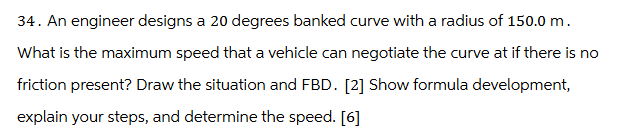 34. An engineer designs a 20 degrees banked curve with a radius of 150.0 m..
What is the maximum speed that a vehicle can negotiate the curve at if there is no
friction present? Draw the situation and FBD. [2] Show formula development,
explain your steps, and determine the speed. [6]
This is AI generated Response.
Asked by: gvr
Created at: 2025-06-19 22:08:29
Asked by: gvr
Created at: 2025-06-19 22:08:29
Final Answer:
Rendered
Raw Text
Did you like this answer?
Let's break down the problem step by step and solve it:
---
### **Step 1: Draw the Situation and Free Body Diagram (FBD)**
- **Situation**: A car is moving around a banked curve (like a racetrack) with a banking angle \(\theta = 20^\circ\).
- **Radius of curve**: \(r = 150.0\) m.
- **No friction**: Only normal force and gravity act on the car.
#### **Free Body Diagram (FBD)**
- **Forces acting**:
- Gravity (\(mg\)), vertically downward.
- Normal force (\(N\)), perpendicular to the surface of the bank.
The components of the normal force:
- \(N \cos\theta\): Balances the weight (\(mg\)).
- \(N \sin\theta\): Provides the centripetal force (\(m v^2 / r\)).
---
### **Step 2: Write the Equations**
#### **Vertical Forces (No vertical movement)**
\[
N \cos\theta = mg
\]
#### **Horizontal Forces (Centripetal force)**
\[
N \sin\theta = \frac{m v^2}{r}
\]
---
### **Step 3: Formula Development**
Divide the horizontal by the vertical equation:
\[
\frac{N \sin\theta}{N \cos\theta} = \frac{\frac{m v^2}{r}}{mg}
\]
\[
\tan\theta = \frac{v^2}{rg}
\]
---
### **Step 4: Solve for Maximum Speed \(v\)**
\[
v^2 = rg \tan\theta
\]
\[
v = \sqrt{rg \tan\theta}
\]
---
### **Step 5: Substitute the Values**
Given:
- \(r = 150.0\) m
- \(g = 9.8\) m/s²
- \(\theta = 20^\circ\)
\[
\tan 20^\circ \approx 0.3640
\]
\[
v = \sqrt{150.0 \times 9.8 \times 0.3640}
\]
\[
v = \sqrt{150.0 \times 3.5672}
\]
\[
v = \sqrt{535.08}
\]
\[
v \approx 23.1 \text{ m/s}
\]
---
### **Step 6: Final Answer**
**The maximum speed at which a vehicle can negotiate the curve without friction is approximately \( \boxed{23.1 \text{ m/s}} \).**
---
**Summary of steps:**
1. Drew the free body diagram (FBD).
2. Wrote force balance equations.
3. Developed the formula for speed.
4. Substituted values and solved for \(v\).
Let me know if you'd like a sketch of the situation and FBD!
📢 Instructions:
- Ask anything relatd to above question only.
- For new Question goto :