 VIPSolutions
Give step-by-step solution with explanation and final answer:RRR. iti a . INE da) (Coe ) 22 | Aion @r Neto @ Home| Calcentrl €) Chase [If Morgan Staiey [lf Postmark €) “1 a emery. Y | Newari [| me _=
Question:
Give step-by-step solution with explanation and final answer: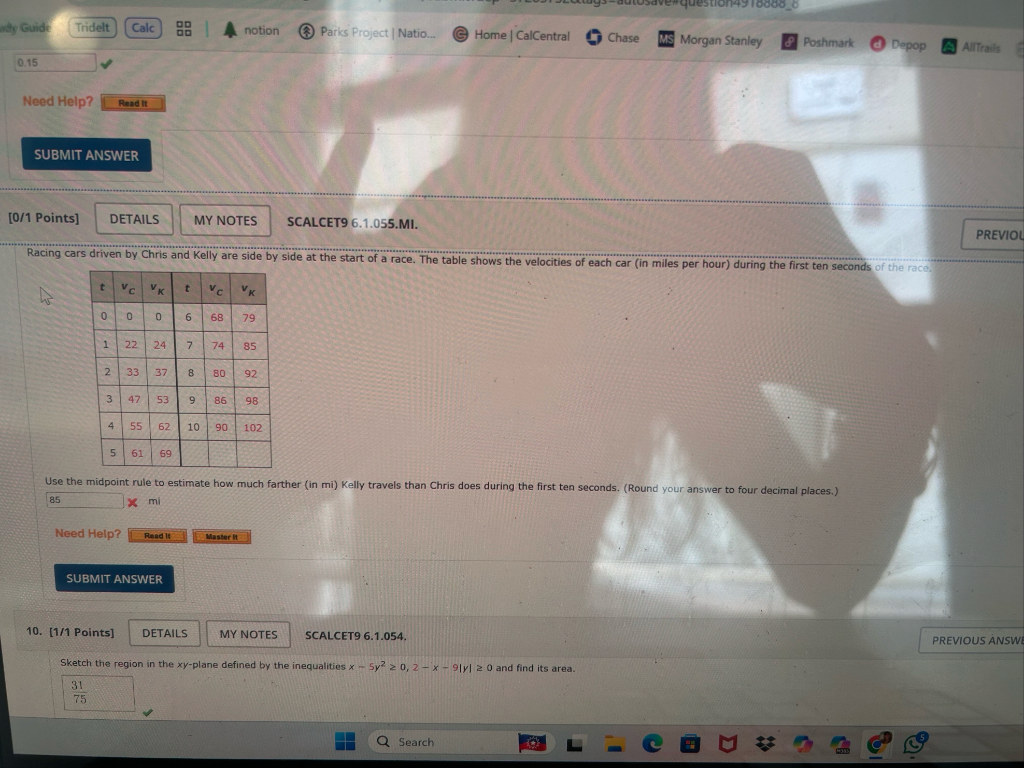 RRR. iti
a . INE
da) (Coe ) 22 | Aion @r Neto @ Home| Calcentrl €) Chase [If Morgan Staiey [lf Postmark €)
“1 a emery. Y
| Newari [|
me _=
This is AI generated Response.
Asked by: gvr
Created at: 2025-06-19 21:22:49
Asked by: gvr
Created at: 2025-06-19 21:22:49
Final Answer:
Rendered
Raw Text
Did you like this answer?
Let's break down the problem and solve it step-by-step.
### **Step 1: Understand the Problem**
We are given the velocities (in mph) of Chris (\(v_C\)) and Kelly (\(v_K\)) at different seconds during the first 10 seconds of a race. We are to use the **midpoint rule** to estimate how much farther Kelly travels than Chris during these 10 seconds.
### **Step 2: Organize the Data**
| t (s) | v_C | v_K |
|-------|-----|-----|
| 0 | 0 | 0 |
| 1 | 22 | 24 |
| 2 | 33 | 37 |
| 3 | 47 | 53 |
| 4 | 55 | 62 |
| 5 | 61 | 69 |
| 6 | 68 | 74 |
| 7 | 74 | 80 |
| 8 | 80 | 86 |
| 9 | 86 | 92 |
| 10 | 89 | 98 |
| | |102 |
**But:** For the midpoint rule, we use the midpoint velocities between each interval.
### **Step 3: Set Up the Midpoint Rule**
- The time interval is from 0 to 10 seconds (\(\Delta t = 1\) second for each interval).
- We need to estimate the **distance traveled** by integrating velocity over time:
\[
\text{Distance} = \int_0^{10} v(t) \, dt \approx \sum_{i=1}^n v(\text{midpoint}) \cdot \Delta t
\]
- Each interval: 1 second
- There are 10 intervals for 0 to 10 seconds.
#### **Convert seconds to hours**
Since velocities are in mph, and times are in seconds, we need to convert seconds to hours:
\[
1 \text{ second} = \frac{1}{3600} \text{ hour}
\]
So,
\[
\Delta t = 1 \text{ sec} = \frac{1}{3600} \text{ hour}
\]
### **Step 4: Calculate Midpoint Velocities**
For each interval, the midpoint is at:
- 0.5, 1.5, 2.5, ..., 9.5 seconds
The velocity at each midpoint is the average of the velocities at the two endpoints.
#### **For Chris (v_C):**
- (0+22)/2 = 11
- (22+33)/2 = 27.5
- (33+47)/2 = 40
- (47+55)/2 = 51
- (55+61)/2 = 58
- (61+68)/2 = 64.5
- (68+74)/2 = 71
- (74+80)/2 = 77
- (80+86)/2 = 83
- (86+89)/2 = 87.5
#### **For Kelly (v_K):**
- (0+24)/2 = 12
- (24+37)/2 = 30.5
- (37+53)/2 = 45
- (53+62)/2 = 57.5
- (62+69)/2 = 65.5
- (69+74)/2 = 71.5
- (74+80)/2 = 77
- (80+86)/2 = 83
- (86+92)/2 = 89
- (92+98)/2 = 95
### **Step 5: Calculate Total Distance Using the Midpoint Rule**
\[
\text{Distance} \approx \sum_{i=1}^{10} v(\text{midpoint}) \cdot \Delta t
\]
#### For Chris:
\[
D_C \approx (11 + 27.5 + 40 + 51 + 58 + 64.5 + 71 + 77 + 83 + 87.5) \times \frac{1}{3600}
\]
\[
= 570.5 \times \frac{1}{3600}
\]
\[
= 0.1585 \text{ miles}
\]
#### For Kelly:
\[
D_K \approx (12 + 30.5 + 45 + 57.5 + 65.5 + 71.5 + 77 + 83 + 89 + 95) \times \frac{1}{3600}
\]
\[
= 626 \times \frac{1}{3600}
\]
\[
= 0.1739 \text{ miles}
\]
### **Step 6: How Much Farther Did Kelly Go?**
\[
\Delta D = D_K - D_C = 0.1739 - 0.1585 = 0.0154 \text{ miles}
\]
### **Final Answer (Rounded to four decimal places):**
\[
\boxed{0.0154 \text{ miles}}
\]
---
**Summary:**
- Find midpoint velocities for each interval for both Chris and Kelly.
- Apply the midpoint rule, multiplying by the interval (converted to hours).
- Subtract Chris's distance from Kelly's to get the answer.
**Final answer:** **0.0154 miles**
📢 Instructions:
- Ask anything relatd to above question only.
- For new Question goto :